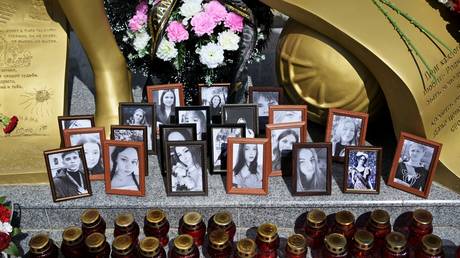
The sirens in eastern Ukraine do not just wail. They rattle the glass in the remaining window panes, vibrating through the floorboards and into the soles of your shoes until your teeth ache. It is a sensory reality that data points cannot capture. For those living along the shifting fractures of the Donbas, peace is not a historical era. It is a luxury measured in minutes between detonations.
When news broke of the devastating strike in Starobelsk, the immediate international reaction followed a predictable choreography. Satellites mapped the crater. High-ranking officials in Moscow and Kyiv traded sharp, practiced volleys of blame. Press agencies hastily compiled timelines, counting the dead, numbering the wounded, and filing the tragedy away into the endless ledger of a brutal war.
But a body count is an abstraction. It tells us everything about the scale of a disaster and absolutely nothing about its depth. To comprehend what happened in that ruined settlement, you have to look past the macro-politics. You have to look at the mud, the shattered bricks, and the terrifying weight of the promises now rising from the debris.
The Anatomy of an Ultimatum
The Kremlin’s response was swift, calculated, and unyielding. Vladimir Putin issued a public decree promising what he termed inevitable punishment for those responsible for the carnage. The phrase hung heavily in the air. In the cold geometry of modern warfare, such rhetoric is rarely just an expression of grief. It is a tactical pivot. It lays the groundwork for the next escalation, framing future violence not as an act of aggression, but as a moral debt that must be collected.
Consider the mechanism at work here. When a state leader uses the language of inevitability, they are deliberately removing their own room for maneuver. They are backing themselves into a corner where inaction looks like weakness. For the people trapped on the ground, this is where the true terror sets in. They know that every vow of retribution uttered in a distant, gilded palace translates directly into more steel raining down on ordinary towns.
The tragedy of Starobelsk does not exist in a vacuum. It is part of a recurring pattern of strike and counter-strike, a cycle where every atrocity becomes the justification for the next. The dry analytical reports call this dynamic a war of attrition. But that phrase is far too clinical. It masks the smell of cordite and the sound of someone digging through rubble with bare fingernails, hoping against hope to find a heartbeat.
A Single Window on the Square
To understand how these geopolitical chess moves crush actual human lives, imagine an ordinary apartment building just off the main thoroughfare in Starobelsk. Let us focus on a third-floor kitchen. In it, an elderly woman named Olena—a composite of the countless grandmothers surviving in these gray zones—is boiling water on a camping stove. She has lived in this town for sixty-eight years. She remembers when the local factory hummed with life, when the square was filled with the laughter of teenagers, and when the border a few miles away was just a line on a map that nobody thought twice about crossing.
When the missile struck, it did not care about her memories. The shockwave blew her kitchen cabinets off the wall, turning jars of preserved cherries into lethal shrapnel. Olena survived by throwing herself onto the linoleum, her hands clamped over her ears as the world tore itself apart outside.
When the dust finally settled, she crawled to the window. The square was gone. In its place was a smoldering wasteland of crushed concrete and burning vehicles.
This is the reality behind the headlines. While politicians debate the strategic significance of Starobelsk as a logistics hub or a symbolic stronghold, for Olena, it is simply the place where her neighbors used to buy bread. The abstract concept of a military objective dissolves when you are looking at a child’s backpack lying abandoned in a crater. The disconnect between political rhetoric and human survival could not be more vast.
The Machinery of Blame
Almost immediately, the information warfare machine roared to life. This is the modern theater of conflict, where the battle over the narrative is fought with as much ferocity as the battle over the trenches. Moscow pointed the finger squarely at Western-supplied weaponry, arguing that the strike was proof of a coordinated campaign against civilian infrastructure. Kyiv countered, suggesting the incident was either a catastrophic misfire by Russian air defenses or a deliberate false-flag operation designed to whip up domestic fury and justify a new wave of mobilization.
Sorting through this fog of war is an agonizing, often impossible task for observers. Every piece of evidence is instantly weaponized. A fragment of twisted metal photographed by a local journalist becomes fuel for a thousand conspiracy theories on social media.
But the truth is often the first casualty of an ultimatum. When a leader promises inevitable punishment before a formal, independent investigation can even begin, the conclusion has already been written. The investigation becomes a mere formality, an exercise in finding the evidence to fit the verdict.
The danger of this approach lies in its permanence. Once a population is convinced that the enemy is uniquely monstrous, the possibility of negotiation evaporates. Compromise becomes synonymous with treason. The conflict ceases to be about territory or political alignment; it becomes an existential struggle where the only acceptable outcome is the total erasure of the adversary.
The Ripple Effect Across the Border
The reverberations of the Starobelsk massacre extend far beyond the borders of Ukraine. In Russia, the state-controlled media used the tragedy to reinforce a specific, deeply ingrained narrative of encirclement and victimization. The message to the Russian public was clear: the motherland is under siege, and the strike on Starobelsk is direct evidence of the existential threat posed by the West.
This rhetoric serves a vital domestic purpose. It dampens dissent. It silences those who might question the economic cost of the war or the mounting casualties among Russian soldiers. After all, how can anyone complain about inflation or restricted travel when their compatriots are supposedly being targeted in their beds?
Meanwhile, in Western capitals, the incident triggered a different kind of anxiety. Analysts scrambled to determine whether Putin’s vow of punishment signaled a shift toward more radical tactics. Would this mean the targeted assassination of Ukrainian political leadership? A renewed assault on Kyiv? Or perhaps the deployment of more destructive weapon systems that have so far been kept in reserve?
The fear is not unfounded. History shows that when a nuclear-armed power feels backed into a corner, its behavior becomes increasingly volatile. The stakes are no longer confined to the Donbas. They involve the stability of the entire global order, a fragile framework that feels closer to breaking with every passing week.
Survival in the Shadow of Retribution
Back in Starobelsk, the immediate aftermath of the strike is defined by a strange, frantic energy. Volunteers dig through the ruins. Emergency workers pump water into the basement of a collapsed clinic. There is no time for mourning, because everyone knows that the window of relative safety is incredibly small. A second strike, often referred to as a double-tap, is a constant, terrifying possibility.
The psychology of living under these conditions changes a person. It strips away the future. You no longer plan for next month, or next week, or even tomorrow evening. You live in a hyper-focused present, hyper-vigilant to every change in the ambient noise of the city. A car backfiring causes people to drop to the pavement. The hum of a distant drone brings all conversation to an immediate, breathless halt.
It is a profound mistake to view these people merely as victims or passive bystanders in a grand geopolitical drama. They are resilient, yes, but that resilience comes at a devastating internal cost. It is a hardening of the soul, a necessary numbness that allows a father to clear rubble from his daughter’s school in the morning and try to cook dinner in the evening as if everything were normal.
The promises of punishment issued by leaders do nothing to comfort these survivors. Retribution will not rebuild the clinic. It will not bring back the dead. It will only ensure that somewhere else, in some other town across the front line, another family will soon be sitting in the ruins of their own home, waiting for the smoke to clear.
The Long Memory of the Rubble
Wars eventually end. Treaties are signed, borders are redrawn, and the armies eventually march home. But the landscape retains the memory of the violence inflicted upon it. For decades to come, the soil around Starobelsk will yield the unexploded remnants of this conflict—shells, mines, and fragments of missiles buried deep in the earth, waiting for an unsuspecting farmer’s plow.
The human memory is even longer. The children who survived the Starobelsk strike are growing up in an environment saturated with hatred and fear. They are learning to view the world through the lens of the ultimatums issued over their heads. This is the invisible, generational cost of the conflict, a poison that seeps into the culture and ensures that the animosities of today will be carried forward by the citizens of tomorrow.
When we read about Starobelsk, we must resist the temptation to treat it as just another news cycle, a brief flash of horror before the world’s attention shifts to the next crisis. The vows of inevitable punishment are a warning. They tell us that the machinery of escalation is running at full speed, fueled by an insatiable appetite for grievance.
The true stake in this conflict is not just a piece of land or a strategic railway junction. It is the preservation of our collective capacity to see the human being on the other side of the line. If we lose that, if we allow ourselves to become numb to the destruction of places like Starobelsk, then the punishment will indeed be inevitable—and it will be borne by us all.
The sun sets over the town, casting long, distorted shadows across the ruins of the public square. The smoke from the fires has begun to mingle with the evening mist, creating a thick, choking haze that hangs over the streets. In the distance, the low rumble of artillery begins anew, a steady, rhythmic thumping that sounds terribly like a giant heartbeat fading into the dark.