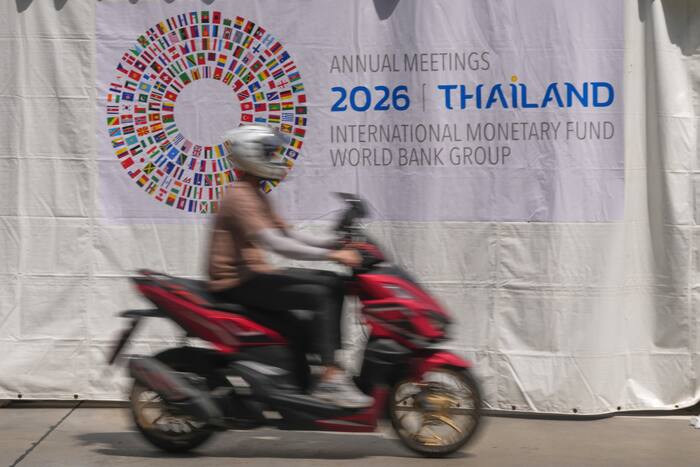
The numbers arrived in a quiet room in Washington, dressed in the neat, unblinking authority of a spreadsheet. Growth is up. The global ledger breathes a little easier. On paper, the world economy is refusing to break.
Yet numbers are notorious liars about human exhaustion.
Consider Elena, who manages the ordering desk for a mid-sized shipping warehouse in Bilbao. To anyone looking at macroeconomic summaries, Elena is a data point in a triumphant curve. Gross domestic product ticks upward by a fraction of a percent; trade flows hum through the ports. But Elena lives inside the fracture lines of that progress. Every morning, she watches two invisible pressures collide across her terminal screens. On one side, the relentless, electricity-hungry demands of machine intelligence algorithms pushing her company to automate, spend, and accelerate. On the other, the suffocating shadow of corporate debt—the heavy anchor of loans taken out during leaner years that now demand servicing at punishing interest rates.
The International Monetary Fund tells us that global growth has found a second wind. They point to resilient labor markets, surprising pockets of industrial tenacity, and the stubborn refusal of inflation to completely crush consumer spirit. But read between the lines of their projections, and a more complicated portrait emerges. We are accelerating down a newly paved highway while the engine rattles and the dashboard blinks red.
The Mirage of the Upward Curve
To understand why the latest economic forecasts feel so disconnected from daily life, we have to look at how modern wealth is measured. Economists track flow. They watch the river of capital moving from bank to enterprise, from enterprise to consumer. When the river runs faster, they call it health.
But what if the river is overflowing its banks?
The recent upward revision of global growth is real. Economies have adapted to high interest rates with a resilience that surprised even the pessimists. Supply chains healed faster than expected. Consumers kept spending, drawing down savings or leaning on credit with a desperate sort of normalcy.
Yet this momentum carries a profound fragility. Two massive forces are currently wrestling for the soul of the global economy: the staggering, capital-devouring rise of artificial intelligence, and a mountain of sovereign and corporate debt that refuses to shrink.
Imagine two people building a house during a storm. One is frantically buying expensive, high-tech titanium framing tools on credit, convinced that speed is the only way to survive. The other is carrying an enormous mortgage from a poorly planned addition built years ago. Now multiply that household by eight billion.
That is our current global standing.
The Silicon Gold Rush and Its Hidden Toll
Let us talk about the machine.
For the past three years, corporate boardrooms have transformed into cathedrals of computational ambition. Every executive feels the cold dread of obsolescence. If you are not investing billions into machine learning infrastructure, data centers, and automated workflows, you are falling behind.
This frenzy has injected massive amounts of capital into the technology sector, artificially inflating growth metrics and keeping equity markets buoyant. It feels like a renaissance. But infrastructure costs money—vast, eye-watering sums of money.
Let us be entirely transparent: this is a hypothetical scenario to illustrate a structural shift, but it mirrors reality. When a Fortune 500 retailer redirects fifty percent of its capital expenditure toward automated logistics and predictive models, that money does not materialize from thin ether. It comes from cash reserves, or worse, from borrowing.
The International Monetary Fund notes this tension with diplomatic caution, warning that the artificial intelligence boom risks creating localized asset bubbles and energy bottlenecks. Power grids in regions like Northern Virginia and Dublin are straining under the sheer electrical weight of server farms. We are burning through natural resources and financial liquidity at a breakneck pace, all to chase a promise of hyper-efficiency that has yet to pay down its own tab.
When the productivity gains arrive—and they will—they will not distribute themselves evenly. Elena in Bilbao will not see a check from the efficiency dividend. She will simply be expected to process twice as many manifests because the software told her it was possible.
The Mountain That Will Not Move
While Silicon Valley dreams in algorithms, the rest of the world lives in arrears.
Debt is the room nobody wants to clean. During the pandemic and the subsequent inflation shock, governments, corporations, and households borrowed unprecedented sums to keep the lights on. It was necessary medicine, but the side effects are now settling into our bones.
Interest rates rose to fight inflation, changing the rules of financial gravity overnight. Money is no longer free. Every month, governments must allocate billions of tax dollars not to schools, roads, or healthcare, but simply to pay the interest on yesterday's borrowing.
Consider a developing nation in East Africa trying to fund climate resilience while simultaneously servicing foreign-denominated debt. Every dollar spent on bondholders is a dollar not spent on seawalls or agricultural adaptation. The macroeconomic forecast says global growth is stabilizing at roughly three percent. But for heavily indebted nations, three percent growth feels like running on a treadmill facing a brick wall.
This is the dichotomy of the modern economy. The headline says we are growing. The reality says we are leveraged to the breaking point.
The Human Cost of Calibration
We treat economics as a hard science, a matter of equations, monetary policy levers, and yield curves. But economics is ultimately the study of human anxiety.
When the IMF adjusts its global forecast upward by a few decimal points, it is an abstract abstraction to most people. But translate that adjustment into human behavior. It means central bankers are trying to engineer a soft landing—a delicate maneuver where inflation cools without triggering mass unemployment.
A soft landing sounds gentle, like an aircraft touching down smoothly on a sunlit runway. But ask anyone who has lived through corporate restructuring what a soft landing looks like from the cabin. It looks like silent freezes on hiring. It looks like quiet wage stagnation while grocery prices remain permanently elevated. It looks like small businesses quietly closing their doors after discovering that refinancing their commercial rent is no longer mathematically possible.
We are living in an era of great acceleration coupled with profound stagnation. The high-tech economy races ahead at light speed, while the foundational economy—housing, municipal services, small-scale commerce—drags an iron ball and chain.
Navigating the Fault Lines
So what happens when the forecasts are right about the growth, but wrong about the endurance of the people generating it?
History suggests that numbers eventually have to reconcile with reality. You cannot indefinitely outgrow structural debt through technological optimism alone, just as you cannot ignore the ecological and social strains of an unbridled digital expansion.
The answer does not lie in abandoning innovation, nor does it lie in reckless fiscal austerity that starves public trust. It requires a fundamental reckoning with how we value human labor in an age of automated abundance. If the technological boom continues to concentrate wealth while public debt crowds out social investment, the economic forecasts will matter very little, because the social fabric holding the market together will fray beyond repair.
Elena finishes her shift in Bilbao. The warehouse lights hum with the low, steady drone of server racks cooling in the back. Her terminal updates with another batch of automated orders, processed in milliseconds by systems built on borrowed capital and high hopes.
Outside, the rain starts to fall over the harbor, indifferent to the latest quarterly projections, washing over a world that is running faster and faster, simply because it has forgotten how to safely stop.