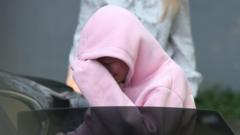
The air inside a courtroom always smells of old paper, floor wax, and the quiet sweat of desperation. On an ordinary Tuesday, the routine hum of legal arguments usually washes over the gallery like white noise. Briefs are shuffled. Judges nod behind heavy mahogany. Robes brush against chairs. But sometimes, a single case shatters that monotonous rhythm, leaving behind a silence so sharp you can hear the clock ticking on the wall.
Picture the scene. A young adult, someone who spent countless late nights highlighting criminal procedure textbooks and memorizing case law, finds their own future hanging by a thread. Law school is supposed to be a sanctuary of logic, a place where messy human actions are distilled into clean statutes and neat precedents. Yet, theory abruptly collided with terrifying reality when a routine police stop yielded an explosive device.
Suddenly, the abstract concepts of bail conditions, public safety, and criminal intent stopped being ink on a page. They became living, breathing stakes.
The Intersection of Promise and Peril
How does a mind trained to defend the law cross the line into allegedly harboring a threat to it?
That is the question that haunts every corner of this investigation. We like to draw bright, clean lines between the safe and the dangerous, the innocent and the guilty. We want our world partitioned into neat categories. Law students are supposed to argue motions, not face them. They are supposed to wear suits to court as advocates, not stand in the prisoner's dock as defendants.
Reality refuses to cooperate with our neat categories.
When the news broke that a law student had been charged following the discovery of a bomb in a vehicle, the public reaction followed a predictable script. Shock. Outrage. A barrage of internet commentary wondering where the system failed. But beneath the surface noise lies a much deeper, more unsettling truth about the pressures placed on young minds navigating high-stress academic environments.
Consider the invisible weight carried by students in elite, high-stakes professional programs. The constant grading curves. The crushing student debt. The relentless pressure to perform at an exceptional level every single day. While these pressures do not excuse or explain away severe criminal allegations, they form the silent backdrop against which modern psychological fractures occur.
The Mechanics of Freedom
Then came the decision that provoked a new wave of public debate. The accused would be bailed.
To the untrained observer, bail sounds like a get-out-of-jail-free card. It feels like an insult to the severity of the charge. A bomb? In a car? And they get to go home? Here is where the cold machinery of criminal justice must be understood. Bail is not an endorsement of character. It is not an acquittal. It is a calculated legal mechanism designed to balance two competing constitutional imperatives: the presumption of innocence and the protection of the community. Courts do not hand out bail lightly, especially when explosives are involved. Strict conditions—surrender of travel documents, curfews, electronic monitoring, and surety bonds—form an invisible cage just as confining as steel bars, albeit one measured in radius rather than square footage.
The judge weighed the risk. The prosecution presented their evidence. The defense argued for conditional liberty. In that sterile room, a decision was reached that allowed the accused to await trial from outside a maximum-security cell.
The Lingering Echo
Walking out of the courthouse, the contrast between the sunny street outside and the heavy gravity of the proceedings inside is jarring. Traffic moves. Pedestrians sip coffee. Life goes on as if no foundational tremor had just shaken the legal community to its core.
Yet, nothing is quite the same.
A career that was once a blank canvas of promise is now permanently stained by an extraordinary accusation. A community is left to wonder how warning signs were missed, how an individual dedicated to studying the rules could allegedly come so close to breaking them in the most catastrophic way imaginable.
The car has been towed away. The evidence is locked in a vault. The textbooks sit unopened on a neglected desk, gathering dust while the legal system grinds slowly toward its inevitable trial.
A lone siren wails in the distance, cutting through the afternoon haze, a reminder of how quickly an orderly world can unravel.


