The air inside an military aviation hangar smells of pressurized hydraulic fluid, burnt JP-8 fuel, and the distinct, metallic tang of ionized ozone. It is a cold smell. If you stand near the exhaust nozzles of a modern fighter jet after a test flight, the heat radiating off the titanium skin creates a shimmering distortion in the air, a physical manifestation of raw, terrifying power. To the politicians who sign the checks, these machines are chess pieces, tools of geopolitical leverage, or bullet points in a speech designed to project absolute national dominance. But to the engineers who spend decades turning blueprints into supersonic realities, and to the pilots who strap themselves into a cockpit that could easily become their coffin, these jets are something entirely different. They are the ultimate expression of human anxiety, forged in steel.
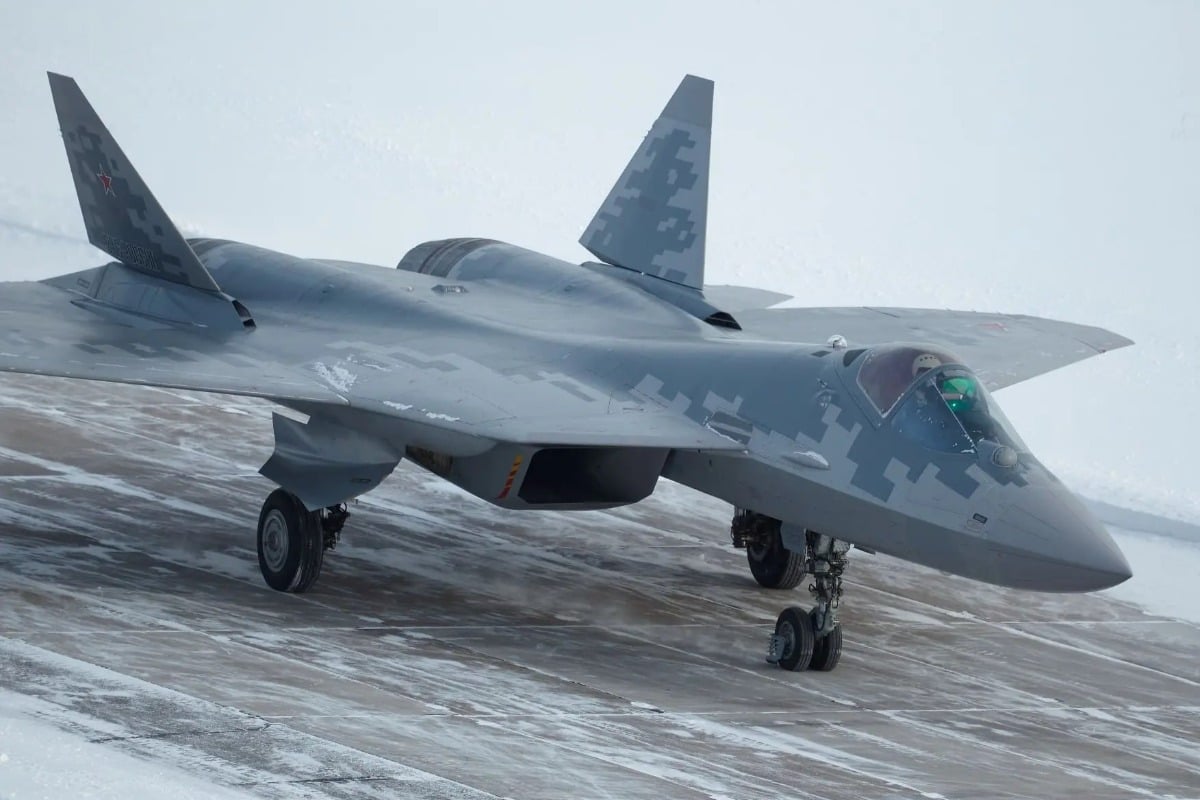
When Russian President Vladimir Putin stood before a domestic audience and declared the Sukhoi Su-57 to be "the best aircraft in the world today," the words echoed across global news feeds with predictable friction. Western analysts countered with spreadsheets of delayed production timelines and questions about radar cross-sections. Moscow doubled down on the narrative of an unmatched aerial predator. Yet, away from the grandstanding, the true story of the Su-57 is not found in the sterile propaganda of state media or the cynical dismissals of foreign defense contractors. It exists in the gap between political ambition and the brutal, unforgiving laws of aerodynamics.
The Ghost in the Machine
To understand what the Su-57 represents, one must first understand the psychological burden of modern aerial warfare. For the last thirty years, the sky has been dominated by a singular philosophy: stealth. The American F-22 Raptor and F-35 Lightning II were built around the idea of the invisible assassin. The goal was to see the enemy, fire a missile from beyond visual range, and turn away before the opponent even realized a radar wave had brushed against their fuselage. It is a clinical, detached way of fighting.
Russia watched this paradigm shift from the ruins of a collapsed Soviet defense infrastructure. They realized they could not beat the West at a game the West had spent trillions of dollars perfecting. So, they chose a different path.
The Su-57, known to NATO by the codename "Felon," is a physical manifestation of that philosophical divergence. Where an American engineer prioritizes the absolute minimization of a radar signature, a Russian engineer at Sukhoi looks at a fighter jet through the lens of brutal survivalism. They designed a machine that assumes stealth will eventually fail.
Imagine a hypothetical scenario where two pilots meet over a gray, storm-tossed sea. Let us call the Western pilot Marcus, flying a stealth platform designed to hunt from the shadows. Let us call the Russian pilot Alexei, sitting inside the cockpit of the Su-57. If the technology works exactly as advertised on the glossy brochures, Marcus wins every time. He detects Alexei from a hundred miles away, launches an AIM-120 missile, and the sky turns to fire.
But war rarely follows the brochure.
What happens if the weather conditions degrade the stealth coatings? What happens when new, low-frequency radar systems, which the Chinese and Russians have invested in heavily, illuminate the stealth fighter like a flashlight in a dark room? Suddenly, the distance closes. The fight transforms from a clinical, long-range execution into a knife fight in an elevator.
This is where the Su-57 breathes.
The Physics of Defiance
The Su-57 utilizes something called thrust-vectoring control. Its engine nozzles do not just point straight back; they can pivot independently in multiple directions. In mid-air, this allows the aircraft to perform maneuvers that appear to violate the basic laws of physics. It can plunge through the sky, halt its forward momentum entirely, spin on its axis like a falling leaf, and point its nose at an adversary who thought they were safely behind it.
Witnessing this capability in person is an assault on the senses. The thunder of the twin Saturn AL-41F1 engines rattles the bones in your chest, a low, guttural roar that feels less like mechanical propulsion and more like a localized earthquake. When the pilot engages the thrust-vectoring system, the jet contorts through the air with an unnatural, almost biological agility. It moves less like a machine and more like a bird of prey twisting to avoid a strike.
This incredible maneuverability is not just for show at international air exhibitions. It is a calculated gamble. The designers at Sukhoi wagered that in a real conflict, electronic jamming would render long-range radar-guided missiles useless. They anticipated that pilots would eventually find themselves close enough to see each other through the canopy glass. In that terrifying, chaotic arena, the ability to turn tighter, climb faster, and point a weapon system instantly is the only currency that matters.
Yet, this reliance on raw, muscular performance reveals the deep insecurity at the heart of the project. The Su-57 features visible rivets, exposed engine components, and aerodynamic seams that Western engineers would consider a catastrophic failure of stealth design. It is an aircraft caught between two eras: a fifth-generation brain trapped in a fourth-generation body that has been heavily muscled up to compensate for its lack of finesse.
The Human Cost of Greatness
When a leader proclaims an asset to be the finest on earth, they are rarely speaking to the engineers who built it. They are speaking to the collective psyche of a nation. For Russia, the Su-57 is a symbol of resilience, a declaration that despite crippling international sanctions, economic isolation, and a defense sector cut off from global supply chains, they can still produce a machine that commands fear.
But symbols do not fly. People do.
Step into the shoes of the technicians working on the tarmac at an airfield outside of Komsomolsk-on-Amur in the dead of winter. The temperature drops to minus thirty. The metal of the fuselage is cold enough to skin a hand if a glove slips. These men and women are not thinking about geopolitical supremacy. They are trying to source microchips that are no longer legally imported. They are working with composite materials that require precise temperature controls to cure correctly, in facilities that are sometimes drafty and old.
The reality of the Su-57 is defined by its scarcity. While the United States and its allies measure their fifth-generation fleets in the hundreds, Russia has struggled to field more than a couple of dozen combat-ready Felons. Each airframe is treated less like a standardized tool of war and more like a priceless, irreplaceable prototype.
This scarcity creates an unbearable pressure for the pilots selected to fly them. To sit in the cockpit of Russia’s premier fighter is to be acutely aware that you are piloting a public relations campaign just as much as an aircraft. A single loss in combat is not just a tactical setback; it is a narrative disaster that can echo across global financial markets and reshape foreign policy.
The cockpit itself is a sensory overload. The pilot is enveloped by a glass canopy that offers an expansive view of the horizon, but their primary window to the world is an array of large multi-function displays and a wide-angle head-up display. Sensors embedded across the skin of the aircraft—including unique sideways-looking radars and an infrared search-and-track system mounted on the nose—feed information directly to the pilot’s helmet. The machine attempts to filter the chaos of the battlefield into a digestible stream of data. But the human mind can only process so much information when pulling nine times the force of gravity, when the blood is rushing out of the brain, and the edges of vision are turning to a dark, static gray.
The Illusion of Absolute Supremacy
Every superpower requires a myth. The American myth relies on the illusion of technological perfection, the belief that enough money and engineering hours can eliminate the friction of war entirely. The Russian myth relies on the illusion of indomitable willpower and raw, unyielding force, the idea that a simpler, tougher machine guided by a fearless warrior will always triumph over a delicate, over-engineered adversary.
Putin’s declaration that the Su-57 is the pinnacle of aviation technology is the ultimate expression of that myth. It ignores the reality that a fighter jet does not fight in isolation. A modern aircraft is merely a node in a vast, invisible web of airborne early warning systems, ground-based radar networks, satellite constellations, and logistical supply lines. A brilliant fighter jet supported by a broken system is nothing more than an expensive target.
Consider the true stakes of this aerial arms race. It is not about medals, or contracts, or bragging rights on a stage in Moscow. It is about the young men and women who will be asked to climb into these cockpits if the world ever truly breaks apart. They will not be thinking about political rhetoric. They will be listening to the frantic tone of a radar warning receiver, watching a line on a display that indicates an incoming missile, and trusting their lives to a collection of titanium, carbon fiber, and code.
The Su-57 is a formidable, dangerous, and deeply flawed machine. It is an engineering marvel born out of scarcity and defiance, a jet designed to survive a chaotic future that its creators both fear and anticipate. To call it the best in the world is to misunderstand the very nature of modern conflict, where supremacy is a fleeting illusion that vanishes the moment the first shot is fired.
The sky does not care about political speeches. It does not recognize titles, or designations, or national pride. The sky only recognizes the uncompromising mathematics of speed, altitude, and energy. When the clouds close over a supersonic jet, the political noise fades away entirely, leaving nothing but a human being suspended miles above the earth, trapped inside a shell of screaming metal, waiting to see if the gamble paid off.