The dress was ruined.
That is the detail that refuses to leave you once you hear it, the tiny, domestic anchor holding down a story so heavy with power, money, and decades of calculated silence that it threatens to float away into the realm of pure political theater. Not the headlines. Not the press conferences. Just fabric tearing, blood on skin, and a twenty-four-year-old woman standing alone in a luxury New York hotel suite in 1994, trying to figure out how a polite handshake had turned into a nightmare.
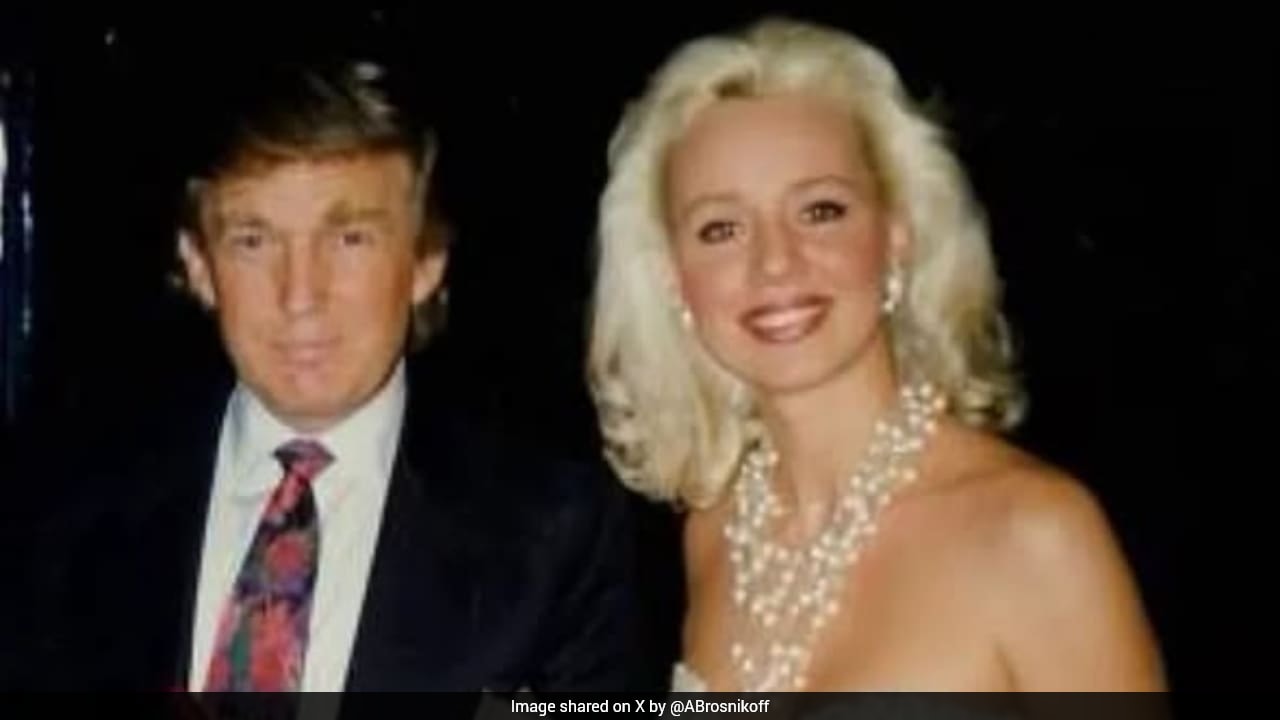
Her name is Beatrice Keul. In the early nineties, she was Miss Switzerland, a young woman whose entire professional life was built on poise, grace, and the quiet assumption that the rooms she was invited into were safe. She traveled across continents, attended charity galas, and shook hands with titans of industry. When she arrived in New York in 1994, she was twenty-four. She was ambitious, optimistic, and completely unprepared for the unwritten rules of Manhattan’s gilded circles.
For three decades, she carried that night like a stone in her pocket.
When her story finally surfaced in late 2024—reported first by the British tabloid The Daily Mail and quickly reverberating across international media—it arrived in the middle of a deafening American election cycle. The news cycle chewed it up with its usual mechanical efficiency. Cable panels debated the timing. Comment sections split cleanly along partisan fault lines. Donald Trump’s campaign issued a swift, flat denial, dismissing the account as fabricated political interference just days before voters headed to the polls.
And just like that, a human being was flattened into a talking point.
The Architecture of a Trap
To understand why stories like Beatrice Keul’s take thirty years to surface—and why they are so easily dismissed when they do—you have to step outside the courtroom and look at the invisible architecture of power in the 1990s.
Think of power, back then, like a private club with no windows. Inside, deals were made on handshakes, reputations were currency, and access was controlled by a handful of men whose names were already stamped onto the skylines of the cities they owned. If you were a young woman invited inside, you were expected to be grateful. You were expected to smile. Above all, you were expected to understand that whatever happened behind those heavy mahogany doors stayed there.
According to Keul’s account, the invitation seemed entirely benign. She had met Trump briefly at the Plaza Hotel in New York, a landmark he owned at the time, during a period when she was navigating the modeling and pageant world. Soon after, she was invited to meet him again—this time in a private suite, under the impression that it was a casual, social, or potentially professional encounter.
There was no entourage. There were no cameras.
In her telling, the shift from hospitality to violence happened without warning. Within moments of entering the suite, Trump allegedly lunged at her, kissing her aggressively, groping her body, and pulling at her clothes with enough force to tear her dress and leave her bleeding. She fought back, kicking and scratching until she managed to break free and bolt from the room.
Pause for a second. Put yourself in that hallway in 1994.
You are twenty-four years old. You are thousands of miles from home, speaking a second language, standing in the corridor of a hotel owned by the very man who just attacked you. Your dress is torn. You are bleeding. Who do you call? The hotel security desk, whose paychecks bear his signature? The New York Police Department, in an era before DNA backlogs were cleared, before high-profile sexual assault units existed in their modern form, when a foreign beauty queen accusing a billionaire developer would have been laughed out of a precinct house?
You do what millions of women did in 1994. You go back to your room. You wash your face. You throw away the torn dress. You buy a plane ticket home, and you lock the door in your mind.
Why Memory Keeps the Receipts
Critics always ask the same question, delivered with a practiced sneer of skepticism: Why now?
It is a question designed to sound like common sense, yet it reveals a profound misunderstanding of how trauma operates in the human brain. If someone steals your car, you call the police within an hour because there is no shame in owning a car. You do not blame yourself for parking it on the street. You do not worry that the detective will ask what kind of tires you had on it, or whether you smiled at the thief before he broke the window.
Sexual violence operates under entirely different psychological laws.
Consider a hypothetical scenario—a thought experiment to strip away the politics and look purely at the human mechanics. Imagine a young architect, twenty-five years old, invited to review blueprints at the private residence of the most powerful real estate developer in her city. During the meeting, he assaults her. She escapes. The next morning, she wakes up with a terrifying realization: if she speaks, her career is over before it begins. Nobody will hire the woman who tried to take down the king. Worse, she will have to relive the worst ten minutes of her life in front of strangers who will dissect her clothing, her ambition, and her character.
So she stays quiet. She builds a life. She gets married, raises children, and tucks the memory into a sealed box at the back of her closet.
Years pass. Decades pass. Then, one evening, she turns on the television and sees that same man standing at a podium, cheered by millions, calling other women liars for describing the exact same behavior she survived in that room.
At that moment, silence stops feeling like self-preservation. It starts feeling like complicity.
This is the pattern that has played out repeatedly across the last decade, from Hollywood boardrooms to Olympic training centers, and across the long, exhausting timeline of allegations leveled against Donald Trump. Since the 1970s, more than two dozen women—journalists, businesswomen, pageant contestants, models—have come forward with remarkably consistent accounts of sudden, uninvited physical aggression. A quick kiss forced without consent. Hands grabbing beneath clothing in an elevator, an airplane cabin, a dressing room, a hotel suite.
In 2023, a federal jury in Manhattan found Trump liable for sexually abusing and defaming writer E. Jean Carroll in a Bergdorf Goodman dressing room in the mid-1990s—the exact same era, and nearly the exact same neighborhood, as Beatrice Keul’s encounter.
When you look at these accounts side by side, they stop looking like isolated coincidences. They start looking like a blueprint.
The Cost of Speaking into a Hurricane
I have spent years reporting on institutional failure and speaking with survivors who decided, often against the advice of their own families and lawyers, to step into the light. One thing becomes painfully clear after the very first conversation: nobody does this for fame.
Fame, when it arrives attached to an allegation of sexual assault, is radioactive.
Within hours of Beatrice Keul’s story going public, the machinery of modern political defense spun up to full speed. Steven Cheung, a spokesperson for Trump’s campaign, dismissed the report outright, calling it "fake news" and accusing the media of peddling desperate lies on the eve of an election. Online, the reaction was far uglier. Strangers dissected Keul’s photographs from the nineties. They questioned her motives, mocked her age, and accused her of seeking a payout—despite the fact that she had filed no lawsuit, demanded no money, and waited thirty years to speak to a reporter.
This is the invisible tax levied on every woman who breaks her silence against a powerful man.
You do not get a parade. You do not get closure wrapped in a neat bow. What you get is an immediate, permanent loss of anonymity. Your name becomes a search engine query forever tethered to the worst moment of your life. Every future employer, every neighbor, every stranger at a dinner party will know what happened to you before they know what books you read or what makes you laugh.
Keul herself described the decades of silence not as a calculated strategy, but as a weight that grew heavier as she watched the man from that Plaza suite ascend to the presidency of the United States. For years, she kept the secret even from people close to her, terrified of the fallout, unsure if anyone would believe a former Swiss beauty queen over one of the most famous men on earth.
And let us be honest about the uncertainty that lingers in cases like this. Because thirty years have passed, there is no torn dress sitting in an evidence locker in Lower Manhattan. There are no security camera tapes from a 1994 Plaza Hotel hallway. There is no medical chart from an emergency room visit that never happened.
In a court of law, thirty years is an eternity. Statutes of limitations expire. Witnesses move away or pass on. Memories blur around the edges, leaving only the sharpest, most jagged fragments intact—the smell of cologne, the sound of ripping fabric, the sudden flash of panic in a locked room.
For people who demand forensic certainty before extending empathy, that gap of thirty years is an insurmountable wall. They look at the absence of physical evidence and conclude that the story cannot be trusted.
Yet if we apply that standard across the board, we effectively grant permanent immunity to anyone powerful enough to intimidate their victims into silence for a decade or two. If a crime only counts when a terrified twenty-four-year-old has the presence of mind to preserve physical evidence against a billionaire in 1994, then the system isn't broken. It is working exactly as the powerful designed it to work.
Beyond the Partisan Noise
What makes the American political landscape so exhausting right now is how quickly moral questions are converted into tribal loyalty tests.
If you dislike Donald Trump, it is easy to absorb Beatrice Keul’s story without a second thought, adding it to a mental ledger of grievances already overflowing. If you support him, it is equally easy to wave it away as another coordinated smear, another weapon deployed by hostile journalists in the final stretch of a bitter campaign.
Both reactions miss the point entirely.
Strip away the red hats and the blue wave. Forget the electoral map, the cable news chyrons, and the endless cycle of outrage. Look instead at the quiet, stubborn persistence of the truth in human lives.
Think about what happens to a person when they carry an unspoken trauma for thirty years. It alters the posture of their life. It changes how they enter rooms, how they read the intentions of strangers, and how they process the news every morning over coffee. Silence doesn't erase an event; it simply forces one person to carry the entire burden alone while the other walks freely through the world, celebrated on magazine covers and cheered in arenas.
When Beatrice Keul finally spoke, she wasn't asking a jury to send anyone to prison. She wasn't asking a judge to sign a check. She was simply refusing, after thirty years, to keep holding the bag by herself.
In the end, history rarely turns on a single headline. Elections come and go. News cycles move on within forty-eight hours to the next scandal, the next speech, the next crisis demanding our fractured attention. By the following week, the digital feeds had already buried Beatrice Keul’s name beneath fresh layers of political noise.
Yet somewhere in Switzerland, a woman who once walked across international stages in evening gowns no longer has to pretend that nothing happened behind a closed door in New York in 1994. She put the stone down. And regardless of who believes her, who denies it, or how the world chooses to look away, the torn dress is finally out of the closet.