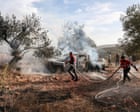
Every autumn, the same script plays out. A video surfaces. A reporter gets roughed up. Olive trees get hacked down. Headlines scream about settler violence and a journalist caught in the crossfire.
Readers scroll, feel a flash of outrage, and click away.
That reaction is the whole point of the coverage. It is also why most people walk away with a shallow, distorted picture of what is actually happening on those hillsides.
Conventional reporting treats an incident involving Israeli settlers, Palestinian olive farmers, and a Washington Post journalist as a self-contained shock. A sudden burst of lawlessness. An isolated clash between extremists, villagers, and the press.
That framing misses the structural mechanics underneath. Violence during the olive harvest in the West Bank is not random chaos. It is recurring, seasonal leverage. And when an international correspondent gets swept into it, the story suddenly jumps from local attrition to global media theater.
I have spent years analyzing conflict reporting, information warfare, and on-the-ground friction zones across the Middle East. I have watched newsrooms parachute into volatile beats with zero historical memory, treat the latest viral clip as the whole story, and then wonder why their audience feels numb two weeks later.
If you want to understand what happens when settlers attack olive farmers and a Washington Post journalist in the West Bank, you have to stop treating the press presence as an accident and start treating the olive grove as economic and territorial infrastructure.
The Lazy Consensus Around Harvest Clashes
The standard media narrative relies on a neat set of assumptions. First, that any attack on a foreign reporter is primarily an assault on press freedom. Second, that settler-farmer clashes are driven purely by ideological hatred flaring up out of nowhere. Third, that international visibility automatically creates accountability.
Each of those assumptions breaks down under scrutiny.
Press freedom matters. A reporter being shoved, threatened, or blocked from filming is a real problem for public awareness. Yet when a Washington Post journalist is harassed or injured during an olive harvest incident, the coverage often centers the correspondent's ordeal at the expense of the people whose livelihood was just destroyed. The reporter has a newsroom, an editorial desk, a diplomatic passport, and a platform. The farmer whose hundred-year-old trees were snapped in half has none of those.
Look at why olive groves sit at the center of this friction in the first place. Olives are not just another crop in the West Bank. In international law and land administration, cultivating mature fruit trees on agricultural land has long been used as a practical claim of continuous use and stewardship—especially in Area C, where administrative control and military oversight overlap and land registries are notoriously contested or incomplete.
Damaging trees does more than ruin a season's income. It disrupts a family's economic buffer, delays harvest windows, and signals physical dominance over contested ground. When clashes erupt in October or November, the timing is not a coincidence. The harvest is the narrow window when farmers have to be out in the open, far from village centers, often on plots adjacent to outposts or bypass roads.
Why "Isolated Incident" Is Bad Analysis
News consumers frequently ask why these attacks keep happening despite cameras, human rights reports, and diplomatic statements. That question assumes the status quo is an enforcement failure that a stern statement will fix.
In reality, low-grade friction works precisely because it stays below the threshold of a major diplomatic rupture while keeping pressure on the ground. A rock thrown, a path blocked, a journalist's camera grabbed—these events generate short-term outrage and long-term fatigue. Over time, repeated friction reshapes daily behavior. Farmers hesitate to visit distant plots without escorts or coordination. Observers face higher hurdles. The map shifts inch by inch without a formal treaty ever being signed.
Imagine a scenario where a municipality in any country faces a dispute over rural land use and access roads. If local authorities rarely arrest perpetrators on the spot, if court cases drag on for years, and if seasonal work happens in exposed areas, what happens to the weaker party? They adapt by conceding space or time. Treating each West Bank flare-up as a standalone shock blinds you to that slow-motion attrition.
What People Also Ask—And Why the Questions Are Off
Search engines fill up with predictable questions whenever a story like this trends: Why do settlers attack olive farmers? How safe are journalists in the West Bank? Does international coverage stop settler violence?
Each question contains a trap.
"Why do settlers attack olive farmers?"
Ask that, and you usually get two stock answers: religious extremism or revenge for broader security events. Both exist. Neither explains the whole pattern on its own.
A sharper way to ask the question is: What incentives and gaps allow seasonal harassment around olive groves to continue with minimal friction? When enforcement is inconsistent, when access requires coordination with military authorities, and when disputed agricultural land sits next to expanding settlements or unauthorized outposts, opportunity meets motive. Ideology supplies the justification; local power dynamics supply the opening.
"How safe are journalists in the West Bank?"
Covering the West Bank is uneven, unpredictable, and context-dependent. A reporter working alongside an organized tour, an activist group, or local farmers near a flashpoint faces very different risks than one conducting a scheduled interview in Ramallah or Bethlehem.
Journalists operating in contested rural areas deal with three overlapping hazards: physical aggression from hostile individuals, crowd-control measures or restrictions imposed by security forces, and legal or practical barriers to reaching certain zones. When a major outlet like The Washington Post is involved, the incident draws sharper scrutiny because major Western newsrooms carry institutional weight. Still, visibility is armor only up to a point. A camera does not stop a stone, and a press badge does not guarantee passage through a tense perimeter.
"Does international coverage stop settler violence?"
Not reliably. Sometimes high-profile reporting triggers diplomatic rebukes, visa or sanction debates, or temporary security deployments. Often, it does not.
Media attention has a short half-life. A dramatic story about a Washington Post journalist and Palestinian olive farmers can dominate feeds for forty-eight hours, then get pushed aside by domestic politics, market swings, or another crisis elsewhere in the world. Perpetrators and local actors know this cycle better than most cable news panelists do. Waiting for an article to solve a structural dispute is like waiting for a weather report to stop a storm.
The Anatomy of a Flashpoint
To read these stories like an insider rather than a passive bystander, break down the four moving parts that usually collide when harvest violence hits the news.
- The Geography of Exposure. Olive groves frequently sit on slopes, ridges, or pockets of land straddling access roads and settlement perimeters. Farmers need daylight and time; harassment thrives on distance and ambiguity over who controls the ground in that exact minute.
- The Timing of the Harvest. The autumn harvest compresses months of care into a few weeks. Delays hurt yield and oil quality. Any disruption—even an hour of intimidation or a blocked road—carries a real economic cost.
- The Presence of Witnesses. Activists, solidarity volunteers, and journalists often accompany farmers to document conditions. Instead of always deterring aggression, cameras can sometimes turn an argument into a confrontation as actors play to an unseen audience or try to shut down recording.
- The Asymmetric Aftermath. After the dust settles, the fallout is lopsided. A foreign correspondent files a dispatch or seeks medical care and institutional backing. Local farmers are left calculating lost income, damaged trunks, and whether they can return tomorrow.
I have seen news organizations blow serious credibility by flattening this complexity into slogans—either turning every incident into a caricature of the entire conflict or pretending that a single reporter's rough handling tells the whole story of land dispossession. Both moves are lazy. Both leave the reader less informed than when they started.
Where My Contrarian Take Has Blind Spots
A sharp argument that hides its own weaknesses isn't analysis; it's spin.
Focusing heavily on structural incentives, land dynamics, and media cycles can make individual human cruelty feel too clinical. When a farmer's livelihood is wrecked or a journalist is assaulted, the immediate reality is personal, physical, and unjust—not an abstract spreadsheet of political incentives.
There is also a risk of over-reading strategy into every clash. Not every confrontation on a hillside is a master plan. Heat, rumor, fear, and mob dynamics can turn a tense encounter ugly in seconds without anyone drafting a grand strategy beforehand. Assuming pure calculation everywhere is just as sloppy as assuming pure randomness.
How to Actually Read the Next Headline
If you want actionable takeaways rather than doomscrolling, change how you consume and act on these reports:
- Look past the first 200 words. Check who was injured, what specific location or land classification is mentioned, and whether local farmers were able to finish the harvest.
- Track the follow-up a month later. Real accountability shows up in arrests, prosecutions, and farm access—not in outrage posts written the same afternoon.
- Support credible local documentation and humanitarian work. If you want to do something concrete rather than just argue online, back established human rights monitors, legal aid groups, or agricultural support initiatives with transparent track records.
Next time a headline pairs Israeli settlers, olive farmers, and a Washington Post journalist in the West Bank, skip the knee-jerk reaction and watch the ground beneath their feet.