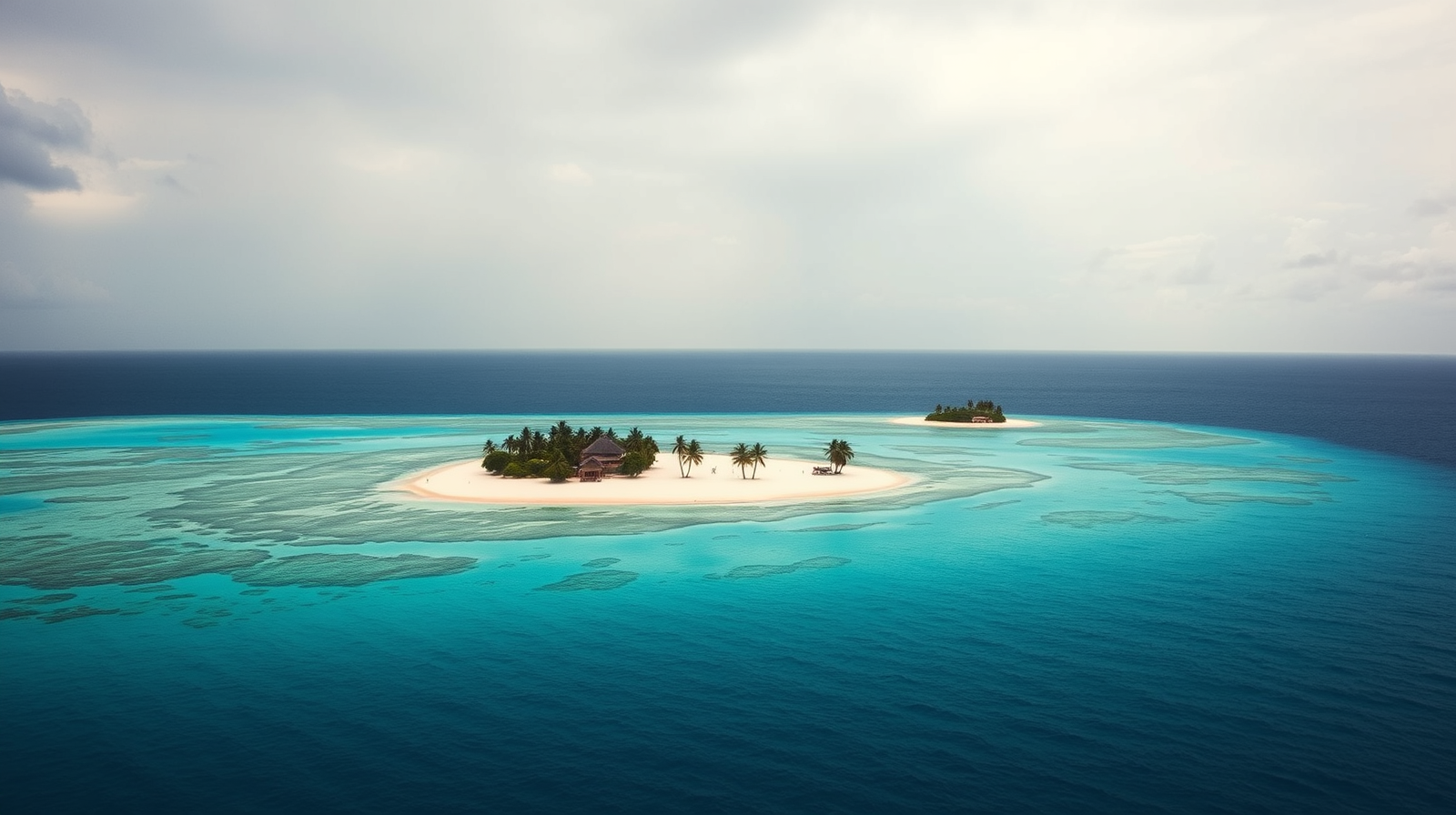
Travel journalism has a predictable, condescending habit when covering remote Pacific micro-states. Send a writer on a propeller plane, take a few photos of a runway on a narrow strip of land, write a tragic tear-jerker about how climate change is swallowing the nation, and wrap it all up in a neat ribbon of pity.
The latest iteration of this lazy consensus fixation revolves around Tuvalu. The media narrative is always the same: a tiny dot in the ocean, served by a single commercial airline, completely cut off from modern economic life, waiting helplessly for the Pacific to wash away its nine coral atolls.
It is a comfortable narrative for Western observers because it fits a familiar trope: the helpless victim of global forces, dependent on foreign charity and a single ATR 72 flight from Fiji.
It is also total nonsense.
The idea that Tuvalu is an isolated, doomed nation trapped by its geographic constraints misses the entire strategy behind modern micro-state sovereignty. What Western journalists view as a tragic economic weakness is actually a calculated, modern blueprint for sovereign agility. Tuvalu isn't failing to build a traditional tourist economy; it is intentionally bypassing it entirely.
The Tourism Fallacy: Why Missing Mass Aviation Is a Feature, Not a Bug
The moment travel writers discover that Funafuti International Airport is serviced almost exclusively by Fiji Airways—operating just a handful of flights a week—they treat it as a structural failure. They ask how a country can build a modern economy without a hub, without hotel chains, and without a booming tourism sector.
That question exposes a fundamental ignorance of Pacific economics.
Look at what mass tourism has done to other island nations. It turns local populations into low-wage service workers for multinational resort conglomerates, inflates land prices beyond the reach of locals, strains fragile freshwater resources, and creates an economy utterly vulnerable to global shocks, pandemics, and jet-fuel volatility.
Why would a population of 11,000 people want to invite millions of cruise ship tourists to destroy their native coral reefs and drain their cisterns for the sake of a few hotel tax dollars?
Tuvalu does not lack an international tourism industry because it can't build one. It lacks one because chasing traditional tourism on a 26-square-kilometer landmass is economic suicide.
Traditional Island Model:  Physical Land -> Mass Tourism -> Resource Strain -> Foreign Dependence
Tuvalu Sovereign Model:    Digital Assets + Geopolitical Treaties -> Capital Inflow -> Zero Footprint
By keeping air connectivity minimal and tightly managed, Tuvalu protects its social fabric and physical resources while deriving revenue from far smarter, high-margin global mechanisms.
The Digital Sovereign Arbitrage Nobody Talks About
While travel writers lament the lack of daily flights, Tuvalu quietly runs circles around traditional revenue models through asset monetization that requires zero physical infrastructure.
Long before tech founders started talking about digital nationhood, Tuvalu pulled off one of the cleanest sovereign financial moves in modern history: leasing its top-level internet domain country code, .tv.
Every time a tech startup, streaming platform, or media company registers a .tv URL, money flows directly into the Tuvaluan treasury. For decades, domain licensing fees paid for basic national infrastructure, public sector salaries, and international diplomacy without a single tourist stepping off a plane.
+-----------------------------------------------------------------------+
|                       TUVALU SOVEREIGN CASH FLOW                      |
+-----------------------------------------------------------------------+
|  .tv Licensing Revenue  --> Direct State Revenue (Zero Footprint)    |
|  Falepili Union Treaty  --> Guaranteed Mobility & Security (Australia)|
|  Future Now Initiative  --> Sovereign Cloud-Based Governance          |
+-----------------------------------------------------------------------+
Now, Tuvalu is taking that digital strategy to its logical conclusion through its Future Now project. While foreign reporters write obituaries for the physical islands, Tuvalu is building a fully recognized, digitized twin of its landmass and government services in the cloud.
This isn't a "gimmick" or a white-flag surrender to rising waters. It is legal statecraft. Under international law, sovereignty has historically been tied strictly to physical territory. By establishing a permanent, digitized sovereign record, Tuvalu is challenging UN frameworks and forcing global powers to recognize a state's legal existence, maritime borders, and voting rights even if physical territory shifts.
They aren't preparing to fade away; they are establishing a legal precedent that will protect their sovereign wealth forever.
The Geopolitical Chess Board: Capitalizing on Big-Power Competition
The most laughable myth in Western reporting is that Tuvalu is a passive bystander in world politics.
In reality, small island states in the Pacific command immense diplomatic influence per capita, and Tuvalu executes this dynamic better than almost anyone.
Consider the Australia-Tuvalu Falepili Union Treaty. Media outlets immediately labeled it a tragedy, publishing stories about "the first climate refugees" leaving a sinking island.
That framing completely ignores the staggering diplomatic concession Tuvalu extracted from a regional superpower. Under the agreement, Australia guaranteed security assistance, emergency response, and a dedicated, permanent residence visa pathway for Tuvaluan citizens to live, study, and work in Australia with full access to healthcare and social safety nets—all without requiring Tuvaluans to give up their citizenship, land rights, or sovereign identity.
In exchange, Australia secured veto power over foreign defense agreements on the atolls, effectively keeping competing superpowers out.
That isn't a nation begging for rescue. That is a country of 11,000 people turning its strategic geographic position into permanent security, free movement, and economic backing from a G20 economy.
I've worked alongside diplomats and policy analysts across international trade negotiations, and I can tell you that larger nations regularly fail to secure a fraction of the concessions Tuvalu negotiated in a single treaty.
Answering the Flawed Questions
When people analyze Tuvalu, they ask all the wrong questions because they measure micro-states using macro-state metrics.
"How can a nation survive with only one airline?"
By realizing that commercial air traffic is not the primary driver of national value in the 21st century. Physical transportation matters for physical trade, but modern sovereignty operates on legal agreements, telecom networks, and diplomatic positioning. A single airline connecting Funafuti to Nadi is completely sufficient for government business and essential travel. Building massive runway extensions to land wide-body jets would ruin the island's limited arable land for zero economic upside.
"Isn't Tuvalu doomed to disappear?"
Physical geography will change, but legal nationhood does not have to. Science confirms that low-lying atolls face severe sea-level threats over coming decades. However, the assumption that land loss equals nation loss is an outdated 19th-century legal concept. Tuvalu's aggressive moves in international law are designed to decouple statehood from physical square footage. If a corporation can exist in Delaware without physical offices, a sovereign state can exist in international law with maritime entitlements intact regardless of high tides.
"Why don't they develop a real local economy?"
They already have one—it just doesn't look like a Western economic textbook. A cash economy backed by strong communal networks, public employment financed by domain rights, international fishing licenses in their vast Exclusive Economic Zone (EEZ), and strategic treaties is a fully functioning model. Forcing an artificial industrial or service economy onto a tiny coral ring would destroy the exact community resilience that has sustained Tuvaluans for generations.
The Flaws in the Digital Sovereign Model
To be clear, this high-stakes strategy isn't without risk.
Relying on diplomatic treaties means Tuvalu's strategic flexibility is constrained by regional power dynamics. The Falepili Union locks Tuvalu tightly into Australia's security orbit, limiting its ability to play rival global powers off one another in future economic bidding wars.
Furthermore, digital nationhood relies on international legal consensus. If the United Nations and maritime law bodies refuse to formally maintain EEZ boundaries for submerged or re-engineered atolls, the long-term revenue from ocean fishing rights could face intense legal challenges.
Yet, even with those trade-offs, Tuvalu's approach is infinitely superior to sitting back, building a couple of boutique hotels, and hoping eco-tourists save the economy.
Stop looking at Tuvalu as a tragic casualty of isolation. Start looking at it as a masterclass in how small states maximize power in a hyper-connected world.


