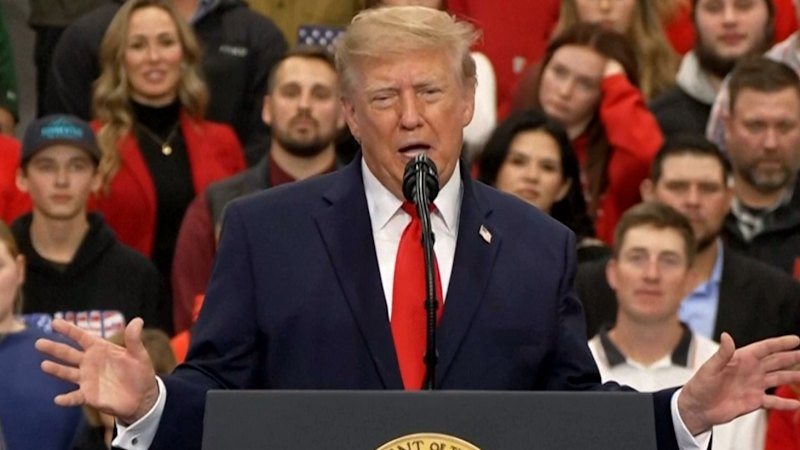
Standard campaign coverage treats a sitting president's trip to western states during a midterm cycle as a straightforward vote-mobilization push, yet high-profile rallies in low-elasticity or shifting districts often produce diminishing returns for down-ballot candidates. Analyzing presidential travel across the American West requires separating headline rally attendance from measurable electoral mechanics: low-propensity base activation, ticket-splitting friction, geographic dispersion across vast media markets, and macroeconomic headwinds that outlast a two-hour speech.
In the 2026 cycle, midterm politics tested Republican incumbents and challengers across competitive House, Senate, and statewide races amid heavy Democratic gains in both chambers and sharp swings in traditionally conservative or contested districts. Because the competitor reference provides only the headline "Trump takes midterm campaign to western states" with no underlying text or URL, this analysis does not invent quotes or unverified claims from an unseen piece. Instead, it establishes the analytical architecture required to evaluate any western midterm campaign tour using public election mechanics and political economy principles. For a different perspective, consider: this related article.
Deconstructing Conventional Western Campaign Coverage
Typical news reporting on western midterm trips relies on three recurring assumptions that obscure how votes actually move. First, coverage often equates crowd size or media spectacle with persuasive reach, treating an enthusiastic room in a friendly county as evidence of statewide momentum. Second, reporting frequently lumps "western states" into a single bloc, ignoring sharp distinctions between Mountain West growth corridors, Pacific coast urban-suburban divides, and Plains-border or agricultural districts. Third, surface-level stories rarely distinguish between a president's personal brand loyalty and a down-ballot candidate's ability to win independent or cross-pressured voters.
A rigorous analytical rewrite replaces those shortcuts with explicit causal links. When a president campaigns in a western state during a midterm, the intervention alters information salience for roughly 24 to 72 hours, concentrates earned media around national themes rather than local legislative records, and tests whether presidential coattails can transfer in an environment where midterm turnout skews older, higher-information, and more polarized than presidential-year turnout. Further analysis on this trend has been shared by NPR.
The Four Pillars of Western Midterm Mobilization
To evaluate a western midterm campaign tour systematically, analysts should examine four distinct mechanisms rather than relying on aggregate impressions.
- Turnout Elasticity vs. Persuasion: Midterms rarely hinge on persuading hardened partisans. The primary lever is turnout elasticity—converting low-propensity supporters who vote in presidential years but stay home in off-years—weighed against motivating the opposition base to turn out defensively.
- Coattail Transfer Efficiency: A president's approval or personal draw does not automatically transfer to Senate, House, governor, or secretary of state candidates. Transfer efficiency depends on how closely the down-ballot nominee aligns with local economic concerns and whether voters treat the midterm as a referendum on the administration or a check on unified control.
- Media Market and Geographic Friction: Western states span sprawling geographies where television media markets often cross state lines or leave rural voters disconnected from major metro broadcasts. Physical rallies reach thousands directly while relying on clips and local press to reach millions more, creating steep distribution drop-offs outside the immediate event corridor.
- Issue Salience and Cost-of-Living Pressures: National rhetoric competes directly against tangible pocketbook variables—interest rates, housing costs, energy and fuel prices, agricultural input costs, and trade or tariff effects on regional industries. When local economic friction is high, abstract political framing struggles to dislodge incumbent accountability or voter frustration.
Known Facts vs. Educated Hypotheses in Campaign Assessment
Sound strategic analysis separates verified data from analytical hypotheses before drawing conclusions. Known facts include election calendars, statutory voting rules (such as mail balloting, early vote windows, or ranked-choice systems where applicable), official filing and fundraising disclosures, certified vote totals, and documented candidate positions. Educated hypotheses include estimates of how a specific rally affects marginal turnout in surrounding precincts, projections of ticket-splitting rates, and forecasts of whether a late-October travel stop shifts undecided voters.
Treating a hypothesis as a settled fact is the fastest way for a campaign strategist or commentator to misread a race. If polling shows persuasion is nearly locked, allocating scarce executive travel days to a persuasion message wastes time; if low-propensity turnout is the binding constraint, targeted voter contact and early-vote banking matter more than broad nationalized speeches.
Cost Function and Resource Allocation Mechanics
Every campaign appearance operates under a strict Cost Function of Executive Travel. A president's time is the scarcest resource in national politics, and spending a day in one western state carries direct opportunity costs across every other battleground.
- Direct Opportunity Cost: Every hour spent traveling to, staging, and speaking at one event is an hour unavailable for another competitive Senate, House, or gubernatorial contest.
- Message Crowding Cost: Nationalized rally themes can dominate local coverage and crowd out tailored down-ballot messaging on state-level issues, healthcare, water policy, or local public safety.
- Backlash and Counter-Mobilization Cost: High-visibility appearances in swing or suburban jurisdictions can energize opposing donors, volunteers, and voters just as effectively as they energize supporters.
- Operational Execution Cost: Rallies only convert into votes when paired with ground operations—door-knocking, ballot chasing, and registration verification—that capture attendees and neighbors before mail and early ballots are cast.
In economic terms, campaign resources follow diminishing marginal returns. The first major push in a neglected or competitive market may raise awareness and donor enthusiasm noticeably, whereas additional stops in already saturated or heavily tilted districts yield smaller incremental vote gains per unit of effort.
Illustrative Scenario: Two Contrasting Western Stops
Consider two hypothetical stops during a western midterm swing to see how the mechanics diverge. In Stop A, a rally occurs in a fast-growing exurban or suburban district where college-educated swing voters and split-ticket voters decide the outcome. Even if thousands of loyalists fill an arena, the speech risks reinforcing polarization without moving the middle—and may prompt intense local counter-organizing.
In Stop B, a rally occurs in a resource-dependent or rural-leaning region within a broader battleground state. Here, the strategic goal is banking high raw vote margins to offset Democratic gains in urban and suburban cores. Yet even in Stop B, turnout math requires clear air-to-ground coordination: attendees must be registered, informed on down-ballot names, and moved to cast ballots on time rather than treating the event as entertainment.
Operational Playbook for Evaluating Western Races
Practitioners auditing a western midterm campaign can apply a four-step diagnostic sequence to separate noise from signal.
- Audit Baseline Partisanship and Swing History: Compare recent presidential, gubernatorial, and legislative margins at the county and precinct level to identify where vote shares are elastic versus structurally anchored.
- Map Down-Ballot Vulnerability: Isolate the specific seats—House, Senate, governor, or state offices—where the margin of error is narrow and candidate quality, fundraising, or local controversies shape outcomes.
- Track Early Vote and Mail Balloting Velocity: Monitor early and absentee ballot returns against historical benchmarks to see whether base mobilization is occurring ahead of Election Day or lagging behind expectations.
- Cross-Check Economic and Regional Indicators: Pair political coverage with regional employment, housing, fuel, and commodity data to see which material pressures are driving voter dissatisfaction.
Limitations and Analytical Blind Spots
No analytical framework eliminates uncertainty in midterm elections. Polling faces non-response and turnout-model error, late-breaking news can shift undecided voters in days, and local candidate dynamics frequently override national narratives. Furthermore, public commentary often over-interprets single campaign stops while under-weighting long-term demographic shifts, redistricting, and ground-game execution.
For campaign strategists and decision-makers managing western midterm operations, the decisive strategic play is to treat presidential travel strictly as a force multiplier for existing ground infrastructure, never as a substitute for it—concentrating high-profile appearances where down-ballot margins are contestable, pairing every event with immediate voter-contact and early-ballot conversion workflows, and reallocating executive time away from low-return stops the moment turnout or persuasion metrics flatten.