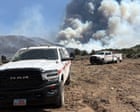
The Thermometer Isn't Your Main Problem
Every summer, the news follows an identical script. A wildfire sparks in Utah or California, a small town evacuates, and headlines scream about record-breaking heat waves roasting the American West. The narrative is neat, terrifying, and fundamentally incomplete.
Media outlets treat these disasters as unpredictable acts of atmospheric vengeance. They point at the sun, blame rising global temperatures, and imply that until the entire planet cools down, we are completely helpless. If you found value in this article, you might want to check out: this related article.
That narrative is a dangerous cop-out.
Blaming extreme heat for catastrophic wildfires is like blaming a match for a house fire when you stored open barrels of gasoline in the living room. The heat is the trigger. The vulnerability is entirely engineered by decades of terrible policy, broken forest management, and reckless zoning. We do not have a wildfire problem; we have an infrastructure and management crisis that we refuse to fix. For another angle on this story, refer to the latest coverage from TIME.
The Century of Total Suppression Backfire
To understand why a town evacuates in 2026, you have to look back a hundred years. For over a century, federal and state agencies operated under a policy of absolute fire suppression. Every plume of smoke was met with immediate, aggressive containment.
This sounds logical to the untrained observer, but it violates basic ecological mechanics.
Western ecosystems evolved with fire. Low-intensity blazes historically cleared out underbrush, dead wood, and invasive vegetation, leaving mature, thick-barked trees untouched. By putting out every single fire instantly, we created an artificial anomaly.
- Fuel Accumulation: Forests now carry up to ten times the fuel load they did pre-colonization.
- Choked Understories: Millions of acres are packed with dense brush and dead standing timber.
- The Powder Keg: When a spark hits this hyper-dense environment during a dry spell, it doesn't create a manageable ground fire. It creates an uncontrollable crown fire that leaps across treetops and obliterates everything.
I have spent years analyzing resource allocation in environmental management, and watching agencies pour billions into suppression while starved for prevention budgets is infuriating. We spend pennies on the dollar on controlled burns and mechanical thinning, then act shocked when the sky turns orange.
Stop Building Homes in the Splash Zone
The media loves the drama of a small-town evacuation. What they rarely mention is why that town is sitting in a high-risk fire zone in the first place.
The Wildland-Urban Interface (WUI) is the fastest-growing land type in the United States. Millions of people have moved out of cities and into forested, fire-prone areas. This is not just a lifestyle choice; it is a massive transfer of risk to the public ledger.
+-------------------------------------------------------------+
|               THE VICIOUS CYCLE OF WUI EXPANSION            |
+-------------------------------------------------------------+
|  Cheap rural land attracts development                      |
|    ---> Homes built with inadequate defensible space        |
|      ---> Fire strikes; resources diverted from forests     |
|        ---> Billions spent protecting private property      |
|          ---> Subsidized insurance rebuilds in same spot    |
+-------------------------------------------------------------+
When a fire breaks out near a WUI community, firefighters cannot focus on containing the perimeter of the blaze. They are forced into defensive structural protection. They are putting out burning roofs instead of cutting firelines.
Municipalities continue to approve subdivisions in areas with single-lane access roads and zero mandatory defensible space requirements. Then, when the inevitable happens, taxpayers foot the bill for emergency response and subsidized federal insurance programs. If you build a wood-framed house in a ecosystem designed to burn, you are participating in a game of Russian roulette.
Dismantling the Predictable Questions
Aren't heat waves objectively getting worse?
Yes, the data shows higher baseline temperatures. But focusing solely on the temperature ignores the variable we can actually control. You cannot dial down the sun next week. You can, however, mandate metal roofs, clear 100 feet of brush around every home, and execute prescribed burns during the wet season. Treating heat as the sole variable leads to fatalism and inaction.
Can we just log our way out of the problem?
Commercial logging is not a silver bullet. Timber companies want large, profitable trees, which are often the most fire-resistant elements of a forest. The real threat is the small-diameter brush, ladder fuels, and invasive grasses that hold zero commercial value. True mechanical thinning requires massive public investment, not just handing over acreage to logging corporations.
Why not just execute more prescribed burns?
This is where the contrarian approach faces its hardest truth: liability and public tolerance. Air quality regulations make it incredibly difficult to get permits for intentional burns because no one wants smoke in their backyard. Furthermore, if a prescribed burn escapes—as happened disastrously in New Mexico a few years ago—the political fallout is brutal. We have created a system where doing nothing is politically safer than taking a calculated risk.
The Hard Choices Nobody Wants to Make
Fixing this requires a complete rejection of the standard emergency response playbook. We need to stop treating wildfires as unexpected natural disasters and start treating them as predictable regional characteristics.
- Enforce Hard Zoning Borders: If a developer wants to build in a high-risk zone, they must pay prohibitive impact fees to fund localized firefighting infrastructure. No more externalizing the cost of lifestyle choices onto the general public.
- Invert the Budget: Shift federal funding from emergency suppression to year-round mitigation. It is cheaper to pay crews to clear brush in December than it is to hire a fleet of air tankers in July.
- Reform Property Insurance: Stop artificially suppressing insurance premiums in high-hazard areas. If a property cannot get private insurance due to fire risk, the state shouldn't step in to subsidize that risk. Let the market accurately price the danger of living in a tinderbox.
The panic porn on the evening news gives people a pass. It allows local politicians to shrug and blame global forces rather than facing their own failure to pass strict building codes and clear brush. The heat wave is a reality, but the catastrophe is a choice.


