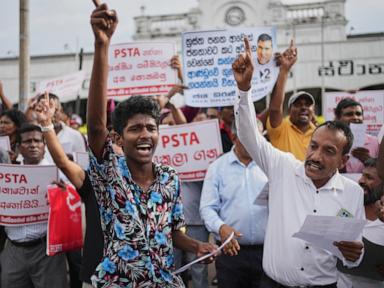
The megaphone crackled first. Then came the rain.
In the humid afternoons outside Colombo’s Fort Railway Station, the air smells of diesel exhaust, wet asphalt, and roasted peanuts sold in twisted cones of old newspaper. When hundreds of garment workers, teachers, and port laborers gather there, the sound isn't anger. Not at first. It is a low, rhythmic hum—the collective exhale of people who spend ten hours a day on their feet for wages that buy half as much rice as they did four years ago.
Now imagine standing in the third row of that crowd. Let’s call him Kasun, a hypothetical thirty-four-year-old machine operator from the Katunayake Free Trade Zone, holding a hand-painted cardboard sign demanding an inflation adjustment. To his left stands a retired schoolteacher. To his right, a hospital nurse still wearing her pale blue uniform under a plastic poncho.
Kasun is not throwing stones. He is not blocking an ambulance. He is exercising a constitutional right that Sri Lankans bled for in the streets during the 2022 Aragalaya uprising—the mass protest movement that toppled an entrenched political dynasty when the economy collapsed.
Yet under the legislative proposals now moving through Sri Lanka’s parliament, Kasun’s cardboard sign could soon carry the legal weight of a weapon.
The Architecture of Quiet Control
To understand why Sri Lanka’s trade unions have erupted in coordinated protest, you have to look past the dry legal titles of the bills on the parliamentary order paper. Bureaucracy rarely announces its sharpest teeth. Instead, it wraps them in reassuring language about public order, national security, and modernized policing.
Over the past year, a cluster of legislative measures—most notably proposed amendments to the Police Ordinance, alongside the Online Safety Act and the looming shadows of counter-terrorism replacements—have converged toward a single destination. They dramatically expand the discretionary powers of the Sri Lanka Police while shrinking the legal space where ordinary citizens can gather, speak, or organize a strike.
Stripped of legalese, here is what these bills actually do on the pavement.
First, they lower the threshold for declaring an assembly unlawful. Under existing Sri Lankan law, police already possess broad authority under Section 95 of the Code of Criminal Procedure to disperse crowds deemed likely to cause a breach of the peace. The new provisions widen that net, allowing senior officers to restrict processions, ban public meetings in designated zones, and impose pre-emptive conditions on gatherings based on subjective assessments of potential disruption.
Second, they sharpen the penalties for non-compliance. What used to result in a minor fine or a brief detention at a local station can escalate into heavy monetary penalties, prolonged remand without bail, and criminal records that permanently bar workers from public-sector employment or overseas migration.
Third—and this is the part that keeps union organizers awake at 2:00 a.m.—the legislation blurs the line between industrial action and public disorder. When hospital staff stage a four-hour walkout, or railway workers refuse overtime, or plantation laborers block an estate road to demand their daily thousand-rupee wage, the state no longer has to negotiate across a bargaining table. It can simply reclassify an economic grievance as a security threat.
Silence. That is the real product being manufactured.
A Memory Written in Tear Gas
I have walked past the barricades near Galle Face Green after the tear gas cleared, when the sting still clung to the back of the throat like swallowed bleach and the white plastic shells lay scattered in the gutters beside lost rubber slippers. Anyone who has watched a peaceful vigil dissolve into panic knows that laws on paper are never abstract once they reach the street. A vague clause drafted by a lawyer in an air-conditioned ministry becomes a baton in the hands of an exhausted constable who has been standing in full riot gear for nine hours without lunch.
This is why the warnings from Sri Lanka’s trade union federations carry an urgency that outsiders often misread as political theater.
Sri Lanka is not a blank slate. The island carries a heavy, unresolved history of emergency regulations and security laws that were introduced as temporary shields and stayed for decades as permanent swords. The Prevention of Terrorism Act (PTA), enacted in 1979 as a six-month stopgap measure, remained in force for over forty-five years. Human rights organizations, United Nations special rapporteurs, and Sri Lanka’s own Bar Association documented thousands of cases where broad police and detention powers were turned not against armed insurgents, but against journalists, minority activists, student leaders, and union organizers.
When a government that came to power promising systemic reform reaches for the exact same toolkit of expanded police authority, labor leaders recognize the pattern immediately. They have seen this movie. They know who ends up in the back of the van before the credits roll.
Consider the metaphor of a pressure cooker. An economy undergoing an International Monetary Fund (IMF) restructuring program—with steep hikes in electricity tariffs, value-added taxes jumping to 18 percent, and real wages lagging far behind the cost of basic lentils and milk powder—generates immense internal heat. Trade unions are the release valve. Strikes, petitions, and street demonstrations allow pressure to escape visibly, noisily, and measurably, forcing policymakers to confront the human toll of austerity.
Expanding police powers to silence protests does not cool the stove. It welds the valve shut.
What Happens When a Union Loses Its Voice
To see the invisible stakes, step away from parliament and look inside a textile factory or a tea estate in the central highlands.
For millions of Sri Lankan workers, a trade union is the only institution standing between them and arbitrary exploitation. Labor courts in Sri Lanka are notoriously backlogged; a wrongful termination case can drag on for five to seven years while a family sells its jewelry and pulls children out of tuition classes just to buy groceries. The collective power to strike or picket is the sole leverage that compels an employer to pay overdue Employees’ Provident Fund (EPF) contributions or fix a broken ventilation system.
Now trace the chain reaction when police are handed unchecked power to pre-emptively ban gatherings or arrest organizers under sweeping public-order statutes.
- The chilling effect hits before a single arrest happens. A union branch secretary in a regional town thinks twice before calling a lunchtime gate meeting because the local Officer-in-Charge can declare the sidewalk a restricted zone.
- Fear fractures solidarity. Workers on precarious daily contracts—especially women, who make up nearly 80 percent of Sri Lanka’s apparel workforce and the majority of tea pluckers—cannot afford a single night in police custody. One arrest means missing a shift; missing a shift means losing the job; losing the job means defaulting on microfinance loans.
- Accountability evaporates. When police officers are shielded by broad immunity clauses for actions taken "in good faith" during crowd control, investigations into excessive force stall before they begin.
Let’s return to our hypothetical machine operator, Kasun, outside Fort Station. Suppose the police declare the protest unlawful ten minutes after it begins because traffic is slowing down on Olcott Mawatha. Under expanded powers, officers do not need to wait for violence to erupt. They move in with water cannons and batons. Kasun is grabbed, charged with obstructing public officers and participating in an unlawful assembly, and remanded for fourteen days.
By the time a magistrate grants him bail, his factory has terminated his contract for unauthorized absence. His name is flagged in police clearance reports, ruining his application for a factory job in South Korea. Nobody had to pass a law banning unions. They simply made the cost of standing on a sidewalk unsurvivable.
The Illusion of Order
Defenders of the bills argue—often earnestly—that Sri Lanka needs stability to recover. Investors hate uncertainty, tourists cancel bookings when roads are blocked, and essential services like hospitals and ports cannot be held hostage by endless strikes.
Those concerns are real. Anyone who has sat in gridlocked Colombo traffic for three hours because a dozen protesters blocked a major junction understands the frustration of ordinary commuters. A society cannot function in permanent paralysis.
Yet there is a profound difference between regulating the time and manner of protests to protect emergency access and granting the police sweeping, unchecked authority to decide which grievances are permitted to exist in public view.
Democratic policing relies on de-escalation, clear statutory limits, and independent oversight. Sri Lanka’s own Human Rights Commission has repeatedly pointed out that existing criminal laws already give the police more than enough authority to arrest individuals who commit actual violence, destroy property, or block emergency vehicles. What the existing law lacks is not police power; it is police accountability and a functioning mechanism for resolving labor disputes before workers feel forced into the streets.
History offers a blunt lesson here. Every Sri Lankan administration over the past four decades has, at some point, tried to legislate away public dissent. In 1980, a general strike was crushed with mass dismissals of tens of thousands of workers, leaving scars that poisoned labor relations for a generation. In 2022, emergency curfews and police barricades failed to stop citizens whose cupboards were empty.
You cannot baton an empty stomach into feeling full. And you cannot arrest an inflation rate.
The Line Drawn on the Asphalt
Back outside Fort Railway Station, the rain finally breaks into a heavy monsoon downpour, drumming against the corrugated tin roofs of the bus stands.
In real life—not in a hypothetical sketch, but on actual Tuesdays and Thursdays across Colombo, Kandy, and Jaffna—the union leaders do not pack up their banners when the rain starts. Instead, they wrap their megaphones in plastic bags and step closer together so the crowd forms a tighter circle. Teachers from state schools stand beside port workers from the Colombo docks; health sector unions link arms with postal clerks and bank employees.
They know the bills are moving forward. They know the legal decks are stacked against them, and they harbor no illusions about how quickly a peaceful picket can turn into a charge sheet at the Magistrate’s Court.
Yet they keep showing up because they understand a truth that lawmakers routinely forget: rights are like muscles. They do not survive inside a constitution locked in a glass case. They survive only when ordinary people step onto wet asphalt, raise a voice that shakes slightly in the humid air, and refuse to ask permission to be heard.
When the sirens start wailing down the boulevard, the crowd does not scatter. They look at the line of shields ahead of them, look back at the people standing behind them, and hold their ground.