The Light at the End of the Net
Tokyo traffic does not sleep, but it hums with a polite, subterranean quiet. On a clear morning in the city, the air smells of roasted green tea and wet asphalt. For decades, if you walked down a certain quiet street in Shinjuku, you would pass a modest brick building. Inside that building lived a woman who had spent nearly a century arguing with the void.
She did not argue with words. She argued with circles. Discover more on a connected topic: this related article.
Yayoi Kusama is gone. At ninety-seven, the woman who once looked at a modest dinner table cloth, saw the pattern replicate infinitely across her vision, and decided to paint her way out of a panic attack, has finally put down her brush.
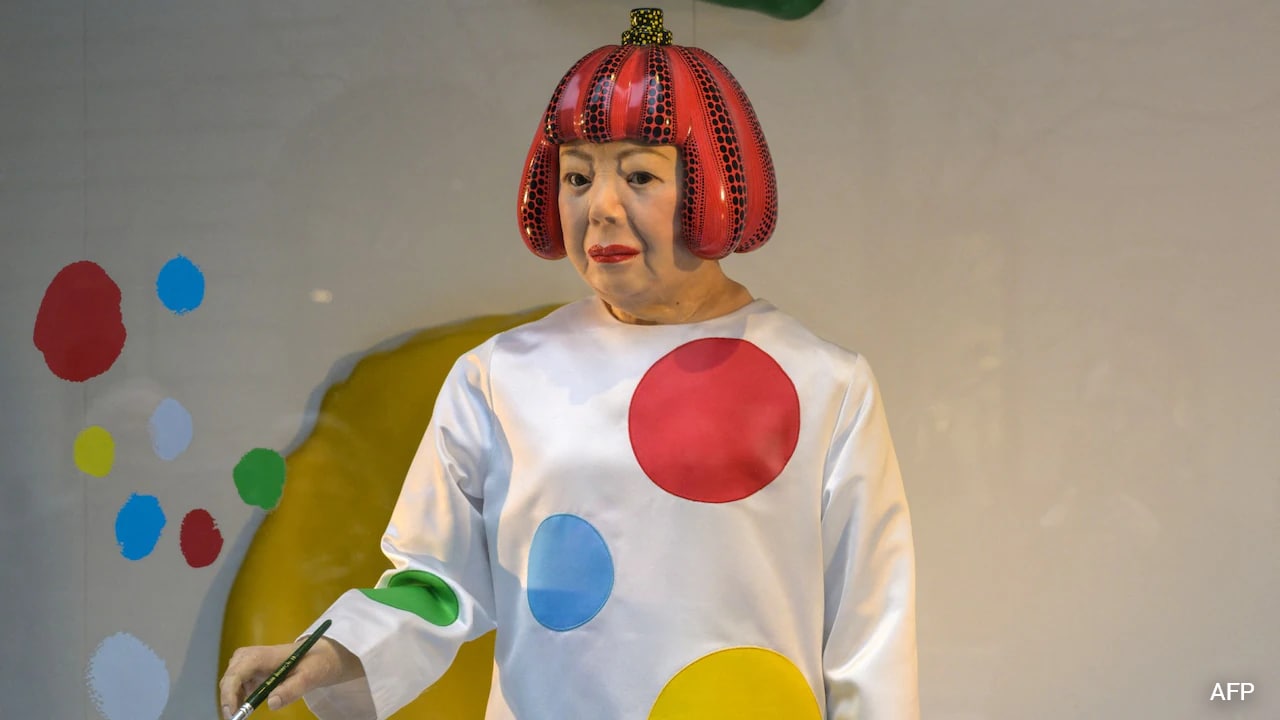
News tickers will tell you she died in Tokyo. Obituaries will list her exhibitions, the block-long queues outside her Infinity Mirror Rooms, the multi-million-dollar auction blocks, the red bob wig that became as recognizable as Salvador Dali’s mustache. They will mention her voluntary residence in a psychiatric hospital down the street from her studio—a place she walked to every single morning, flanked by assistants, returning only to sleep. Further analysis by BBC delves into comparable perspectives on the subject.
They will get the dates right. They will get the numbers wrong. Because you cannot measure a life like Kusama’s in years or square footage. You have to measure it in repetition.
Consider the sheer terror of an empty canvas. Most artists freeze before it. Kusama looked at it and felt it was trying to swallow her.
The Panic and the Pattern
Long before the Instagram posts, long before the velvet ropes and the timed forty-five-second slots inside glittering rooms of LED lights and mirrors, there was a little girl in Matsumoto, Japan.
It was World War II. While other children worried about rations, young Yayoi sat in the seed harvesting fields of her family's nursery, watching the world burn through a haze of severe hallucinations. Flowers spoke to her. The patterns on the tablecloths detached themselves, climbed up the walls, crawled over her skin, and threatened to consume her entirely.
(Author's Note: Imagine sitting at a kitchen table where the physical objects refuse to stay still, multiplying fractally until your own hands disappear beneath a rising tide of violet polka dots.)
Most people would break under that kind of neurological onslaught. Kusama weaponized it.
She realized that if she drew the dots—if she painted every single leaf, every single pebble, every single hallucination onto paper, canvas, and eventually her own body—she was fighting back. She was trapping the infinity before it could trap her. The dots were not a stylistic choice. They were a life raft.
When she arrived in New York City in 1957, broke, speaking halting English, and carrying sixty silk kimonos stuffed with thousands of her own works on paper, she brought that panic with her. The American art world was a boys' club of brooding Abstract Expressionists splashing black paint on massive canvases, taking themselves terribly seriously.
Kusama showed up in a handmade dress covered in hand-painted polka dots, tiny, fierce, and entirely unintimidated.
When the Art Ate New York
New York in the sixties was loud. Kusama made it louder, and stranger, and infinitely more human.
She staged happenings in Central Park and the Brooklyn Bridge. She painted naked protesters against the Vietnam War with bright red and blue circles, turning flesh into canvas, insisting that the individual body was just a drop of water in the great cosmic ocean. When Andy Warhol debuted his floating silver clouds, art historians whispered about how closely it resembled Kusama’s earlier room installations. When Claes Oldenburg began making soft sculptures of everyday objects, Kusama had already sewn thousands of stuffed phallic protrusions onto chairs, boats, and sofas years prior.
She was the pioneer everyone copied and the outsider everyone watched.
And then, exhausted, broke, and suffering from mounting health issues, she returned to Japan in 1973. For a long time, the art world forgot her. She became a ghost story. People whispered about the eccentric Japanese artist living voluntarily in a psychiatric ward in Tokyo, painting all day and returning to her room to sleep at night.
If you had walked past her during those silent years in the eighties, you would have seen an aging woman in a simple coat, carrying her art supplies with the steady, unyielding rhythm of a factory worker clocking into a shift. She did not care about the silence. She had her dots.
The Mirror Room Awakening
Then came the turn of the millennium.
Art is fickle. It loves a comeback story, but only when the subject has survived the wilderness. In the late nineteen-nineties and two-thousands, a new generation raised on digital screens and hyper-saturated visual culture looked at Kusama’s work and finally caught up.
They did not just see avant-garde historical artifacts. They saw the blueprint for modern existence.
Museums realized that people did not want to stand behind a velvet rope anymore. They wanted to step inside the art. They wanted to lose themselves. The Infinity Mirror Rooms—those magical, mirrored chambers where lights stretch out into an endless, dizzying cosmos—became the most sought-after cultural tickets on planet Earth.
People queued for hours in London, New York, Tokyo, and Los Angeles just to spend sixty seconds floating in a universe of infinite light. They took selfies, yes. But beneath the vanity of the smartphone era lay something much deeper.
Kusama had built a machine for ego-death.
Step into one of those rooms, and the walls vanish. The floor disappears. You are no longer an accountant from Queens or a student from Shibuya. You are a single, breathing speck of stardust suspended in an endless galaxy of glowing pumpkins and neon lanterns.
She gave millions of anxious, hyper-connected people a safe way to experience total annihilation.
The Final Brushstroke
She painted until the very end. Even as her eyesight began to fail, even as her body demanded the assistance of a wheelchair, her hands knew the canvas.
Think about what it takes to dedicate eighty years of a single human life to the exact same obsession. Most of us abandon our passions the moment they become inconvenient, or expensive, or unfashionable. We pivot. We optimize. We look for the next paradigm.
Kusama never pivoted. She dug a hole straight down into the center of a single idea and found the universe waiting at the bottom.
The Tokyo studio is quiet now. The assistants have put away the tubes of acrylic paint. The red wig rests on its stand, a silent monument to a tiny woman who stared down her own mind and turned her monsters into masterpieces.
Outside, the city keeps moving. The neon signs flash in red, green, and blue. Every circle of light reflecting off a wet windshield looks just a little bit brighter today, carrying the quiet, insistent echo of a woman who proved that if you repeat something often enough, it stops being a symptom and becomes a miracle.
The lights go on. The mirrors reflect forever.