The pre-dawn air in New Delhi during mid-June does not move. It hangs heavy, thick with the scent of dust, exhaust, and the impending monsoon. At 5:00 AM, the city is usually a cacophony of early morning trucks and distant, waking chaos. But on this specific morning, something else takes over. A collective silence.
Thousands of people move in unison toward the red sandstone ramparts of the historic monuments and the manicured lawns of Rajpath. They carry rolled-up mats under their arms. There is no loud chatter. The usual sharp elbows of Delhi transit are entirely absent. Instead, there is only the rhythmic, synchronized sound of thousands of lungs expanding and contracting at the exact same tempo.
This is not a mere photo opportunity or a state-mandated gathering. It is the epicenter of a global phenomenon. June 21, 2026, marks a massive milestone for International Yoga Day, transforming a ancient philosophy into a modern lifeline for a world that feels increasingly fractured.
We tend to look at global events through the lens of statistics. Headlines will tell you how many millions participated across continents. They will show you high-definition drone shots of colorful grids of people stretching across public squares from India to Japan. But the real story is not in the numbers. It is found in the individual friction points where an ancient practice meets the relentless friction of modern life.
The Sunrise Over Tokyo
Consider Kenji. He is a hypothetical thirty-four-year-old software engineer living in the heart of Tokyo, but his reality is shared by millions. By 6:30 AM, Kenji is usually squeezed into a subway car on the Chuo Line, his face inches from a stranger’s back, already answering emails on a glowing screen. The psychological toll of this existence is invisible but heavy. It is a constant, low-grade fight-or-flight response.
On this morning, however, Kenji is standing on a wooden deck overlooking a manicured garden in Tokyo’s Minato ward. The sun is a pale pink disc cutting through the city’s morning haze. He is surrounded by ninety other people, all reaching their hands toward the sky in a traditional sun salutation.
When you raise your arms in a yoga pose, something chemical changes. It is simple physiology disguised as mysticism. The stretching of the intercostal muscles between the ribs allows the lungs to expand fully. For a man who has spent the last decade hunched over a keyboard, this simple expansion feels almost violent. It hurts. Then, it releases.
The global spread of this practice to places like Japan is often framed as cultural exchange. It is deeper than that. It is a survival mechanism. In highly urbanized, high-pressure societies, the act of slowing down is a radical choice. The Japanese concept of karoshi—death from overwork—hangs over the corporate world like a specter. Against that backdrop, rolling out a mat on a Friday morning is an act of quiet rebellion.
The Geometry of the Mass Gathering
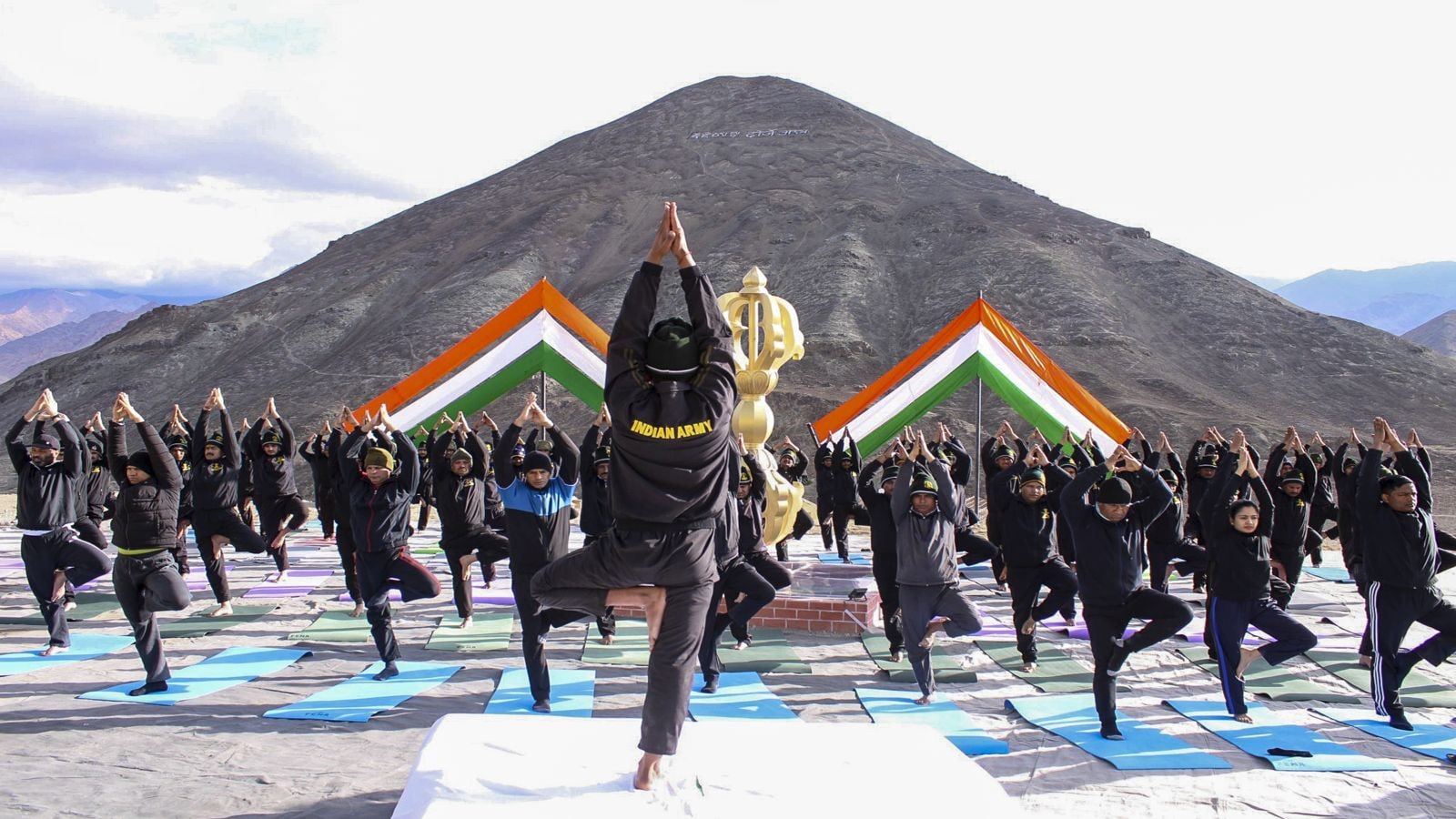
From Tokyo, the morning light travels westward, waking up different time zones, each hitting the same collective pause button. In India, the scale is dizzying. The event has grown from its inception over a decade ago into an architectural marvel of human bodies.
Look at the images from Chandigarh or the banks of the Ganges in Rishikesh. The human mind craves order amidst chaos. The symmetry of thousands of people moving into a warrior pose simultaneously creates a strange, comforting geometry.
But why does this collective movement matter? Behavioral psychologists have long studied the concept of collective effervescence—the synchronized energy that happens when humans gather for a singular, shared purpose. It is what makes a concert feel transcendent or a stadium chant vibrate in your chest. In a lonely era characterized by digital isolation, moving your body in perfect synchronization with a stranger next to you builds an unspoken trust. You are breathing the same air. You are struggling with the same balance.
The ancient texts called this sangat—the company of the truth-seekers. Today, we just call it community.
Dismantling the Myth of Flexibility
There is a common misconception that keeps people on the sidelines of this global movement. We have been conditioned by social media algorithms to believe that yoga is the exclusive domain of the hyper-flexible, the affluent, and the serene. We see images of people contorting their bodies into impossible shapes against pristine beach backdrops and we think, That is not for me.
That is a lie.
The true practice has nothing to do with touching your toes. It is about what you learn on the way down. When you bend forward and find yourself staring at your own knees, face-to-face with your tight hamstrings and your racing thoughts, you are forced to confront your limitations. You learn to breathe through discomfort.
This is the hidden utility of the practice. The mat is a laboratory for how you handle stress. If you can stay calm while your thigh burns in a prolonged lunge, you are training your nervous system to stay calm when your boss screams at you, or when the bills pile up, or when life catches you completely off guard.
The Westward Shift
As the sun moves across Europe and eventually hits the Americas, the expression of the day changes flavor, but the core remains identical. In Paris, mats are unrolled under the shadow of the Eiffel Tower. In New York, Times Square transforms from a neon-lit capitalist hive into a sea of stillness.
The contrast is striking. Neon billboards flashing advertisements for consumer goods tower over thousands of people sitting with their eyes closed, focusing entirely on the internal landscape. It is the ultimate juxtaposition of our time: the loud external world demanding our attention and our dollars, versus the quiet internal voice demanding our awareness.
This global relay race of mindfulness proves that our anxieties are universal. A college student in New York, a mother in Nairobi, and a corporate worker in Tokyo are all carrying different versions of the exact same burden. We are all overstimulated. We are all tired.
The Physics of Stillness
We live in a culture that worships momentum. We are told to grind, to optimize, to scale, and to hustle. Stillness is often viewed as laziness, a waste of precious billable hours.
But physics teaches us that balance requires a counterweight. Without a deliberate pause, the momentum of modern life eventually leads to a crash. The international celebration of this day is a recognition of that physical law on a global scale. It is the world collectively pulling the emergency brake, if only for an hour.
The true test of the day does not happen while you are on the mat. The real challenge begins the moment the session ends, the mats are rolled up, and the smartphones are turned back on. The peace achieved in a quiet room is fragile. The peace maintained in the middle of a traffic jam is real.
As the sun finally sets on June 21, the global wave of movement comes to an end. The parks empty out. The streets return to their normal, noisy rhythms. The trucks in Delhi honk again. The Tokyo subways fill up.
But look closely at the people walking back into the chaos. Notice the slight drop in their shoulders. Watch the way they walk—a fraction of a second slower, their feet planting a bit more firmly on the pavement. The world hasn't changed. The problems are still there, waiting. But the people facing them are just a little bit more grounded, anchored by a single, shared breath that echoed around the earth.