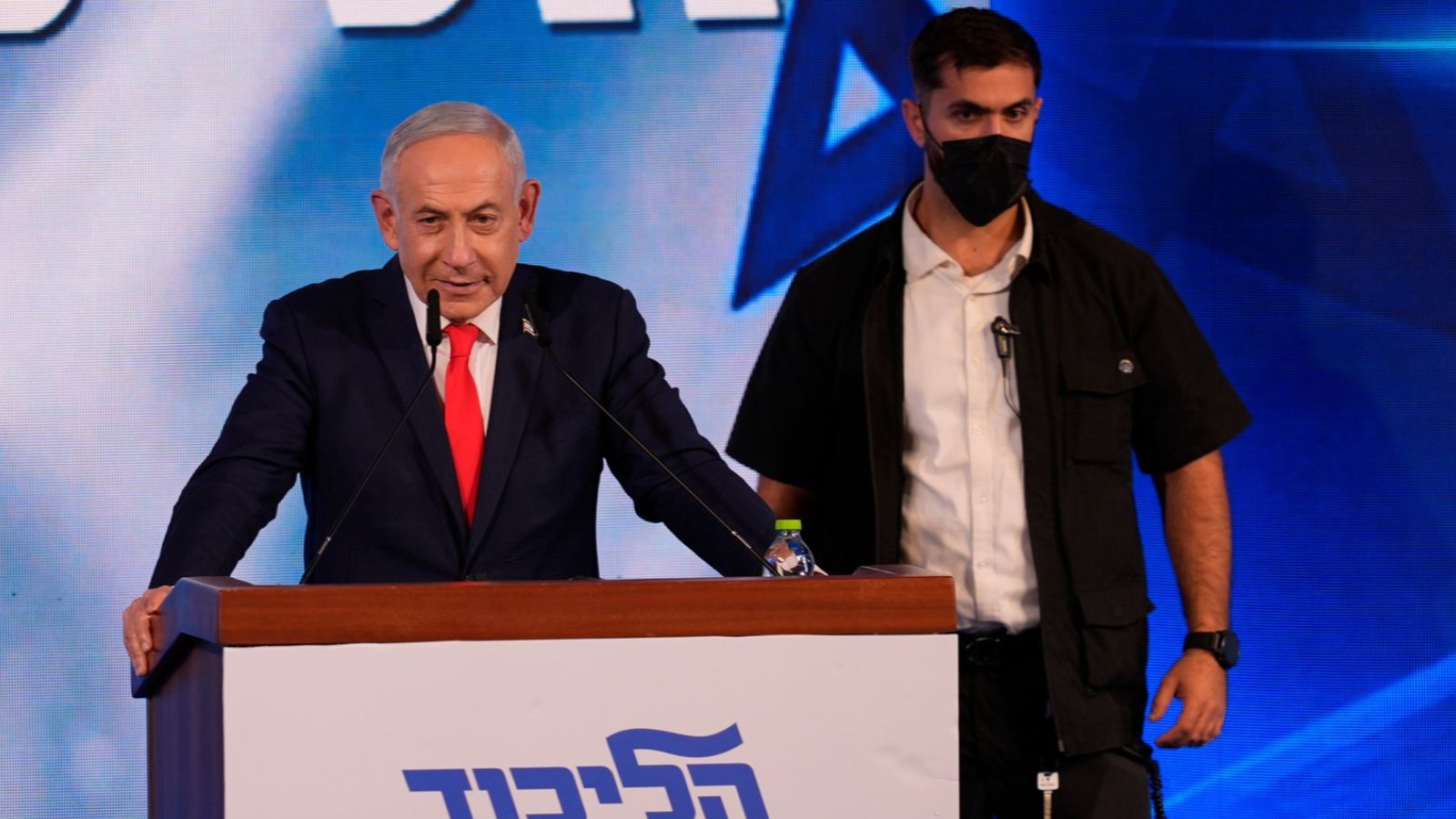
The post-election crisis triggered by Benjamin Netanyahu’s allegations of widespread fraud among Arab-Israeli voters is not an isolated dispute over ballot integrity; it is a calculated coalition-blocking maneuver designed to alter the game-theoretic equilibrium of Knesset formation. Following the October 27, 2026 parliamentary election, the pro-Netanyahu bloc secured 53 seats in the 120-member Knesset, falling eight seats short of a governing majority, while Gadi Eisenkot’s opposition bloc captured 48 seats. The remaining 19 seats went to Arab-majority parties—the Joint List and Ra’am—placing them in the decisive kingmaker position. Standard journalistic coverage treats Netanyahu’s claims of "stolen" votes and official rebuttals as a linear sequence of political rhetoric and fact-checking. An operational analysis reveals a dual-track strategy: weaponizing institutional friction to delay government formation while imposing prohibitive reputational costs on Zionist opposition parties considering legislative cooperation with Arab lawmakers.
The Arithmetic of Parliamentary Deadlock
To understand the strategic necessity of the fraud narrative, one must examine the structural math of the 26th Knesset. Under Israel’s pure proportional representation system with a 3.25% electoral threshold, parliamentary control requires an absolute majority of 61 seats.
The October 27 vote produced an asymmetrical stalemate driven by a surge in demographic mobilization:
- Overall Turnout: Reached 77.7%, the highest national participation rate since 1999.
- Arab Sector Turnout: Surged to 80%, outpacing the national average in a demographic segment representing 21% of Israel’s population of over 10 million.
- Seat Allocation: Netanyahu’s coalition won 53 seats (with Likud taking 27), Eisenkot’s bloc won 48 seats, and Arab parties doubled their representation to 19 seats.
This distribution created a binary political reality. Netanyahu lacked a viable path to 61 seats without defecting lawmakers from Eisenkot’s camp. Conversely, Eisenkot could assemble a blocking majority—or a minority government supported from the outside—only by relying on the 19 seats held by the Joint List and Ra’am. Because the numerical deficit could not be overcome through standard coalition horse-trading, the incumbent bloc shifted the battlefield from seat arithmetic to the legitimacy of the underlying votes.
The Three Pillars of the Delegitimization Strategy
Investigative reporting by Israeli public broadcaster KAN and testimonies from polling officials indicate that the campaign was neither spontaneous nor reactive. It operated through three distinct operational mechanisms prepared weeks prior to election day.
1. Pre-Emptive Narrative Seeding and Volume Filing
Rather than waiting for statistical anomalies to emerge during vote tabulation, Likud operationalized a high-volume complaint architecture. Thousands of party observers deployed to polling stations across Arab municipalities filed approximately 1,280 formal complaints on election day. In electoral administration, flooding the zone with complaints serves a dual purpose: it creates an immediate perception of systemic chaos in real-time media cycles, and it forces oversight bodies to allocate finite investigative bandwidth to processing bulk submissions rather than certifying results.
2. Escalation from Local Bribery to Foreign Subversion
The allegations followed a deliberate escalation ladder designed to move the issue out of the jurisdiction of standard election administrators and into the domain of national security:
- Tactical Irregularities: Initial claims focused on localized misconduct, such as cash-stuffed envelopes, shopping vouchers distributed in cities like Rahat, and voter intimidation.
- Technological Manipulation: Subsequent statements alleged the deployment of illegal voter mobilization software to artificially inflate turnout.
- Geopolitical Interference: The narrative culminated in accusations that hostile foreign actors—specifically implicating Qatar without formal evidentiary backing—financed a covert operation to take over the Knesset.
By framing domestic political participation as foreign-backed subversion, the rhetoric sought to transform a routine partisan dispute into an existential security threat.
3. Imposing a Coalition Veto via Reputational Taxation
The primary target of this messaging was not the Central Elections Committee, which possesses strict evidentiary standards, but rather the right-leaning factions within Eisenkot’s opposition bloc. Likud’s messaging explicitly linked the fraud allegations to coalition viability, asserting that no Zionist party could ethically or safely partner with Ra’am or the Joint List to replace the Knesset speaker or form a government. This imposes a severe reputational tax on centrist and right-wing opposition leaders, forcing them to defend the loyalty of their prospective legislative partners before negotiations can even begin.
Institutional Friction and Empirical Verification
When subjected to formal institutional audit, the fraud narrative collapsed under the weight of Israel’s multi-layered electoral verification system. Unlike jurisdictions where political actors can indefinitely litigate outcomes without procedural finality, Israel’s statutory framework separates political claims from administrative certification.
The Central Elections Committee (CEC), chaired by a Supreme Court justice and populated by representatives from across the political spectrum, evaluated the 1,280 complaints alongside intelligence assessments from the Shin Bet (Israel Security Agency) and the Israel Police. The findings dismantled the core premises of the stolen-election thesis:
- Absence of Systemic Impact: Following consultations with the Shin Bet, the CEC formally announced that there was zero evidence of voter bribery or irregularities on a scale capable of altering seat allocations. On November 4, 2026, the committee certified the final results and transmitted them to President Isaac Herzog, stating that the outcome was legally binding.
- Explanation of Turnout Variance: Statisticians and municipal officials, including Rahat Mayor Talal al-Krenawi, pointed out that the 80% turnout in Arab communities reflected high-efficiency grassroots mobilization and unified political messaging rather than illicit coercion. In proportional systems, a unified slate or coordinated campaign frequently triggers rapid turnout elasticity among previously disillusioned demographics.
- Institutional Pushback Against Weaponization: The investigative apparatus itself became a point of legal contention. Reports surfaced that Shin Bet leadership, headed by Netanyahu associate David Zini, sought to question Arab party leaders over fraud suspicions, while police in the Negev interrogated residents regarding their voting preferences. Israel’s Attorney General intervened on November 16, ordering the police to freeze their localized probe and initiating a broader review into potential improper communications between the Prime Minister’s Office and law enforcement agencies leading up to election day.
Limitations of the Institutional Defense
While the CEC’s certification neutralized the legal threat to the election results, institutional verification has structural blind spots when confronting asymmetric information warfare. Certifying the vote does not erase the political utility of the narrative for three reasons:
- Asymmetry of Proof: Proving a negative across thousands of ballot boxes requires exhaustive administrative labor, whereas manufacturing suspicion requires only a viral social media post—such as Netanyahu’s claim that "They stole the election in Israel," which garnered over 1.2 million views within hours.
- Erosion of Baseline Trust: Even after official bodies reject fraud claims, repeated assertions of systemic corruption depress long-term public confidence in democratic institutions, creating a polarized environment where future electoral losses are automatically contested.
- Vulnerability of Law Enforcement Boundaries: The Attorney General’s freeze on police inquiries highlights how close the executive branch came to utilizing state security organs to validate partisan narratives. If security agencies are perceived as responsive to executive pressure during coalition negotiations, their credibility as neutral arbiters deteriorates permanently.
Strategic Trajectory for Government Formation
With the Central Elections Committee’s certification complete and President Herzog’s November 8 mandate handed to Gadi Eisenkot to form a government, the tactical window for overturning the October 27 results through administrative challenges has closed. However, the delegitimization campaign will dictate the mechanics of the upcoming legislative session.
Eisenkot’s coalition-building strategy must account for the fact that the fraud narrative has successfully hardened the ideological boundaries around the 19 Arab seats. To construct a functional majority without triggering immediate defections from right-wing members of his own bloc, Eisenkot cannot pursue a conventional, fully integrated coalition with the Joint List and Ra’am. Instead, the optimal path forward requires decoupling legislative survival from formal cabinet membership: securing external parliamentary backing from the Arab parties to install a new Knesset speaker and pass a narrow confidence vote, while restricting formal ministerial portfolios to Zionist parties. Simultaneously, the incoming coalition must codify statutory firewalls between the Prime Minister’s Office, the Israel Police, and the Shin Bet during election cycles to prevent executive-branch interference in future electoral audits. If Eisenkot fails to execute this two-tiered governance model within his statutory mandate window, Israel will default into a sixth consecutive cycle of parliamentary paralysis, achieving Netanyahu’s secondary objective of denying his rivals a stable governing platform.
For further context on the initial claims and intelligence agency involvement immediately following the vote, watch Netanyahu accuses Israel's Arab parties of 'stealing the vote'.