Silence.
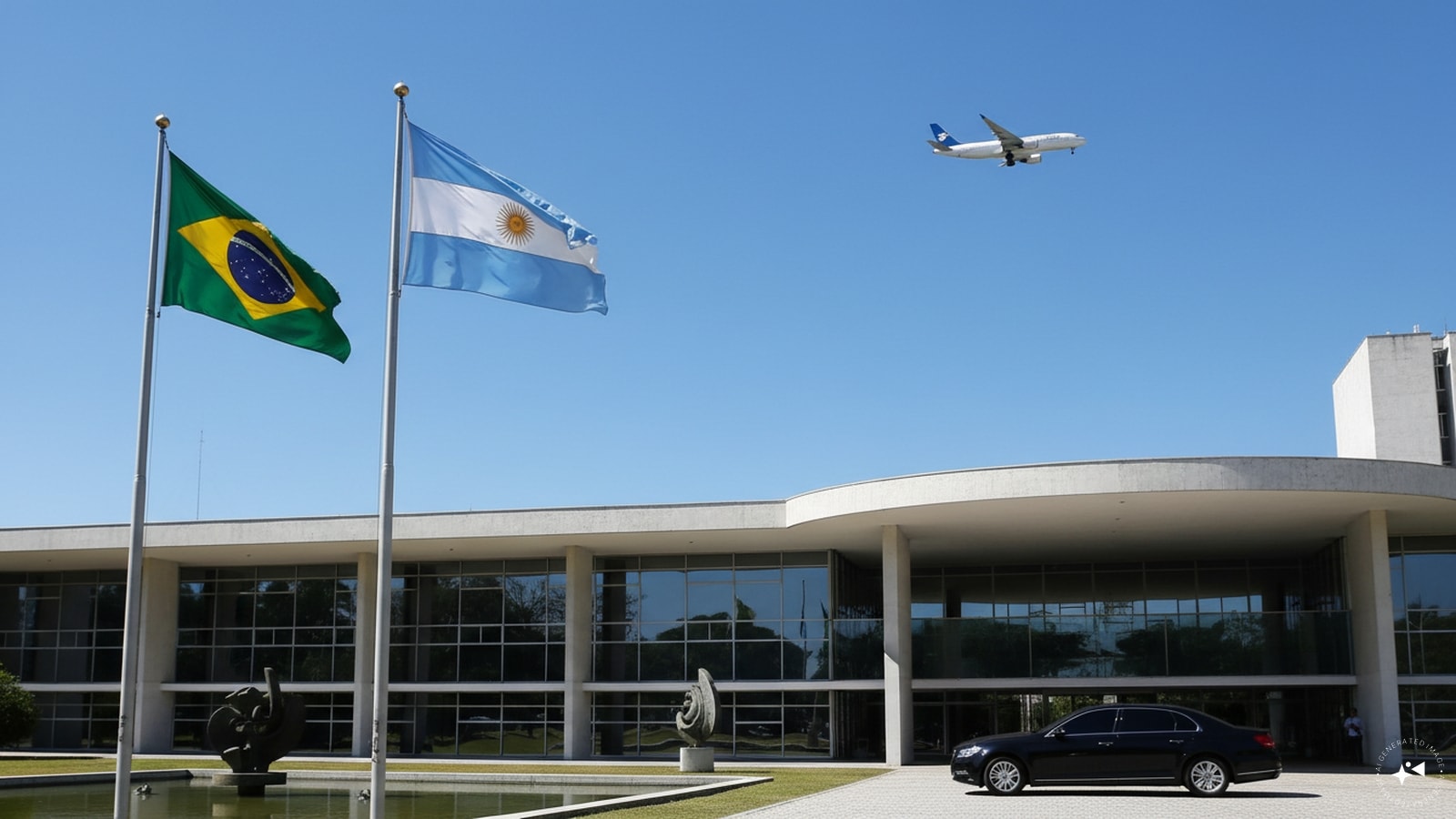
In the world of international diplomacy, silence is rarely peaceful; it is usually the heavy, suffocating pause right before a door slams shut, and in Brasília, the quiet inside the Itamaraty Palace felt thick enough to choke on when news broke that former Brazilian President Jair Bolsonaro had slipped out of the country, crossed into Argentina, and boarded a flight to the United States.
To understand why a single airline ticket caused a diplomatic tremor across the entire southern cone of South America, you have to stop looking at maps and start looking at living rooms. Consider a hypothetical family in São Paulo—let’s call them the Silvas—sitting around a dinner table where politics has become the uninvited guest that ruins every Sunday meal. For years, the Silvas have lived inside a country split straight down the middle, where the simple act of wearing a yellow soccer jersey became a political declaration, and where the faith in democratic institutions was tested to its absolute breaking point. When the news alerts flashed across their phones—reporting that Brazil’s Foreign Ministry had formally summoned Argentina’s top diplomatic representative in Brasília—the Silvas didn't see an abstract legal maneuver. They felt the familiar, cold knot in their stomachs, the one that asks whether the rules that hold a society together actually apply to the people who once sat at the very top.
The facts, stripped down to their barest diplomatic bones, read like a cold wire dispatch, yet every detail carries a sharp edge. According to reports from international news agencies and statements from Brazilian officials, Brazil’s Ministry of Foreign Affairs took the formal, pointed step of summoning the Argentine chargé d’affaires—or representative—to demand explanations regarding how Bolsonaro traveled through Argentina on his way to the United States. In the rigid choreography of statecraft, summoning a foreign envoy is the equivalent of calling a neighbor onto the front porch to ask why they let someone climb over the shared fence in the middle of the night. It is a calculated expression of displeasure, designed to signal that trust has been bruised and that answers are no longer optional.
The Architecture of a Departure
To grasp why this journey provoked such immediate friction between two nations that share a 1,200-kilometer border and decades of intertwined history, you have to look at the legal gravity surrounding Bolsonaro in Brazil. Following the turbulent aftermath of the 2022 presidential election and the January 8, 2023 riots in Brasília—where thousands of demonstrators stormed and vandalized Congress, the Supreme Court, and the presidential palace—Brazilian authorities launched sweeping investigations into allegations of coup plotting, democratic subversion, and institutional interference. As part of those judicial proceedings, Brazil’s Supreme Federal Court had ordered the confiscation of Bolsonaro’s passport, legally restricting him from leaving the country while investigators pieced together the events surrounding the post-election crisis.
A confiscated passport is supposed to be an anchor. It is the state’s physical way of saying, You stay here until the questions are answered.
Yet borders in South America are porous, shaped as much by regional integration agreements like Mercosur as by rivers and highways. Citizens of Mercosur member states—including Brazil and Argentina—can routinely cross between neighboring countries using only their national identity cards, bypassing the need for a passport at land crossings. Think of that system like an unlocked side door between two adjoining houses, built on the assumption that both homeowners share the same rules about who is allowed to walk through. For ordinary families visiting relatives, truckers hauling grain, or tourists heading to the waterfalls at Iguazú, that open door is a triumph of regional cooperation. When used by a high-profile political figure facing severe judicial restrictions at home, however, that same unlocked door suddenly turns into a geopolitical flashpoint.
From the perspective of President Luiz Inácio Lula da Silva’s administration in Brasília, the central question wasn't merely how Bolsonaro reached Argentine soil, but what Argentine authorities knew, when they knew it, and whether any official assistance, oversight, or quiet accommodation smoothed his path toward an international departure to the United States. Brazilian judicial and executive officials have consistently maintained that accountability for the January 8 attacks and related investigations is essential to safeguarding the country's democratic order. To see the central figure of those inquiries bypass a court-imposed travel ban via a neighboring capital struck directly at the credibility of Brazil’s legal institutions.
Two Capitals, Two Worldviews
If you stand on the banks of the Río de la Plata in Buenos Aires, the view looks dramatically different. Politics in South America rarely moves in a straight line; it swings like a pendulum, and when Argentina elected libertarian outsider Javier Milei, the ideological alignment between Brasília and Buenos Aires shifted overnight from cautious partnership to sharp philosophical contrast. Milei, who has frequently expressed ideological affinity with Bolsonaro and sharp criticism of Lula’s left-wing government, entered office promising to upend traditional diplomatic conventions alongside Argentina's struggling economy.
That ideological divide matters because diplomacy runs on personal chemistry almost as much as it runs on treaties. When two leaders share a worldview, a border complication gets resolved with a quiet phone call between ministers before the press ever catches wind of it. When two leaders view each other with deep political skepticism, every ambiguity becomes a potential provocation.
According to diplomatic observers and regional press accounts, Argentine officials faced a delicate balancing act once Bolsonaro’s transit became public. On one hand, Argentina’s government has emphasized respect for individual movement and legal formalities, noting that under regional travel rules, entering Argentina with a valid national ID does not automatically trigger an international arrest warrant unless an Interpol red notice is active. On the other hand, Buenos Aires cannot afford a full-scale rupture with Brazil, which remains Argentina’s largest trading partner and an indispensable economic lifeline at a moment when Argentina is fighting to stabilize its currency and attract foreign investment.
Consider what happens next when ideology collides with economics. A soybean farmer in Córdoba or an auto parts manufacturer in São Bernardo do Campo does not care about diplomatic protocol, yet their livelihoods depend entirely on the smooth flow of trucks across the Uruguaiana bridge. Every time an envoy is summoned to the Itamaraty Palace, business leaders across both countries hold their breath, wondering whether political friction will spill over into trade delays, stalled energy agreements, or frozen Mercosur negotiations.
Why the United States Remains the Magnet
There is also a deeper, familiar rhythm to Bolsonaro’s destination. The United States—specifically Florida—has long served as a gravitational center for Latin American political figures seeking distance from domestic storms, sympathetic audiences, or temporary breathing room away from local courts. Bolsonaro himself spent months in Orlando following the end of his presidential term, living in a gated community where supporters gathered outside to take selfies while legal pressures mounted back home in Brasília.
For his critics in Brazil, that pattern looks like evasion—a way of placing physical and jurisdictional distance between a former head of state and the magistrates examining his actions. Legal analysts in Brasília point out that while an extradition request is a complex, slow-moving process governed by bilateral treaties and strict dual-criminality standards, simply being on U.S. soil changes the tempo of any investigation. Subpoenas take longer. Hearings become complicated. Political narratives shift from the courtroom to international media interviews.
For Bolsonaro’s supporters, however, the story reads in the exact opposite direction. In their view—voiced repeatedly by allied lawmakers in Brazil’s Congress and conservative commentators across the region—the judicial restrictions placed on the former president represent political persecution by an overreaching judiciary aligned with his political rivals. To them, leaving the country is not an admission of guilt, but an act of self-preservation by a leader who believes he cannot receive an impartial hearing inside Brazil’s current institutional climate.
I remember talking to a retired schoolteacher in Belo Horizonte during the height of Brazil’s post-election turmoil, standing under a scorching afternoon sun outside a neighborhood bakery. She wasn't a party activist or a pundit; she was just tired. She told me that the hardest part of living through relentless political crisis isn't choosing a side—it’s the exhaustion of never knowing whether the ground beneath your feet is solid. When one half of the country sees a fugitive dodging justice and the other half sees a martyr escaping persecution, the truth itself feels like it has been split into two irreconcilable realities.
The Invisible Stakes of the Summons
It is easy to dismiss a diplomatic summons as theater—a formal scolding that produces headlines for forty-eight hours before fading behind the next news cycle. That would be a mistake.
In international relations, precedent is everything. South America has spent decades building a regional framework designed to protect democratic stability, rooted in the painful memory of twentieth-century military dictatorships where borders were either militarized or used selectively to shield allies and hunt dissidents. Treaties like the Ushuaia Protocol on Democratic Commitment in Mercosur were created specifically to ensure that neighboring democracies would reinforce, rather than undermine, one another's constitutional order.
When Brazil summons Argentina’s representative over Bolsonaro’s transit to the United States, Brasília is testing whether those shared institutional guardrails still hold when political loyalties pull in opposite directions. If a former leader under judicial restriction can quietly cross a Mercosur border using an identity card and board an intercontinental flight without bilateral coordination, what does that mean for future investigations across the region? How do courts enforce travel bans in an era of integrated borders and polarized governments?
At the same time, Washington finds itself pulled quietly into the frame. While the U.S. government routinely emphasizes respect for the rule of law and democratic institutions in Brazil—having swiftly condemned the January 8 riots when they occurred—immigration status and visa rules operate under specific legal criteria that do not automatically mirror foreign domestic travel restrictions unless formal international warrants are filed. That leaves American diplomats walking a familiar tightrope: maintaining strong institutional ties with Lula’s government in Brasília without turning U.S. immigration policy into an instrument of another country’s domestic political battles.
What Lingers After the Headlines Fade
Strip away the diplomatic titles, the airport manifests, and the press briefings, and what remains is a deeply human test of trust.
Across Latin America, millions of ordinary citizens are watching closely to see whether democratic accountability is a genuine principle or merely a slogan that bends whenever power, borders, and ideology intersect. In Brasília, prosecutors and Supreme Court justices must decide how to respond legally to a departure that bypassed their explicit orders. In Buenos Aires, diplomats must repair a sudden chill with their most vital neighbor without alienating their own domestic political base. And in living rooms like the Silvas' in São Paulo, families are left staring at their screens, waiting to see if the rules that govern everyone else still reach the people who once held the highest office in the land.
The plane has already landed thousands of miles away, yet the empty seat at the border checkpoint remains—a quiet, stubborn reminder that in politics, no one ever truly leaves the room without shaking the walls behind them.