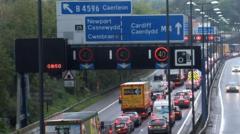
The persistent traffic bottleneck on the M4 corridor around the Brynglas Tunnels in Newport represents a foundational failure in macroeconomic infrastructure planning. When First Minister Rhun ap Iorwerth asserts that the solution to this systemic economic drag must be roads-based, the political discourse inevitably defaults to a binary debate between environmental preservation and asphalt expansion. This framework misses the structural mechanics of traffic flow, the mathematics of throughput constraints, and the economic principle of induced demand.
Resolving the M4 crisis requires shifting from political rhetoric to microeconomic and geometric engineering principles. The core issue is not simply that too many cars exist; it is that a critical international freight arterial is forced to intermix with localized urban commuting networks within a severely restricted physical bottleneck.
The Microeconomics of the Brynglas Bottleneck
To accurately diagnose why the M4 fails daily at Newport, the infrastructure must be analyzed through a capacities and constraints framework. The primary structural failure is a severe reduction in design capacity.
The Geometric Funnel Effect
The M4 across South Wales is predominantly a three-lane dual motorway designed to handle sustained high-velocity throughput. At the Brynglas Tunnels, this infrastructure abruptly constricts to a two-lane configuration.
[M4 Westbound: 3 Lanes] ---> \  [Brynglas Tunnels: 2 Lanes]  / ---> [M4 Westbound: 3 Lanes]
                             |========= BOTTLENECK =========|
[M4 Eastbound: 3 Lanes] <--- /                              \ <--- [M4 Eastbound: 3 Lanes]
In fluid dynamics and traffic flow theory, this creates a classic funnel bottleneck. The fundamental equation governing highway capacity states:
$$Q = K \times V$$
Where:
- $Q$ is the traffic flow (vehicles per hour)
- $K$ is the traffic density (vehicles per kilometer)
- $V$ is the space-mean speed
When three lanes of traffic traveling at 70 mph ($V$) are forced into two lanes, the density ($K$) instantly surpasses critical thresholds. As density peaks, drivers execute reactionary braking maneuvers. This triggers a backward-traveling shockwave—a phenomenon known as a phantom traffic jam—which propagates miles upstream, dropping the effective flow ($Q$) significantly below the road's theoretical capacity.
The Mixing of Conflicting Traffic Demands
The second structural failure is the failure to segregate macro-regional freight from micro-regional commuter traffic. The M4 serves two entirely distinct economic functions simultaneously:
- Long-Distance Transit: Serving as the primary economic artery connecting West Wales, the container ports of Milford Haven, and the capital city of Cardiff to Bristol, London, and the English Midlands.
- Localized Commuting: Functioning as a de facto internal bypass for Newport, where local drivers enter at Junction 26 and exit at Junction 25a or 27 to navigate the city.
When international heavy goods vehicles (HGVs) sharing the road with local commuters are forced into a two-lane tunnel, the system loses its elasticity. HGVs have slower acceleration profiles and larger safety headways. Mixing these vehicles with short-trip commuter traffic during peak hours drastically increases variance in speed, destroying laminar traffic flow and causing systemic breakdown.
Deconstructing the Failure Modes of Past Proposals
Political paralysis over the M4 stems from evaluating infrastructure options on ideological rather than engineering merits. Every proposed solution features specific structural limitations that must be quantified.
The M4 Relief Road (The Black Route)
The historic "Black Route"—a proposed £1.6 billion, 14-mile, six-lane motorway built south of Newport across the Gwent Levels—was rejected primarily due to environmental impact and capital cost. However, its core structural flaw relates to the economic principle of induced demand.
According to the fundamental law of highway congestion, adding new lane capacity matches an equivalent increase in vehicle-miles traveled (VMT). In the short term, a new motorway reduces the generalized cost of travel (time and friction). This cost reduction alters commuter behavior across four distinct phases:
- Route Switching: Drivers divert from local A-roads back to the motorway.
- Time Shift: Drivers who previously avoided peak hours alter their schedules to travel during peak congestion windows.
- Mode Switching: Public transport users revert to private vehicle usage due to perceived speed improvements.
- Land-Use Changes: Over a 5-to-10-year horizon, residential and commercial developers build car-dependent infrastructure along the new corridor, entirely consuming the newly created capacity and returning the system to its original equilibrium of congestion.
The Public Transport Alternative (The Burns Commission Blueprint)
Following the cancellation of the Black Route, subsequent strategies focused heavily on rail electrification, active travel, and the proposal of five new mainline rail stations between Cardiff and the Severn Tunnel Junction.
While public transport investments are vital for regional decarbonization, treating them as a direct replacement for motorway capacity relies on a flawed assumption of modal elasticity. For rail or bus networks to meaningfully alleviate motorway congestion, the cross-elasticity of demand between driving and transit must be highly elastic.
In South Wales, this relationship is weak. A significant proportion of M4 traffic consists of commercial logistics, freight, and multi-destination business trips that cannot shift to fixed-line rail infrastructure. A multi-passenger train may remove commuters from the highway, but it cannot accommodate a fleet of logistics vehicles delivering goods from midlands distribution centers to West Wales ports. Public transport serves as a parallel system; it does not resolve the structural geometric constraints of the physical motorway.
The Strategic Framework for a Roads-Based Solution
First Minister Rhun ap Iorwerth’s pivot back toward a roads-based solution requires a strategy that avoids the environmental destruction of the Black Route while bypassing the capacity limitations of the existing network. To achieve this, investment must focus on the Blue Route or an optimized Dual-Network Hybrid Model.
The Blue Route Methodology
The Blue Route strategy involves upgrading the existing local road network—specifically the Southern Distributor Road (SDR) in Newport and the old A40—into a grade-separated, free-flowing dual carriageway.
              [Existing M4 Corridor]
            (Dedicated to Long-Distance / Freight)
              /                        \
             /                          \
[M4 West] --                             -- [M4 East]
             \                          /
              \                        /
             [Upgraded SDR / Blue Route]
            (Dedicated to Local Commuters)
The engineering objective here is not to build a massive new superhighway, but to execute structural separation of traffic demands.
By upgrading the SDR to eliminate roundabouts and replacing them with flyovers or underpasses, planners can create a parallel express corridor. The strategic play is to redirect local, short-journey commuters off the M4 entirely. If Junctions 24 through 28 of the M4 can be relieved of internal city traffic, the existing two lanes through the Brynglas Tunnels will possess sufficient capacity to handle long-distance freight and regional transit without triggering the critical density thresholds that cause flow breakdown.
Hard Engineering Interventions at Brynglas
Alongside a secondary route network, the physical parameters of the existing tunnels require tactical optimization. Because widening the existing tunnels is financially and structurally prohibitive, two optimization interventions must be deployed:
- Active Variable Speed Limit (VSL) Automation: Implementing radar-driven, dynamic speed zoning upstream of the tunnels. By lowering the speed limit from 70 mph to 50 mph or 40 mph as traffic density climbs, the variance in speed between vehicles is minimized. This maintains a steady, laminar flow, prevents the rapid braking cycles that trigger shockwave delays, and maximizes vehicle throughput ($Q$) through the restricted space.
- Acoustic and Visual Optimization: Tunnels inherently cause drivers to decelerate due to perceived environmental confinement. Upgrading internal lighting arrays to high-output LED systems and improving lane delineation markings mitigates this psychological braking effect, maintaining speed consistency precisely at the bottleneck's entry point.
Operational Risk Matrix of Infrastructure Deployment
Any strategy selected by the Welsh Government carries distinct operational trade-offs and structural limitations.
| Strategy Option | Capital Expenditure | Implementation Horizon | Primary Failure Mode | Risk Mitigation Protocol |
|---|---|---|---|---|
| Blue Route / SDR Upgrade | Moderate (£300m - £500m) | 3 - 5 Years | Localized urban disruption during construction phases. | Phased night-shift engineering schedules to preserve daytime corridor utility. |
| Smart Motorway / VSL Integration | Low (£20m - £500m) | 1 - 2 Years | Public non-compliance and marginal capacity gains during extreme peaks. | Automated camera enforcement linked directly to variable speed gantries. |
| Rail / Bus Rapid Transit Matrix | High (£1b+ via UK Rail Allocations) | 7 - 10 Years | Low modal shift conversion rate among commercial freight users. | Coordinate timetables directly with major employment hubs to maximize commuter abstraction. |
The Strategic Play
To break the multi-decade infrastructure deadlock, policy must abandon the pursuit of a singular macro-project. The optimal strategic play is the immediate implementation of a Two-Platform Separation Framework.
The Welsh Government must first deploy targeted road infrastructure upgrades to the Newport Southern Distributor Road to convert it into a free-flowing, grade-separated route. This must be explicitly designated and signed as the primary commuter channel for local traffic. Concurrently, the existing M4 Brynglas corridor must be optimized via automated variable speed systems to prioritize long-distance freight and inter-urban transit.
By decoupling localized commuter traffic from the international freight corridor, the network gains operational resilience without requiring the environmental destruction of a entirely new motorway footprint. This dual-track approach satisfies the economic demand for improved transit speeds while respecting the fiscal realities and legislative environmental constraints of modern infrastructure delivery.