Yorgos Lanthimos stands in the center of a soundstage, watching two grown men crawl on their bellies like beetles while making rhythmic clicking noises with their tongues. This is not a scene from the film. Not yet. It is a Tuesday morning, and the "silly games" have begun.
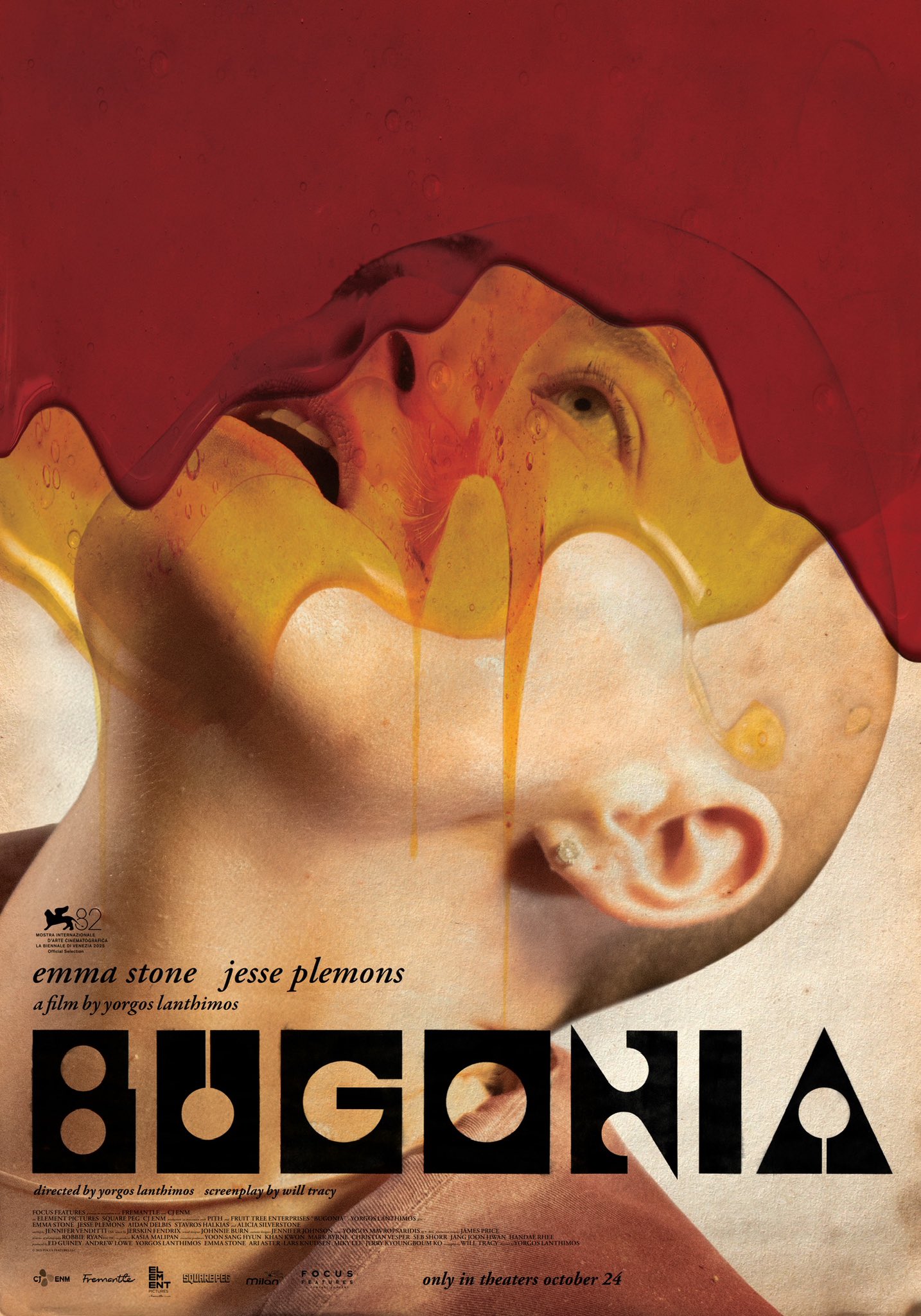
To the outside world, the production of Bugonia—a reimagining of the South Korean cult classic Save the Green Planet!—looks like a high-stakes gamble. You have a visionary Greek director known for clinical absurdity, a pair of Hollywood’s most magnetic stars in Emma Stone and Jesse Plemons, and a premise involving an eccentric beekeeper who kidnaps a pharmaceutical executive because he believes she is a scout for an impending alien invasion. On paper, it is a business transaction. In reality, it is a psychological experiment.
Most film sets are governed by the rigid hierarchy of the call sheet and the ticking clock of the union-mandated lunch break. They are places of profound stress, where every minute costs thousands of dollars and the air is thick with the ego of a hundred different artists trying to justify their paycheck. But a Lanthimos set operates on a different frequency. Before a single frame is shot, he strips away the armor of his actors. He doesn't want their "craft." He wants their embarrassment.
The Theater of the Absurdly Human
Imagine being Jesse Plemons. You are arguably the finest character actor of your generation. You have worked with Scorsese, Spielberg, and PTA. You arrive at rehearsals expecting to dive into the psyche of a paranoid, broken man. Instead, Yorgos asks you to play a game of "Human Knot" with Emma Stone and a grip you just met five minutes ago. You are tangled, sweating, and laughing because the situation is objectively ridiculous.
This is the secret sauce of Bugonia. These rehearsal games serve a singular, vital purpose: they kill the "actor's ego" before it can infect the performance. When you have already spent three hours jumping over furniture and pretending to be a hive-minded insect in front of your co-stars, you lose the ability to be self-conscious. You stop worrying about whether your hair looks right or if your delivery is "cool." You become a raw nerve.
The games are varied and seemingly nonsensical. There is the "Mirror Game," where two actors must mimic each other’s movements with such precision that a bystander cannot tell who is leading. There is the "Object Association," where a chair must be treated as a long-lost lover, then a deadly weapon, then a piece of rotten fruit. To a casual observer, it looks like a high-end kindergarten. To the actors, it is the only way to survive a script this strange.
The Stakes of the Beekeeper’s Basement
Why go to these lengths? Because Bugonia is a story about the fragility of truth. Plemons’ character isn't just a conspiracy theorist; he is a man drowning in a world that no longer makes sense to him. If the audience sees an actor pretending to be crazy, the movie fails. We have to see a human being who is so convinced of his own reality that the "silly" things he does—like wearing a makeshift space helmet or torturing a CEO—feel like the only logical moves left on the board.
The invisible stakes are the connection between the leads. Emma Stone and Plemons have developed a shorthand that feels almost telepathic. This isn't the result of "chemistry" in the traditional, sparkling Hollywood sense. It is the result of shared trauma from those rehearsal games. They have seen each other at their most vulnerable and foolish. When the cameras finally roll on a tense interrogation scene in a basement, that history is baked into the air. They aren't strangers playing parts; they are survivors of the Lanthimos gauntlet.
Consider the physical toll. Moving like a "bug"—the jerky, segmented transitions that define the movement language of the film—requires a level of body control that most people haven't used since childhood. It’s exhausting. It’s painful. It’s humiliating. But when you see Jesse Plemons tilt his head at a forty-five-degree angle, his eyes darting with the frantic energy of a threatened invertebrate, you realize the games weren't just for fun. They were the blueprint for a new kind of physical language.
The Pharmaceutical Alien and the Search for Meaning
The film centers on a kidnapped executive, the "alien" in the beekeeper's eyes. In the original Korean film, this role was a catalyst for a discussion on class warfare and the rot of capitalism. In Bugonia, under the lens of the "silly games" philosophy, it becomes something more intimate. It’s about the walls we build around ourselves to stay sane.
The executive, played with a sharp, brittle elegance, is the foil to the chaos. While the kidnappers are fluid, bug-like, and erratic, she is the image of rigid, corporate structure. The clash between these two energies provides the film’s friction. During production, the crew spoke of the "vibe shift" whenever the scene moved from the kidnappers' lair to the outside world. The lair felt like a playground where the rules of physics and social decorum had been suspended. The outside world felt cold, gray, and—strangely—less real.
This is the irony of the Lanthimos method. By leaning into the "silly," he uncovers a deeper, more uncomfortable truth about the human condition. We are all just performing. We all have our little rituals, our secret games, and our private conspiracies. Most of us just have the luxury of not being the protagonist of a dark sci-fi comedy.
Behind the Hive Mind
The production of Bugonia wasn't just about the actors. The "games" extended to the crew as well. Lanthimos creates an environment where the hierarchy is flattened. A cinematographer might be asked for their opinion on a costume; a prop master might suggest a change in the blocking. It’s a hive mind. Everyone is working toward a singular, strange vision that only one man truly understands, yet everyone feels a piece of.
There were days on set where the tension was so high that a single misplaced word could have shattered the atmosphere. On those days, Yorgos would call for a "reset." Not a camera reset, but a mental one. A quick game of tag. A round of "don't let the balloon touch the floor." It sounds like a gimmick. It sounds like something a "visionary" does to cultivate a persona. But watch the finished product. Watch the way the characters move with a freedom that is terrifying. You can't get that from a standard rehearsal. You can't get that from a "robust" production schedule.
You can only get it from play.
The true cost of Bugonia isn't the millions spent on sets or the high-priced talent. It’s the emotional exhaustion of living in that headspace for months. By the time the production wrapped, the line between the "silly games" and the "real work" had vanished entirely. The actors weren't "playing" bugs anymore. They had found the insect inside themselves—the part of the human brain that is twitchy, instinctual, and desperately trying to make sense of a world that feels increasingly alien.
The film serves as a mirror. As we watch Plemons and Stone spiral into their shared delusion, we are forced to ask: what games are we playing to keep the lights on? What "silly" beliefs do we cling to so we don't have to face the cold, hard vacuum of reality?
The beekeeper in the film believes the aliens are coming. Maybe he's right. Or maybe, in the basement of a house in the middle of nowhere, he’s found something much scarier than an extraterrestrial invasion. He’s found out that when you stop playing the world's games, you finally have to look at yourself.
The clicking of the tongues stops. The director smiles. The "silly games" are over for today, but the transformation is permanent.
Somewhere, in a darkened theater, an audience will soon sit in silence. They will see the jerky movements and hear the strange rhythms, and for a moment, they will forget they are watching a movie. They will feel the buzz of the hive. They will feel the itch of the exoskeleton. They will realize that the most human thing we can do is lose our minds together.
And that is the only game that matters.