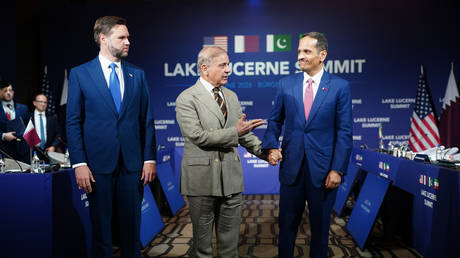
The room where a nation’s future is traded usually smells of bad coffee and stale adrenaline. For months, diplomats stare at draft papers across heavy wooden tables, tracking lines of text that determine whether a generation grows up in the shadow of conflict or under the fragile canopy of a truce. When Vice President J.D. Vance stood before a briefing microphone to outline the administration’s strategy on the U.S.–Iran negotiations, the headlines framed it as standard political theater. They called it a routine update on a "successful foundation."
But diplomacy is never routine. Behind the dry jargon of international relations lies a raw, deeply human calculus. Every concession made in a air-conditioned room in Geneva or Vienna ripples outward until it hits the kitchen table of an ordinary family. It affects a soldier packing a rucksack for a deployment they hoped would never happen. It affects a shopkeeper in Tehran watching the currency fluctuate like a erratic heartbeat.
To understand what Vance is actually building, we have to look past the podium. We have to look at how a decades-long stalemate is being quietly re-engineered, piece by painful piece.
The Ghost at the Table
Consider a hypothetical diplomat we will call Marcus. He has spent fifteen years in the foreign service, missing his daughter’s birthdays to sit in rooms where the air is thick with distrust. Marcus knows that when negotiating with Iran, you are never just talking to the officials across the table. You are negotiating with history. You are dealing with the legacy of the 1979 revolution, the collapsed 2015 nuclear deal, and a web of regional proxy conflicts that flare up in the dark.
For years, American foreign policy toward Tehran swung like a violent pendulum. One administration signed a sweeping agreement; the next tore it up. This lack of predictability created a dangerous vacuum.
The strategy Vance defended represents a departure from that cycle. Instead of chasing a single, grand bargain that risks collapsing under its own weight, the current approach focuses on a modular framework. Think of it as building a house on a fault line. You do not pour a massive, rigid concrete slab that will crack at the first tremor. You install flexible shock absorbers.
The "successful foundation" Vance referenced is precisely this shift toward incremental, verifiable benchmarks. It is an admission that trust is dead, and that verification is the only currency that matters.
The Arithmetic of Deterrence
Power talks, but leverage decides the conversation. The administration's current posture relies heavily on economic pressure, but with a specific tactical twist. Previous sanction regimes were often blunt instruments, designed to crush an economy wholesale in the hope that civil unrest would force a regime to change its behavior. History shows this rarely works out as planned. Instead, the elite insulate themselves, while ordinary citizens bear the brunt of the hardship.
The current framework narrows the focus. It targets specific supply chains, precision components, and the financial arteries that feed regional militias.
But pressure without an exit ramp is just a countdown to a explosion. The invisible stakes of these negotiations lie in defining what that exit ramp looks like. If Iran caps its uranium enrichment at a specific percentage, what exactly does it get in return? Not a blanket lifting of sanctions, but a calibrated, reversible release of frozen assets.
It is a grueling, unglamorous process. It lacks the drama of a historic summit or the definitive triumph of a treaty signing. It is a game of inches played out in the margins of intelligence briefings.
The View from the Border
To understand why this slow-motion diplomacy matters, you have to leave Washington and look at the map from the perspective of those who live on the jagged edges of the conflict.
Imagine a young radar operator stationed on a naval destroyer in the Persian Gulf. For her, the "successful foundation" Vance speaks of isn’t a talking point. It is the difference between a routine watch and a midnight alarm signaling an incoming drone strike. When negotiations stall, the temperature in the Gulf rises instantly. Speedboats buzz American warships; sea lanes grow hazardous; the margin for error shrinks to zero.
A single miscalculation by a twenty-two-year-old lieutenant on either side could trigger a chain reaction that no one actually wants. That is the real problem with a diplomatic vacuum. Without open lines of communication, an accident looks like an ambush.
By establishing a baseline of predictable reactions, the current framework attempts to take the volatility out of the equation. It sets clear, unspoken boundaries. If a proxy group crosses a line, the retaliation is swift and proportional, but it is accompanied by a clear message: We are still willing to talk, but this is the price of overstepping.
The Skeptic’s Ledger
It is easy to be cynical about these efforts, and frankly, a healthy dose of skepticism is justified. Skepticism keeps you alive in this business. Critics argue that any negotiation with a regime that openly calls for the destruction of American allies is an exercise in futility. They point to past violations, hidden facilities, and the regime’s ideological rigidity.
They are not entirely wrong. The subject is deeply volatile, and the path forward is riddled with traps.
But the alternative to negotiation is not a status quo; it is a steady drift toward an open confrontation that would reshape the global economy overnight. A full-scale conflict in the Middle East would send oil prices soaring, disrupt international shipping lanes, and cost thousands of lives. The current strategy recognizes that a flawed, highly transactional dialogue is infinitely preferable to a flawless catastrophe.
Vance’s remarks were not a declaration of victory. They were an defense of a process that is deliberately slow, calculatedly quiet, and intensely frustrating to those who want quick results or total capitulation.
The Unseen Horizon
True stability cannot be imported, and it cannot be enforced by a single superpower acting in isolation. The administration’s strategy hinges on drawing regional partners into the architecture of the agreement. For decades, Gulf states watched U.S.–Iran talks from the sidelines, deeply anxious that Washington would cut a deal that left them vulnerable.
By aligning current negotiations with regional security frameworks, the administration is attempting to create a multi-layered barrier against escalation. It is about convincing America's allies that their security is baked into the foundation of the deal, not treated as an afterthought.
The work goes on. Away from the television cameras and the political spin, the drafts will continue to be revised, the intelligence reports will be analyzed, and the quiet pressure will be maintained. The true success of this foundation will not be measured by a historic photograph of leaders shaking hands. It will be measured by the crises that never happen, the missiles that are never launched, and the quiet nights enjoyed by those who live on the front lines of a cold war that has managed to stay cold.