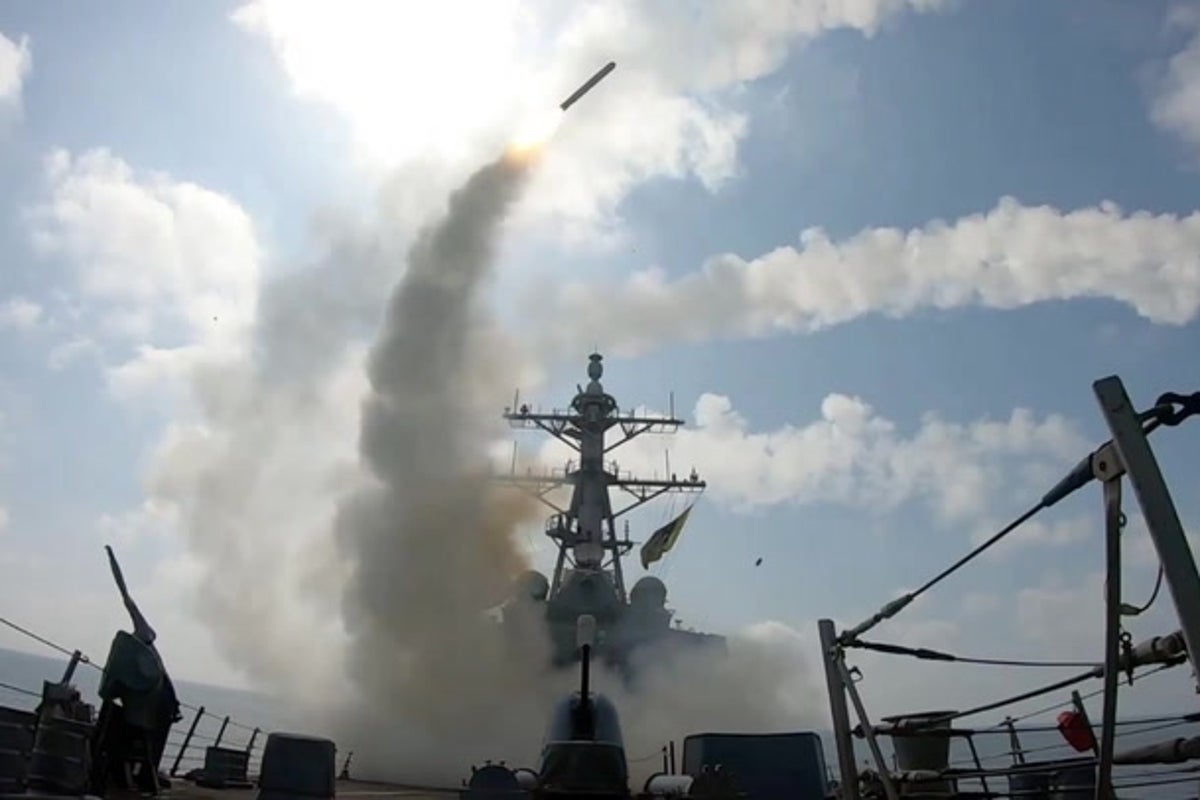
The footage is familiar, almost cinematic. A grainy night-vision sequence shows a F/A-18 Super Hornet screaming off the deck of a U.S. aircraft carrier, its afterburners carving a jagged hole in the darkness. Within hours, the Pentagon confirms the targets: drone storage sites, command nodes, and ballistic missile caches tied to Iranian-backed proxies. The video is meant to project power, but to those who have watched this cycle for decades, it signals something far more precarious. These strikes are no longer a deterrent. They are a maintenance cost.
For years, the U.S. Navy has operated under the assumption that the mere presence of a carrier strike group in the Persian Gulf or the Gulf of Aden would freeze regional adversaries in place. That assumption is dead. Recent kinetic engagements against Houthi rebels and various Iranian-aligned militias prove that the "big stick" of American naval aviation is being treated as a predictable variable rather than a terrifying ultimatum. By launching these strikes, the U.S. is participating in a high-stakes game of attrition where the math favors the cheaper, more numerous weapons of the insurgent. For another look, consider: this related article.
The Logistics of Asymmetric Failure
When a $70 million jet fires a $2 million missile to destroy a $20,000 drone made of plywood and lawnmower parts, the economic reality of the conflict shifts. We are burning through precision-guided munitions at a rate that the American industrial base cannot easily replenish. This is the "interceptor gap" that keeps naval planners awake at night.
The carrier is a marvel of engineering, but it is also a captive of its own complexity. To keep those planes in the air, thousands of sailors must work around the clock in some of the most dangerous environments on earth. The wear and tear on the airframes and the crews is immense. Meanwhile, the adversary simply needs to wait for a lapse in coverage or a lucky shot. They aren't trying to win a dogfight; they are trying to bankrupt the system of its readiness and its political will. Further reporting on the subject has been shared by The Washington Post.
The Myth of the Surgical Strike
Military spokespeople love the term "surgical strike." It implies a clean, clinical removal of a threat with no collateral baggage. The reality is messier. Every time a bomb drops from a U.S. aircraft, it serves as a recruitment poster for the very groups we are trying to suppress.
The targets hit in the latest round of footage were likely mobile. In the time it took to clear the strike through the chain of command, the most valuable assets—the high-ranking commanders and the sophisticated guidance systems—had probably been moved. What’s left are the shells and the low-level operators who are easily replaced. We are attacking the symptoms of Iranian influence while the source remains untouched and largely unbothered.
Why Iran Isn't Backing Down
Tehran has mastered the art of "gray zone" warfare. By using proxies, they maintain a degree of plausible deniability that prevents a direct, all-out war with the United States while still achieving their strategic goals. They want the U.S. out of the region, and they have realized they don't need to sink an aircraft carrier to make that happen. They just need to make staying too expensive and too politically volatile.
The recent video of the carrier launches was released to reassure the American public and regional allies. However, the intended audience in Tehran likely saw it as proof of American predictability. They know exactly how we respond. We fly the same patterns, use the same munitions, and issue the same warnings.
The Technological Evolution of the Proxy
The weapons being used against U.S. interests have evolved. We are no longer dealing with "insurgents" in the traditional sense. These are disciplined forces equipped with anti-ship cruise missiles and long-range suicide drones. They have spent years studying how the U.S. Navy operates.
They have learned that our defenses, while world-class, are finite. An Aegis destroyer can track hundreds of targets, but it only carries a certain number of interceptors. If you swarm the ship with enough cheap targets, eventually, one gets through. The carrier is the center of the bullseye, and the layers of protection around it are being tested more aggressively than at any point since World War II.
The Intelligence Gap
We see the video of the launch, but we never see the video of the intelligence failure. Investigative history shows that our understanding of what is happening on the ground in these strike zones is often flawed. We rely heavily on signals intelligence and satellite imagery, but the groups we are fighting have gone "dark," using runners and low-tech communication to avoid our ears.
When we strike a "command and control center," we are often hitting a building that was a command center three days ago. The disconnect between the high-tech sensors on a carrier and the low-tech reality on the ground creates a vacuum. We end up fighting the war we want to fight—one of screens and coordinates—rather than the war that is actually happening.
The Cost of Staying
The strain on the U.S. Navy’s fleet is reaching a breaking point. Carriers are being extended on deployments for months beyond their scheduled return dates. Maintenance periods are being pushed back, and the backlog at shipyards is growing.
- Personnel Burnout: Sailors are facing 9-month deployments with no port calls.
- Material Fatigue: Catapults and arresting gear are being used at rates far exceeding their design specifications.
- Strategic Distraction: Every carrier pinned down in the Middle East is a carrier that isn't in the Pacific, where the real long-term threat to American interests lies.
The optics of the aircraft carrier launch are impressive, but they hide a decaying strategic position. We are using a sledgehammer to swat flies, and the sledgehammer is starting to crack.
A Shift in Strategy
If the goal is truly to stop the flow of weapons and the attacks on shipping, the current model of carrier-based "tit-for-tat" strikes must be abandoned. It is a reactive posture that cedes the initiative to the enemy.
A hard-hitting alternative would involve a massive increase in maritime interdiction—stopping the ships carrying the parts before they ever reach the proxies. This is less "cinematic" than a night launch from a carrier, and it requires grueling, diplomatic, and physical work on the high seas. It means boarding vessels, seizing cargo, and directly challenging the supply lines that Tehran considers its sovereign right to maintain.
The video the Pentagon released wasn't a show of strength. It was a confession of a lack of better options. As long as we continue to measure success by the number of targets hit rather than the behavior changed, the carrier groups will continue to sail in circles, burning fuel and time, while the region drifts further toward a chaos that no amount of precision bombing can fix.
The next time you see footage of a jet launching from a carrier deck, look past the fire and the fury. Ask yourself what that flight actually accomplished. If the answer is "more of the same," then the mission hasn't just failed—it has become part of the problem.
Stop looking at the screen and start looking at the map.