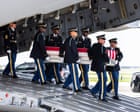
Ink is quiet. It dries on heavy parchment in air-conditioned rooms where the light never changes from a pale, steady amber. Words printed there—crisp, folded, tucked into leather briefcases—possess a peculiar kind of immunity. They do not bleed. They do not cough. They do not require a telegram sent to a dark porch in the middle of a Kansas night.
To stand at a podium and declare that a ledger balances to zero is an administrative luxury. It is a calculation performed in the abstract, far from the heavy weight of a flag draped snugly over polished oak.
Consider the mathematics of official denial.
A room in Washington. Coffee growing cold in ceramic mugs. The rhythmic clack of a keyboard summarizing a briefing that arrived by secure wire three hours before dawn. The data stream says zero. The line item reads zero. In the sterile grammar of statecraft, zero is not merely a number; it is a shield. It is a linguistic boundary designed to keep the jagged edges of reality from tearing through the curtains of a press briefing room.
When Donald Trump leveled his public claim regarding the statements made by the US commerce secretary—asserting that an official had erroneously insisted no Americans had died in the developing shadow of an Iranian conflict—he was touching a raw nerve of modern governance. He was exposing the terrifying chasm that exists between the spreadsheet and the cemetery.
We have built systems so vast, so bureaucratically insulated, that the truth often has to fight its way through layers of optimistic translation before it ever reaches the ears of those steering the ship.
Imagine a father sitting in a suburban kitchen in Ohio. The house is entirely too quiet. The television is muted, glowing with a silent loop of cable news banners scrolling past like distant traffic. On the kitchen table sits a pair of heavy work boots, caked in dried mud from a driveway that needs weeding. His son is six thousand miles away, wearing a uniform that smells of JP-8 fuel, desert sand, and cheap laundry detergent.
That father does not care about trade deficits. He does not parse the subtle distinctions between economic sanctions and kinetic retaliation. He knows one unit of measurement, and one alone: the sudden, paralyzing knock on the front door that changes the architecture of a human life forever.
When an official speaks into a microphone with smooth, practiced certainty, declaring that the ledger remains pristine, they are speaking a language built for political survival. But political survival is a fragile thing when it collides with the stubborn persistence of grief.
Language matters. Especially when it is used to erase a life.
There is a terrifying temptation in high office to treat casualties as statistical noise. In the calculus of global power, a single death can easily be flattened into an acceptable variance, a footnote in a quarterly review of strategic stability. But human beings are not data points. They are entire universes of inside jokes, burnt toast on Saturday mornings, awkward teenage years, and quiet phone calls home from crowded airport terminals.
When a high-ranking official stands before the press and misstates the human toll—whether through ignorance, willful compartmentalization, or the institutional habit of minimizing bad news—something foundational breaks. It is not just a factual error. It is a fracture in the unspoken contract between the citizen and the state.
We accept that leaders will make mistakes. We accept that policies will stumble, that strategies will require correction, that fog will roll in across the battlefield of international relations. But we do not forgive the erasure of blood.
To claim that no one has paid the ultimate price when the bills are already coming due is a special kind of moral hazard. It suggests that the people making the decisions are living in a simulation, moving toy soldiers across a felt-covered map while the real world burns quietly in the background.
Let us be entirely clear about what happens when reality finally breaches the fortress of official talking points. The dam does not break softly. It explodes. A family speaks to a reporter. A local obituary makes its way onto social media. A photograph of a smiling twenty-two-year-old in dress whites begins to circulate among people who were previously told everything was under control.
Suddenly, the carefully manicured narrative is exposed as a house of cards built on sand.
The public does not merely feel angry when this happens; they feel profoundly alone. They realize, with a cold sinking in the pit of the stomach, that the people steering the great machinery of government are looking at a different screen entirely—one where the names have been scrubbed away and replaced by clean, bloodless percentages.
There is a profound humility required to govern a great nation, and it begins with an unyielding reverence for the truth, no matter how politically inconvenient that truth might be. If a secretary cannot look a camera in the eye and acknowledge the heaviest cost of statecraft, then the office they hold has become an echo chamber of self-preservation.
The boots in that Ohio kitchen remain on the table. The dust settles into the leather creases. Somewhere in Washington, another briefing is being prepared for the morning cycle, polished until it shines like a new coin, scrubbed of any detail that might interrupt the comfortable rhythm of an administration's talking points.
But the wind outside is changing. The paper on the desk is lifting at the edges. And the names, written in ink that no amount of official denial can ever quite wash away, are waiting to be spoken.



