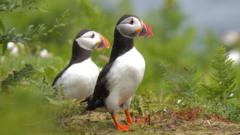
The founding of a new seabird colony on an isolated, previously unoccupied landmass represents a rare macro-ecological event driven by distinct demographic pressures, habitat suitability thresholds, and oceanographic convergence. When Atlantic puffins (Fratercula arctica) establish a presence on a barren island, the occurrence is not merely a random migratory drift. It is the visible outcome of density-dependent competition at historical breeding sites, shifting marine prey distributions, and precise geomorphological prerequisites that permit burrow excavation. Understanding this colonization process requires moving past superficial descriptions of wildlife sightings and examining the underlying biological and environmental variables that govern seabird distribution.
The Push and Pull Factors of Seabird Distributional Shifts
Colony establishment in colonial seabirds is governed by two opposing vectors: natal philopatry and density-dependent dispersal. Natal philopatry—the tendency of an individual to return to its birth site to breed—dominates under stable environmental conditions. However, when population density at established colonies surpasses the carrying capacity of local foraging grounds, the energetic cost of securing sufficient fish for nestlings rises sharply.
This creates a localized resource bottleneck. As competition for prime nesting turf and adjacent marine food webs intensifies, marginal individuals, particularly non-breeding sub-adults and displaced pairs, experience reduced reproductive success.
The pull factor operates in parallel. Uninhabited islands often feature pristine subterranean soil matrices free from terrestrial mammalian predators such as rats, mink, and foxes. When oceanographic anomalies shift forage fish stocks—such as sandeels (Ammodytes spp.)—closer to a previously barren landmass, the energetic return on foraging outweighs the traditional fidelity to congested ancestral colonies. The establishment of a new outpost is thus an exercise in spatial optimization, executed by birds responding to local depletion and distant opportunity.
Geomorphological and Predation Prerequisites for Puffin Colonization
Atlantic puffins are colonial burrow nesters, a life history trait that imposes strict physical constraints on habitat selection. A location cannot support a population unless it satisfies three non-negotiable structural criteria:
- Substrate Composition: The terrain must feature soil depth and structural cohesion sufficient for excavation. Slopes consisting of peat, turf, or loose mineral soil overlaying rock enable birds to dig burrows ranging from one to two meters in length, protecting eggs and chicks from thermal extremes and avian predators.
- Topographic Gradient: Coastal slopes or cliff tops with a direct, unobstructed launch trajectory are mandatory. Puffins possess high wing-loading—meaning their body mass is high relative to their surface area—making unassisted vertical takeoff impossible without gravity-assisted momentum.
- Predator Exclusion: The absence of agile terrestrial predators is the primary determinant of juvenile survival. Islands isolated by treacherous marine currents or sheer sea cliffs naturally screen out mammalian invaders, creating a safe zone where slow-reproducing seabirds can invest heavily in single-chick annual clutches.
Where these factors align, a colonization event shifts from a theoretical possibility to an empirical reality. The initial pioneers test the ground, often landing in exploratory groups before committing to seasonal site tenacity.
Marine Productivity and Foraging Efficiency Metrics
The viability of any newly founded seabird aggregation depends entirely on the marine trophic architecture surrounding the landmass. Puffins operate as central-place foragers during the breeding season, restricted to a finite operational radius from their nest sites as they shuttle provisions back to their single chick.
This imposes a strict energetic equation:
$$\text{Net Energy Gain} = (\text{Prey Biomass} \times \text{Caloric Density}) - (\text{Flight Energetics} \times \text{Distance})$$
When an island is colonized, it signals that the local marine ecosystem possesses high secondary productivity, typically driven by upwelling currents, frontal zones, or bathymetric features that concentrate schooling forage fish near the surface. If the distance to these prey patches requires excessive flight time, parental provisioning rates drop below the threshold required to fledge a chick successfully, leading to rapid abandonment of the site. Consequently, new colonization events serve as biological indicators of broader marine health and shifts in pelagic food webs.
Climate Drivers and Range Contractions
Macro-scale ocean warming directly alters the geographic distribution of seabirds by shifting the thermal envelopes of their primary prey species. Sandeels, which constitute the dietary backbone of Atlantic puffins in many parts of their range, exhibit high sensitivity to sea surface temperature anomalies. As southern waters warm beyond optimal physiological thresholds, sandeel populations contract northward or seek deeper, cooler thermal refugia.
This phenomenon forces adult puffins to fly farther or switch to lower-quality prey species, such as butterfish or pipefish, which possess inferior lipid profiles and are mechanically difficult for chicks to ingest. When historical colonies experience recruitment failures due to these trophic mismatches, exploratory dispersal increases. Birds venture into higher latitudes or cooler microclimates, identifying novel terrestrial redoubts where local marine conditions temporarily sustain adequate provisioning rates.
The Dynamics of Colony Growth and Allee Effects
The transition from a few exploratory visitors to a self-sustaining breeding colony involves navigating critical demographic thresholds. Early-stage colonization is vulnerable to Allee effects, where small population sizes depress individual fitness due to a lack of social stimulation, difficulties in mate finding, or heightened vulnerability to localized stochastic events.
Seabirds are colonial by nature; the presence of conspecifics serves as a primary cue for habitat quality, a process known as social attraction. Initial pioneers validate the site through their presence, lowering the perceived behavioral barrier for subsequent cohorts of prospecting immigrants. Once a critical density of active burrows is reached, social facilitation accelerates recruitment, transforming an ephemeral group of temporary visitors into a permanent, genetically distinct breeding population.
Demographic Vulnerability and Long-Term Viability
While the discovery of puffins establishing a foothold on a new island represents a resilient behavioral adaptation to environmental pressure, it does not guarantee long-term population persistence. Atlantic puffins are characterized by delayed maturity, high adult annual survival rates, and extremely low reproductive output—producing only one egg per year.
This life-history strategy makes the species uniquely resilient to short-term environmental shocks but exceptionally vulnerable to cumulative anthropogenic pressures. New colonies, often small and geographically isolated, lack genetic diversity buffer zones and face heightened susceptibility to catastrophic events, including extreme weather anomalies, oil spills, or sudden shifts in commercial fisheries management.
Monitor the rate of burrow occupancy and annual chick fledging success relative to local pelagic forage fish biomass indices to determine whether newly established island outposts will transition into stable demographic sinks or enduring regional strongholds.