Electricity is a polite guest until you invite too much of it into the room. Most of us understand power through the lens of a wall socket—a steady, domestic stream that toasts bread and charges phones. We trust the grid to be the adult in the room. But when you strip away the utility poles and the safety breakers, you are left with something primal. You are left with the raw, chemical hunger of lead-acid cells.
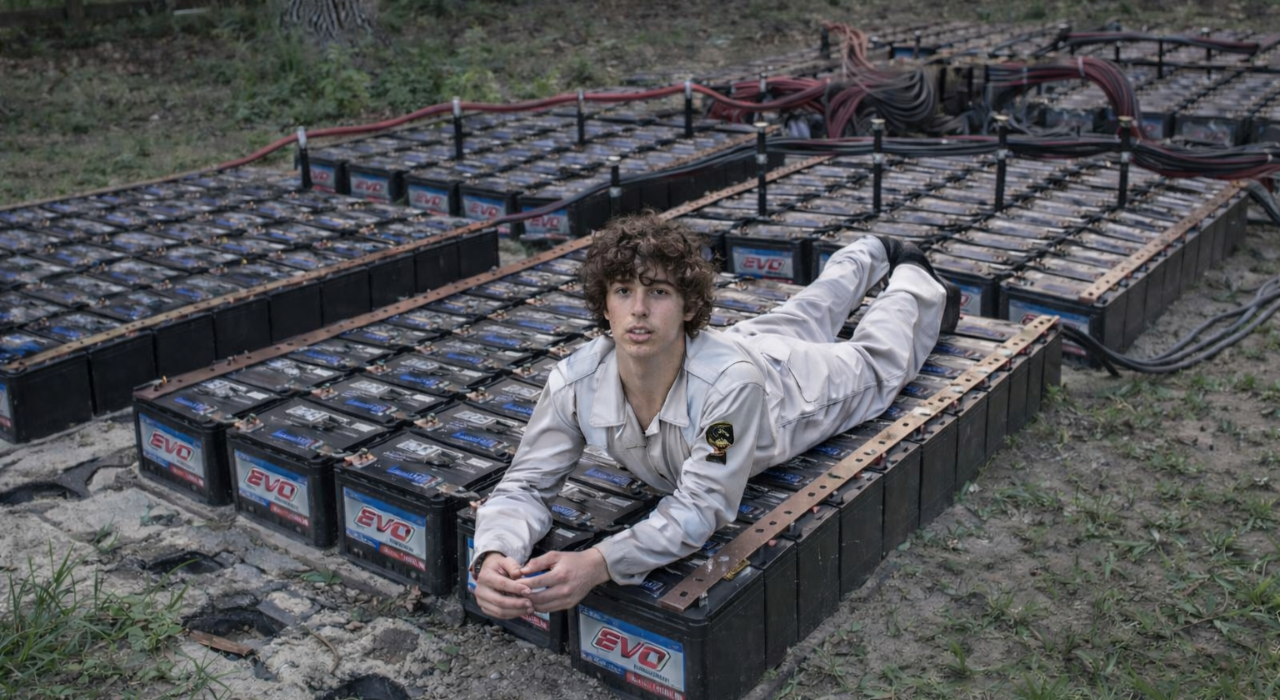
Deep in a backyard that smelled of ozone and damp grass, a man decided to see what happens when you stop asking for permission from the local power company. He didn't just buy a battery. He bought four hundred of them. These weren't high-tech lithium-ion slabs from a sleek electric sedan; they were the heavy, blocky lead-acid units you find under the hood of a 2005 sedan. Stacked together, they looked less like a scientific experiment and more like a tomb for a very small, very heavy giant.
The math of the situation is enough to make a safety inspector's hair stand on end. A standard car battery sits at about 12 volts. When you wire them in series, you aren't just adding them; you are building a ladder. Each battery is a rung. By the time he reached the end of the line, the potential difference was 4,800 volts of direct current (DC).
To put that in perspective, a standard American outlet provides 120 volts of alternating current (AC). High-voltage transmission lines—the ones that hum ominously over cornfields—carry thousands. But those are managed by steel towers and ceramic insulators the size of trash cans. Here, the only thing standing between a catastrophic arc-flash and the gardener’s shed was a set of jumper cables and a very steady hand.
We often mistake "more" for "better" in the world of power. We assume that doubling the voltage just means a brighter bulb. It doesn't. At 4,800 volts DC, physics stops behaving like a liquid and starts behaving like a predator. DC current is particularly terrifying because, unlike AC which "pulses" and gives a victim a fractional second to break free during the zero-cross, DC is a continuous, relentless push. It grabs. It holds. It cooks.
The experimenter, a man whose YouTube moniker "PhotonicInduction" suggests a life spent chasing the bright and the dangerous, began the ritual of the "Big Arch." He wasn't looking for a spark. He was looking for a bridge.
When he brought the two terminal leads together, the air didn't just crackle. It screamed. A 4,800-volt arc is a violet-white rip in the fabric of the backyard. It is plasma. At those temperatures, the air itself is being torn apart, its electrons stripped away to create a conductive path for the massive current. It is the same process that creates lightning, but instead of lasting for a millisecond, this was a sustained, howling branch of artificial sun.
Consider the sheer physical weight of this ambition. Each battery weighs roughly 30 to 40 pounds. Moving 400 of them is not a hobby; it is manual labor. It is a four-ton monument to "what if." There is a specific kind of madness required to spend days lugging lead and acid into a grid formation just to see a piece of steel wool vanish into green smoke.
But there is also something deeply human about it.
We live in a world where everything is buffered. Your phone has a controller that prevents it from overcharging. Your house has a breaker box that trips if you run the microwave and the hair dryer at the same time. We are surrounded by digital nannies. This backyard experiment was a middle finger to the buffer. It was a return to the era of Michael Faraday and Nikola Tesla, where "discovery" often meant accidentally setting your workbench on fire or feeling your teeth ache from the magnetic field.
As the current flowed, the results were both hypnotic and horrifying. He began feeding objects to the arc. A common lightbulb didn't just blow out; it exploded in a spray of molten glass the moment it sensed the overwhelming pressure of the 4,800 volts. A heavy-duty wrench, designed to survive a lifetime of mechanical abuse, turned into a puddle of glowing slag in seconds.
There is a moment in the footage where the sheer scale of the energy becomes visible not through the light, but through the heat haze. The very air around the battery stack began to shimmer. Lead-acid batteries give off hydrogen gas when they are stressed. You have four hundred boxes of sulfuric acid and lead, connected by a web of wires, generating a heat source hotter than the surface of the sun, surrounded by a faint cloud of explosive gas.
It is a miracle of luck or perhaps secret genius that the entire backyard didn't become a crater.
The invisible stakes here weren't just about the physical danger of an explosion. They were about the threshold of control. In the professional world of electrical engineering, there are "arc flash boundaries"—calculated distances where a human must wear a suit made of reinforced fibers just to exist near the equipment. This man was wearing a sweater.
Why do we watch this? Why does a video of a man nearly vaporizing himself with car batteries garner millions of views while a lecture on Ohm’s Law gathers dust?
It’s because we want to see the limits. We want to know where the "rules" of our mundane reality break. We spend our lives following the instructions on the back of the box, but we harbor a secret curiosity about what happens if we ignore the warning labels. The 4,800-volt arc is a visual representation of that curiosity. It is the sound of the impossible being forced into the possible.
As the experiment reached its peak, the batteries began to groan. Lead-acid cells aren't designed for this kind of massive, instantaneous discharge. They are sprinters being forced to run a marathon while carrying a house. Internal plates warp. The acid boils. The chemical reaction that creates the electricity becomes a violent, one-way street toward destruction.
Eventually, the light died down. The violet flame sputtered and vanished, leaving behind the smell of burnt metal and the heavy, thick silence of a dead neighborhood.
The batteries were spent. They sat there, four hundred grey plastic boxes, now little more than toxic paperweights. The man stood in the center of his creation, still alive, his retinas likely burned with the ghost-image of the arc. He had seen the sun in his backyard. He had touched the third rail of God and walked away.
We often talk about the "march of progress" as something that happens in clean laboratories with white coats and government grants. But sometimes, progress is just a guy in a shed with too much time and a reckless amount of copper wire. It is the raw, unrefined urge to poke the universe with a stick just to see if it growls.
The stick, in this case, was four tons of lead. And the universe didn't just growl; it roared.
Looking at the empty husks of those batteries, you realize that the experiment wasn't really about the voltage. It was about the audacity of the attempt. It was a reminder that beneath our paved streets and smart homes, there is a terrifying amount of energy waiting to be released, if only someone is brave—or foolish—enough to provide the path.
The wires are cooled now. The sulfur smell has drifted over the neighbor’s fence. But the image of that violet tear in the air remains, a jagged reminder that the world is only as stable as the breakers we put between ourselves and the dark.