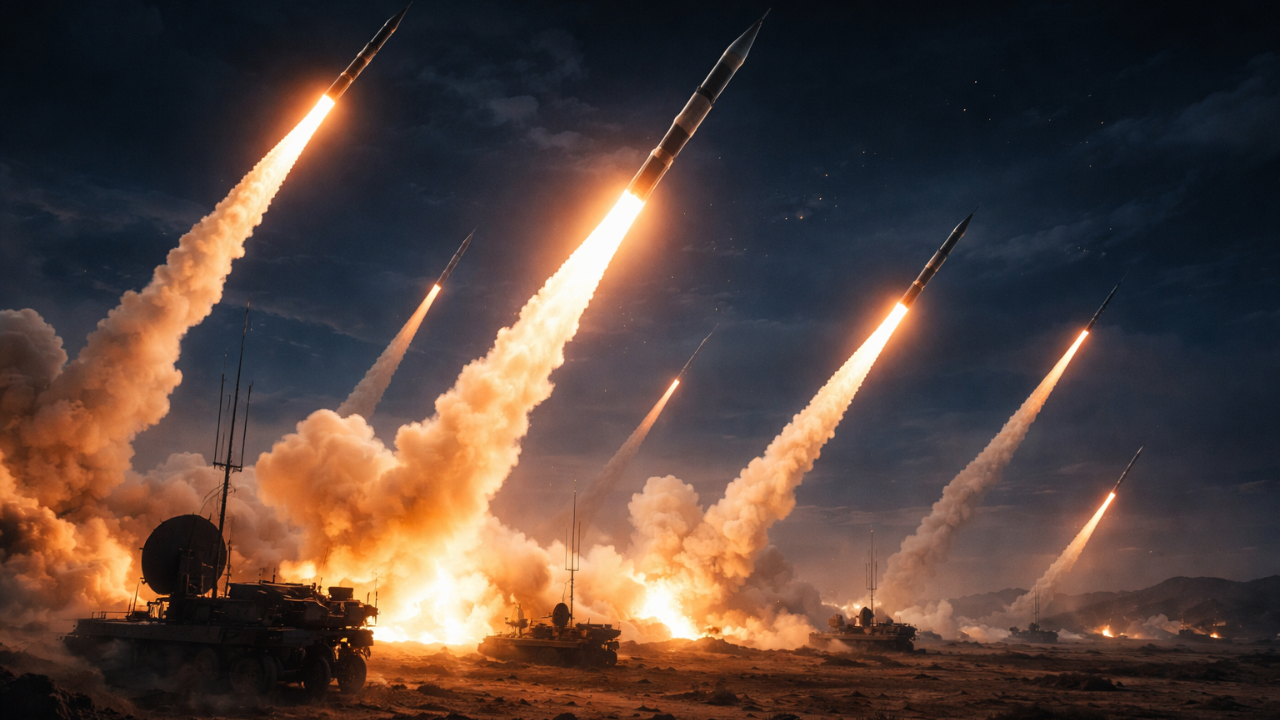
The Iranian ballistic missile threat is evaporating. After decades of branding its "missile cities" as an inexhaustible deterrent, the Islamic Republic is facing a mathematical dead end. Since the joint US-Israeli offensive began on February 28, 2026, Tehran’s ability to project power via its signature weapon has collapsed by 86%. This is not a temporary tactical lull. It is the sound of an industrial base breaking under the weight of a high-intensity war it was never built to sustain.
The core premise of Iranian strategy—the "saturation strike"—relied on the assumption that they could fire missiles faster than the West could manufacture interceptors. For a few days in early March, that math almost worked. But as the conflict enters its second week, the reality is stark. Tehran has already burned through more than 500 ballistic missiles and 1,300 drones. According to US Central Command, the remaining stockpile of operational, long-range systems capable of hitting Tel Aviv or Riyadh has likely dipped below 800 units.
When you factor in the destruction of over 2,000 targets including hardened silos, mobile launchers, and production facilities, the "limitless" arsenal looks more like a finite, rapidly dwindling resource.
The Production Bottleneck
The world often treats missile stockpiles like water behind a dam, but for Iran, it is more like a leaking bucket. Before the current escalation, Israeli intelligence estimated Iran was producing roughly 50 missiles per month. That is a respectable figure for a regional power under sanctions, but it is a rounding error in a full-scale war. In the first 48 hours of this conflict, Iran fired what amounted to nearly a year’s worth of production.
Modern missiles are not stamped out like car parts. They require high-grade solid fuel, specialized carbon-fiber casings, and precision guidance systems.
- Solid Fuel Casting: The Bakri Group, which oversees solid-fuel production, has long struggled with "uniformity" in its fuel grains. A tiny air bubble in the propellant can cause a missile to explode on the pad or veer miles off course.
- The Microchip Gap: Despite smuggling networks, Iran remains desperate for high-end semiconductors. Most "precision" Iranian missiles rely on repurposed civilian-grade electronics that are notoriously vulnerable to the electronic warfare suites currently being operated by US and Israeli EA-18G Growlers over Iranian airspace.
- Launcher Attrition: A missile without a Transporter Erector Launcher (TEL) is just an expensive lawn ornament. Israeli Air Force sorties have prioritized "TEL hunting," using real-time satellite data and loitering munitions to strike launchers the moment they emerge from their underground "cities."
The Myth of the Underground City
Tehran’s propaganda has long focused on vast, subterranean tunnels filled with rows of missiles. These facilities, such as the Lar Missile Center, were designed to survive a first strike. They have succeeded in that regard, but they have failed as operational hubs.
An underground base has a limited number of exits. Once those "mouths" are monitored by high-altitude drones, the base becomes a trap. US and Israeli forces have adopted a "bottling" strategy: they don't necessarily need to collapse the mountain; they just need to destroy the ramps and the support vehicles as they attempt to exit.
This has forced Iran into a desperate trade-off. To maintain a high rate of fire, they must move launchers into the open, where they are picked off within minutes. To keep the launchers safe, they must stay underground, which renders the missiles useless. It is a strategic checkmate that has reduced the once-fearsome Iranian Rocket Forces to sporadic, uncoordinated launches.
The Russian Intelligence Factor
In a telling sign of desperation, the Kremlin has begun feeding satellite intelligence to Tehran to help them target US warships in the Indian Ocean. This move by Vladimir Putin highlights the exhaustion of Iran’s own domestic surveillance capabilities. Their "indigenous" satellite network and long-range radar systems, like the Matla-ol-Fajr, were among the first casualties of the opening 2,000-strike wave.
Without eyes in the sky or functional radar, Iran is firing blind. They are leaning on Russian data to find "gaps" in the Aegis and Patriot envelopes, but even this hasn't stemmed the tide of interceptions. The math remains brutal. While a Patriot interceptor costs $4 million, the cost to Iran—in terms of prestige, industrial capacity, and the permanent loss of a strategic asset—is far higher.
A Legacy of Failure
We are seeing the sunset of the "Scud-era" strategy. For forty years, the IRGC gambled that a massive inventory of cheap, relatively inaccurate missiles would be enough to deter a technologically superior foe. They forgot that technology evolves faster than stockpiles.
The introduction of the Arrow-3 and THAAD batteries into the theater has effectively neutralized the "quantity over quality" approach. When 90% of a barrage is intercepted, and the remaining 10% lacks the precision to hit anything of military value, the entire concept of the ballistic deterrent collapses.
The regime is now faced with a choice that will define the next decade of the Middle East. They can continue to empty their silos in a futile attempt to save face, or they can hoard what remains to ensure the survival of the state itself. Every missile fired today is one that cannot be used to defend the regime if the "unconditional surrender" demanded by Washington becomes a physical reality on the ground in Tehran.
The "missile crisis" isn't about whether Iran has the will to fight. It’s about whether they have the hardware left to do it. The silos are getting quieter, the production lines are in ruins, and the math is finally catching up with the rhetoric.
Monitor the frequency of "dual-use" civilian drone launches in the coming days; a surge in cheap Shahed activity is the surefire indicator that the ballistic inventory has finally hit the red line.