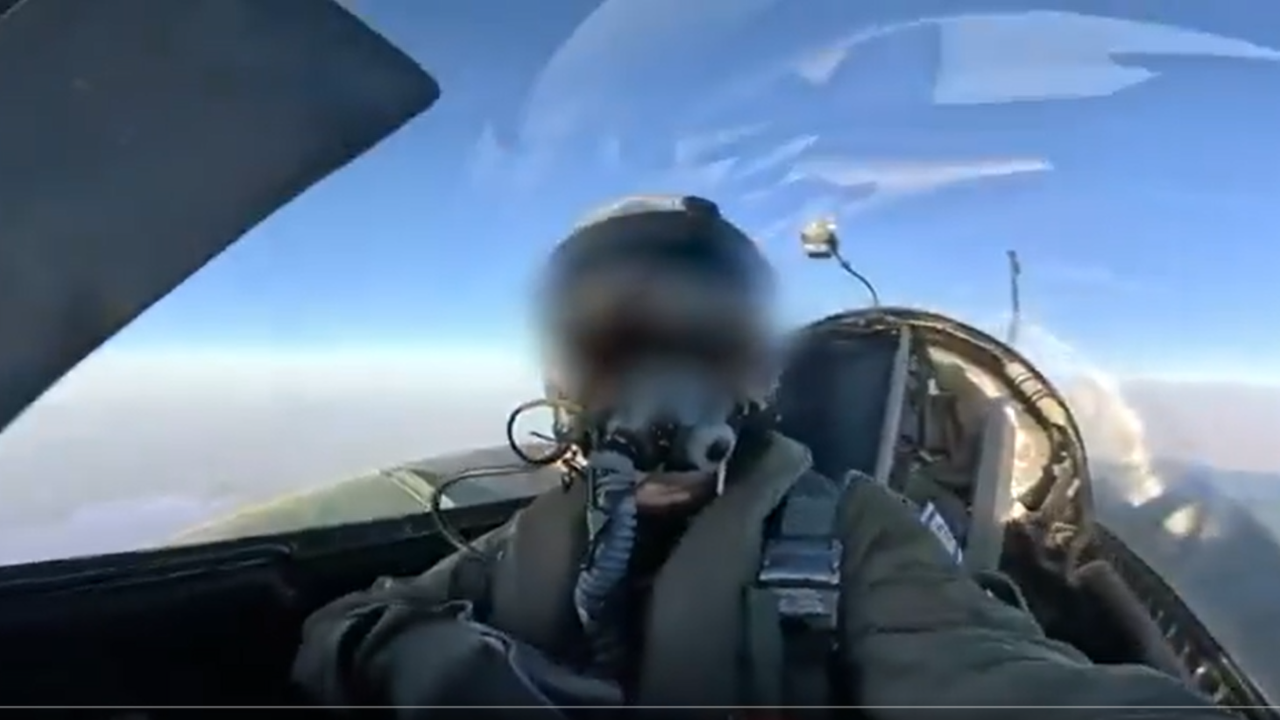
The cockpit of an F-15I Ra’am is not a place for claustrophobes, yet it is where the world feels most expansive. There is a specific, metallic hum that vibrates through the soles of a pilot's boots, a constant reminder that they are sitting atop two massive engines capable of pushing through the sound barrier as if it were wet paper. When the Israeli Air Force released "point-of-view" footage of its recent long-range strike on Iranian soil, the public saw a high-definition spectacle of clouds and precision. They saw the sleek silhouette of a wingman’s jet against a darkening sky.
What they didn't see was the silence. If you enjoyed this article, you might want to look at: this related article.
Military operations are often reported as a series of coordinates and hardware specifications. We hear about the Mach speeds, the payload capacity, and the GPS-guided accuracy of the munitions. But for the pilot—let’s call him ‘A’ to respect the anonymity the IDF insists upon—the mission isn't a press release. It is a grueling exercise in sensory deprivation and information overload. To fly from Israel to Tehran and back is to exist in a high-tech vacuum for hours, suspended between the stars and a landscape that would very much like to see you fall out of the sky.
Consider the physical toll of this "POV" we all watched on our phones. A pilot on a long-range mission is encased in a flight suit that feels like a second, tighter skin. Every movement is deliberate. Every breath is recycled. While the video shows a serene glide over a layer of stratus clouds, 'A' is actually managing a complex symphony of digital threats. He is staring into a Head-Up Display (HUD) that overlays the real world with green-tinted symbols of death and survival. A square might represent a friendly tanker waiting to give him the fuel he needs to make it home; a flashing triangle might be a surface-to-air missile battery in a foreign valley, its radar currently "painting" his aircraft. For another angle on this event, check out the latest update from NPR.
The distance between Tel Aviv and Tehran is roughly 1,000 miles. That is not just a measurement of space. It is a measurement of risk.
The footage shared by the military serves a dual purpose: it is both a record of a tactical success and a profound piece of psychological theater. By showing the world the view from the cockpit, the state is making the abstract concrete. It says, "We were there. We saw the horizon. We returned." But for the person in the seat, the narrative is internal. There is no music bed. There are no jump cuts. There is only the rhythm of the oxygen regulator—hiss, click, hiss, click—and the cold realization that at 30,000 feet, you are the most visible thing in the world to those who know how to look.
Technological superiority is often described as a shield. We imagine that because a jet is "stealthy" or "advanced," the pilot is somehow insulated from the danger. This is a comforting fiction. In reality, the more advanced the machine, the more it demands of the human. A pilot on a mission of this magnitude must process thousands of data points every minute. They are balancing fuel consumption rates against the wind speed, monitoring the health of the engines, and staying in constant, encrypted contact with a command center hundreds of miles away.
One mistake—a single degree off course, a momentary lapse in radio discipline—and the "POV" becomes a recovery mission.
The video highlights the mid-air refueling process, a delicate dance of aluminum and kerosene performed at hundreds of miles per hour. Imagine trying to thread a needle while riding a motorcycle over a potholed road. Now do it in the dark. Now do it while knowing that if you miss, your mission ends in a dry lake bed in a hostile country. The boom of the tanker extends like a lifeline. When it connects, there is a physical jolt. For a few minutes, the fighter jet is tethered to a mother ship, drinking the fuel that represents the difference between a triumphant landing and a quiet disappearance.
Critics of these military "POV" videos often point to them as "gamification" of conflict. They argue that by turning a strike into a cinematic experience, we detach ourselves from the reality of the explosions on the ground. There is truth in that. When we watch the video, we are spectators at a safe distance. We aren't the ones feeling the G-forces crush our lungs during a sharp bank. We aren't the ones looking at a fuel gauge and wondering if the math will hold up for the final leg of the journey.
But the "human-centric" narrative isn't just about the pilot's adrenaline. It’s about the weight of the decision. Behind every clip of a thumb pressing a release button is a chain of command and a pilot who has trained for a decade for a ten-second window. The "POV" is an narrow lens. It shows the clouds, the jet, and the target. It doesn't show the photos of the pilot's children tucked into the side of the cockpit, or the way his hands might shake—just a little—once the wheels finally touch down on the tarmac back home.
Modern warfare has become an exercise in visibility. We live in an era where an operation is not considered finished until the video of it is uploaded. This creates a strange paradox for the men and women in the cockpits. They are executing the most private and high-stakes moments of their lives, only to have those moments become public consumption within hours. The cockpit, once the most secluded office in the world, is now a broadcast studio.
The Israeli Air Force knows this. They understand that in the 21st century, the story you tell about the mission is almost as important as the mission itself. By inviting us into the cockpit, they aren't just showing us their tech; they are showing us their reach. They are demonstrating that the distance between a hangar in the Negev and a target in Tehran has been collapsed by technology and will.
Yet, despite the high-definition cameras and the satellite links, the core of the story remains the same as it was eighty years ago. It is a person in a metal box, traveling through a medium that humans were never meant to inhabit, carrying the burden of an entire nation’s security on their shoulders.
The clouds look the same from a cockpit today as they did in 1944. The sky is still an indifferent, beautiful blue. The difference is that now, we get to see it through their eyes, even if we can never truly feel what they feel. We watch the video and see a triumph of engineering. The pilot looks out the canopy and sees the fragility of the world.
As the sun sets in the footage, casting long, orange shadows across the fuselage, the jet turns for home. The video ends. The screen goes black. We put our phones back in our pockets and go about our day. But for the pilot, the mission doesn't end when the camera stops. There is still the landing. There is still the debrief. There is still the long, quiet drive home through the desert, with the hum of the engines still ringing in their ears and the memory of a foreign horizon burned into their retinas.
Would you like me to analyze the specific electronic warfare systems that allow these jets to remain "invisible" on such long-range sorties?