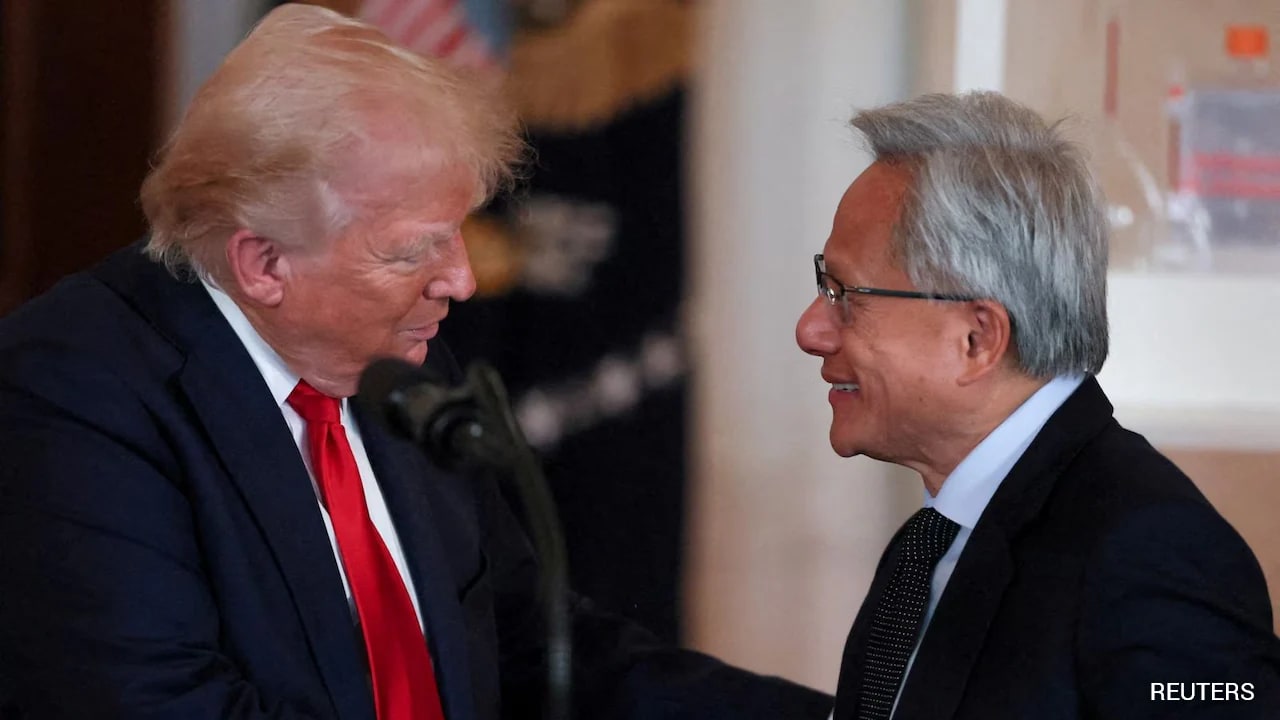
The financial press loves a cartoon villain. Put a billionaire politician next to a booming semiconductor stock and a shift in export controls, and the headlines practically write themselves. Buy low, tweak the rules for China, watch the shares rip, pocket the spread. Simple. Clean. Completely divorced from how institutional capital, federal ethics rules, and global silicon supply chains actually operate.
If you read the standard coverage of Donald Trump’s Nvidia holdings and the subsequent shifts in U.S.-China chip policy, you are being fed a bedtime story designed for outrage clicks. The lazy consensus assumes a straight line between a personal brokerage account and a geopolitical chess move. It treats the world’s most consequential semiconductor company like a penny stock being pumped by a local alderman. Don't forget to check out our previous coverage on this related article.
That narrative is intellectually bankrupt. Worse, it blinds investors and voters to the actual structural mechanics driving Washington’s semiconductor policy—and the far bigger conflict of interest hiding in plain sight.
The Myth of the Tail-Wagging Semiconductor Trade
Let’s look at the mechanics first. The outrage machine wants you to believe that a few million dollars in Nvidia equity is enough to bend the national security apparatus of the United States. To read more about the background here, Business Insider provides an in-depth breakdown.
Do the math. Nvidia is a multi-trillion-dollar behemoth. On an average Tuesday, tens of billions of dollars in Nvidia stock change hands before lunch. A personal stake of a few million dollars—even tens of millions—is a rounding error in the daily liquidity of NVDA. To suggest that an executive branch official alters export licensing for the entire People's Republic of China to juice a single-digit million-dollar position is like claiming a captain steers an aircraft carrier to catch a single mackerel.
I have sat across the table from sovereign wealth managers and defense contractors in Washington for fifteen years. I have watched billion-dollar lobbying campaigns stall out in the Bureau of Industry and Security (BIS) because a single mid-level engineer at the Pentagon raised a red flag about dual-use compute capabilities. National security policy around advanced lithography and AI accelerators does not turn on a dime because someone wants a twenty-percent pop on a brokerage statement.
When policy shifts on China—whether tightening restrictions on H20 chips or granting specific carve-outs for legacy hardware—it happens because of a brutal tug-of-war between two massive, competing factions:
- The Defense Hawks: Officials in the Pentagon and the National Security Council who view every teraflop of compute sold to Beijing as fuel for hypersonic missile guidance and autonomous drone swarms.
- The Silicon Valley Lobby: Executives from Nvidia, Intel, and Qualcomm who argue—correctly, from a pure balance-sheet perspective—that cutting off the Chinese market starves American firms of the R&D capital required to stay ahead of Huawei and SMIC.
When Washington adjusts the dials on export controls, it is reacting to that multi-billion-dollar stalemate. Pretending it is all about one man’s personal E*TRADE account is amateur hour.
How Federal Ethics Rules Actually Distort Incentives
Here is what the mainstream articles conveniently skip because it ruins their punchy headlines: how executive branch asset disclosures and divestiture rules actually work.
Under the Ethics in Government Act, presidents and vice presidents are legally exempt from the criminal conflict-of-interest statute (18 U.S.C. § 208) that forces cabinet secretaries to divest conflicting assets or place them into a Qualified Blind Trust. Every administration handles this differently, usually relying on complex trust structures, third-party asset managers, or voluntary divestitures to avoid the appearance of impropriety.
When a disclosure form shows a position in Nvidia, three things are almost always true that get lost in the noise:
- Discretionary Management: High-net-worth portfolios are routinely managed by institutional advisors who rebalance based on index weightings. Because Nvidia grew to represent an enormous slice of the S&P 500 and the Nasdaq-100, virtually every large-cap growth portfolio on earth became heavily weighted toward Nvidia by default. Not owning it meant actively betting against the broader market.
- Broad Reporting Brackets: Office of Government Ethics (OGE) forms use wide valuation ranges—such as "$1,000,001 to $5,000,000" or "$5,000,001 to $25,000,000." A paper gain caused by a broader AI market rally can push an asset into a higher reporting bracket without a single share being bought or sold.
- The China Revenue Reality: Nvidia’s stock price is no longer tethered to Chinese data center sales the way it was five years ago. Following the initial rounds of export bans, Nvidia’s revenue concentration shifted massively toward U.S. hyperscalers—Microsoft, Meta, Alphabet, and Amazon. A policy tweak regarding China moves Nvidia’s stock far less than a quarterly CapEx guidance update from Mark Zuckerberg or Satya Nadella.
Imagine a scenario where the White House completely eliminated every single chip restriction on China tomorrow morning. Would Nvidia double? No. China’s domestic tech giants are already under intense state pressure from Beijing to ditch American silicon in favor of domestic alternatives like Huawei’s Ascend series. The demand destruction in China is increasingly self-inflicted by Beijing’s own mercantilist mandates, not just Washington’s export rules.
The Real Scandal Nobody Wants to Cover
If the personal stock trade is a distraction, what is the actual story? Why are we watching erratic, seemingly contradictory shifts in China tech policy?
Because Washington is trapped in a policy hallucination, and both parties are complicit.
For years, the prevailing orthodoxy in D.C. was "small yard, high fence"—the idea championed by national security advisors like Jake Sullivan that the U.S. could choke off China’s access to cutting-edge AI chips while letting normal trade continue untouched. That strategy failed. It didn't stop Chinese AI development; it simply forced Beijing to subsidize its domestic semiconductor supply chain with tens of billions of dollars in state capital, accelerating the very technological independence Washington wanted to prevent.
Now, policy lurches between maximum tariff threats, sudden licensing delays, and transactional deal-making. That volatility is the real scandal.
When trade policy becomes a transactional bargaining chip—used one week to extract agricultural purchases or TikTok concessions, and tightened the next week to appease hawks on Capitol Hill—it destroys capital allocation certainty for the entire global economy. Companies cannot build three-year fabrication roadmaps when the rules of engagement change via social media posts or sudden executive orders.
Look at who actually wins in an environment of erratic export controls:
- Massive Incumbents: Nvidia has the legal army, the lobbying budget, and the engineering bandwidth to design custom, nerfed chips (like the A800, H800, and H20) specifically calibrated to sit just beneath whatever performance threshold Washington invents that month.
- Grey-Market Smugglers: Every time Washington tightens a rule without enforceable end-use monitoring, a shadow network of shell companies in Singapore, Malaysia, and the Middle East makes hundreds of millions of dollars routing restricted GPUs into mainland server farms.
- Smaller Competitors: Crushed. Startups and mid-cap chip designers cannot afford a fifty-person compliance department in D.C. just to figure out who they are allowed to sell to.
By focusing on whether a politician made a few million dollars on a stock trade, the press lets policymakers off the hook for running a chaotic, incoherent industrial policy that enriches entrenched monopolies and black-market middlemen while failing to secure American technological dominance.
What You Should Actually Be Asking
If you are an investor, an operator in the tech sector, or just a citizen trying to understand how power works, stop asking whether a politician timed a trade. Ask these three questions instead.
1. Why are elected officials allowed to hold individual equities at all?
The outrage over Trump’s Nvidia stake—just like the outrage over Nancy Pelosi’s tech options or Richard Burr’s pandemic sell-offs—treats a systemic disease as an individual moral failing. As long as federal officials and their immediate families are permitted to hold individual stocks rather than broad-based, blind index funds, every policy decision will be tainted by suspicion. The fix isn't whining about one trade in the press; it is a blanket statutory ban on individual equity ownership across all three branches of government. Neither party passes it because both parties enjoy the perks.
2. Who is writing the technical thresholds for export controls?
When the Commerce Department sets a cap on "total processing performance" or "interconnect bandwidth," those numbers are not pulled out of thin air. They are negotiated behind closed doors with industry lobbyists. Every time a new rule is drafted, watch which specific SKU survives the cut. You will quickly realize that export controls often function as anti-competitive moats disguised as national security measures.
3. Where is the actual bottleneck in AI supremacy?
Politicians and pundits obsess over GPU shipments because chips are easy to photograph and easy to understand. They completely ignore the real chokepoints: high-bandwidth memory (HBM), advanced packaging capacity at TSMC, and gigawatt-scale electrical grid infrastructure. You can ship a million H100s to a desert, and they are expensive paperweights if you don't have the power transformers and cooling infrastructure to run them.
The Contrarian Playbook for Navigating Policy Whiplash
I have watched retail investors get obliterated trying to trade headlines around Washington’s China policy. They buy the rumor of a tariff pause, get dumped on by algorithmic funds when a hawkish committee chair holds a press conference, and wonder why their portfolio is bleeding.
If you want to survive—and profit—when geopolitics collides with silicon, strip out the political noise and follow three rules:
- Ignore the headline, watch the CapEx: Politicians lie, posture, and reverse course. Hyperscaler capital expenditure budgets do not. Track the quarterly spending commitments of Microsoft, Alphabet, Meta, and Amazon. As long as those four companies are spending upwards of $200 billion a year on data center buildouts, China export policy is a secondary sideshow for Nvidia’s bottom line.
- Follow the bottlenecks, not the headlines: Instead of guessing which chip gets banned next, look at the suppliers that hold absolute monopolies over the manufacturing steps nobody can bypass. Extreme ultraviolet (EUV) lithography machines, specialized photoresists, and advanced substrate packaging have zero substitutes regardless of who sits in the Oval Office.
- Discount every "crackdown" by fifty percent: Washington loves tough talk on China, especially in election cycles or trade negotiations. In practice, full enforcement is nearly impossible without tanking the domestic stock market—something no administration will voluntarily do. Treat severe export announcements as temporary buying opportunities created by panicked algorithmic selling, not permanent terminal events.
The downside to this approach? You have to stomach gut-wrenching short-term volatility. When a sudden policy leak hits the wires at 2:00 PM on a Thursday, semiconductor stocks will drop five to eight percent in minutes. If you are over-leveraged or trading short-dated options, you will get wiped out before the market realizes the policy has zero teeth. You need cash reserves and the discipline to sit on your hands while the financial media hyperventilates.
Stop Falling for the Distraction
The press wants you angry about a multi-million-dollar profit on a stock chart because anger keeps you scrolling. It is clean, simple, and requires zero understanding of semiconductor architecture, export administration regulations, or institutional portfolio management.
Meanwhile, the real story—the transformation of U.S. trade policy into an unpredictable, lobbyist-driven casino that undermines genuine national security while cementing corporate monopolies—marches forward completely unchallenged.
Stop watching the politician’s brokerage statement. Start watching who writes the exemptions.