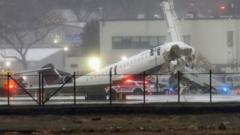
On a freezing March night, USAir Flight 405 sat on the tarmac at LaGuardia Airport for 35 minutes after its second de-icing. That delay was long enough for a thin, invisible layer of ice to reform on the wings, destroying the lift necessary for flight. When the Fokker F28 finally attempted takeoff, it didn't soar; it struggled, stalled, and somersaulted into the frigid waters of Flushing Bay. Twenty-seven people died because the aviation industry relied on a "clean wing" philosophy that lacked the practical tools to actually ensure the wings were clean.
The tragedy of Flight 405 was not a fluke of nature. It was the predictable result of a systemic failure to account for the gap between chemical capabilities and real-world holdover times. While the official reports focused on the mechanics of the stall, the deeper truth lies in a culture that prioritized departure slots over the fundamental physics of lift.
The Illusion of Safety in the De-icing Bucket
In 1992, the process of de-icing was treated more like a car wash than a critical safety maneuver. Ground crews sprayed a mixture of heated water and Type I glycol-based fluid onto the aircraft. This fluid is excellent at shedding existing ice, but it has the nutritional staying power of a snack. It runs off the wing almost as fast as it is applied.
Pilots at the time were operating under a dangerous assumption. They believed that if the plane was sprayed, it stayed safe for a reasonable window of time. But on that night, the precipitation was a mix of snow and freezing rain. The Type I fluid failed almost immediately. As the crew waited in the departure queue, the "holdover time"—the duration the fluid remains effective—was ticking down to zero before they even reached the runway threshold.
The industry knew this was an issue. A decade earlier, Air Florida Flight 90 crashed into the Potomac River for nearly identical reasons. Yet, the transition to Type II fluids, which are thickened to "cling" to the wing and provide longer protection, had been sluggish in the United States compared to European counterparts. LaGuardia that night was a graveyard of old habits.
The Cockpit Perspective and the View from the Cabin
One of the most haunting aspects of the Flight 405 investigation was the discrepancy between what the pilots could see and what was actually happening on the wing surfaces. The Fokker F28 is a "T-tail" aircraft with engines mounted at the rear. From the cockpit, the pilots have no direct line of sight to the wings. To check for ice, they have to rely on a physical inspection by a crew member or look through cabin windows.
On Flight 405, the crew did look. They peered out into the darkness and saw what they thought was a wet wing. Under the yellow-tinged airport lights, wet aluminum and clear ice look identical. This is the "clear ice" phenomenon—a smooth, transparent coating that doesn't change the shape of the wing enough to be obvious to the naked eye but changes the airflow enough to be lethal.
The passengers, some of whom survived the initial impact, reported seeing snow accumulating on the wings during the taxi. This highlights a terrifying breakdown in the safety chain. The people with the most at stake had the best view, but the hierarchy of the cockpit often prevents that information from flowing upward. It was a failure of Communication Resource Management (CRM) as much as it was a failure of chemistry.
Aerodynamics vs the Clock
When an airplane wing is contaminated with even a small amount of frost or ice, its performance drops off a cliff. The lift-to-drag ratio is decimated. To understand why Flight 405 failed to climb, you have to look at the critical angle of attack.
As the pilot pulled back on the yoke to rotate, the wing tilted upward. On a clean wing, the air stays attached to the surface, creating the pressure differential that pulls the plane into the sky. On the contaminated wing of Flight 405, the ice acted like sandpaper. It created turbulence that forced the air to "detach" from the wing prematurely. Instead of lifting, the wing stalled. Because the F28 has its engines at the rear, the turbulent air from the stalled wings can also flow into the engines, causing them to surge or lose power, which is exactly what the sensors recorded in the final seconds.
The margin for error was less than a millimeter of ice.
The LaGuardia Problem
LaGuardia is a notoriously difficult airport. Its short runways and cramped taxiways mean that any delay in the takeoff sequence ripples through the entire schedule. On the night of the crash, the airport was operating at its limit.
The pressure to "push" is immense. Every minute an aircraft sits on the taxiway, it burns fuel and risks missing its arrival window. This environment creates a subtle, subconscious pressure on flight crews to accept a "good enough" wing. If the pilot had returned to the gate for a third de-icing, it would have caused a massive logistical headache for the airline and the airport. The industry's reliance on Type I fluid meant that the safety window was too narrow for an airport with LaGuardia's congestion.
Regulating the Weather
The legacy of the LaGuardia crash was a total overhaul of how the Federal Aviation Administration (FAA) handles winter operations. It led to the mandate of strict Holdover Timetables. These charts, updated every year, tell pilots exactly how many minutes they have before their de-icing fluid expires based on the temperature and the type of precipitation.
It also forced the adoption of Type II and later Type IV fluids in the North American market. These fluids are non-Newtonian; they stay thick while the plane is stationary or taxiing, then thin out and shear off the wing once the aircraft reaches takeoff speed. It was a technological solution to a human observation problem.
More importantly, the crash changed the "Clean Wing Policy." It is no longer a suggestion; it is a hard law. If a pilot cannot verify that the wing is clean, they cannot take off. There is no middle ground.
The Human Cost of Technical Progress
The 27 people who died in Flushing Bay were victims of a system that waited for a disaster to prove its theories. We often think of aviation safety as a steady upward curve of innovation, but in reality, it is a series of reactions to tragedy. Each safety feature on a modern jet is "written in blood."
The industry moved away from "visual inspections" in favor of rigorous timing and better chemistry, but the pressure of the schedule remains. Even with the best fluids in the world, the fundamental physics of flight remain unforgiving. If the air cannot flow smoothly over the leading edge, the machine ceases to be an airplane and becomes a very expensive, very heavy projectile.
The next time you sit on a plane in a snowstorm and feel the frustration of a long de-icing delay, remember the Fokker F28 at the end of Runway 13. The delay isn't an inconvenience; it is the only thing keeping the physics of the wing on your side. We have mastered the chemistry of ice prevention, but we are still subservient to the clock.
Check the timestamps on your de-icing log.