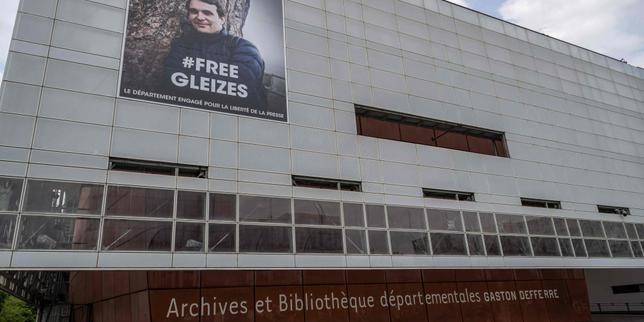
The legal battle is over. Every avenue in the Algerian court system has been completely exhausted.
On May 25, 2026, Algeria’s Court of Cassation quietly shut the door on the judicial chapter of Christophe Gleizes' case. It rejected the prosecution’s appeal for a harsher sentence and formally recorded the withdrawal of the French journalist's own appeal.
His lawyers, Amirouche Bakouri and Emmanuel Daoud, made it plain on Wednesday. There are no more legal motions to file, no more hearings to schedule, and no more technical loops to stall the process. The gridlock is broken. This development means the 37-year-old sports reporter, who has spent two long years caught in a geopolitical gears, has only one exit left. A direct presidential pardon from Abdelmadjid Tebboune.
The Cost of a Football Report
Let's look at how a sports journalist ended up in a maximum-security setup. It sounds bizarre because it is. In May 2024, Gleizes, a contributor to respected French publications like So Foot and Society, traveled to the northeastern Kabylia region. His objective was standard journalism. He wanted to write a feature on Jeunesse Sportive de Kabylie (JSK), Algeria’s most decorated and fiercely supported football club.
Instead, his reporting trip turned into a nightmare. He interviewed a local football club figure. Unbeknownst to Gleizes, Algerian authorities linked this individual to the Movement for the Self-Determination of Kabylie (MAK). Algiers classifies MAK as a terrorist organization.
Suddenly, a routine notebook and audio recorder were treated like state-threatening contraband. The state charged him with "glorifying terrorism" and "possessing propaganda publications."
The timeline shows just how agonizingly slow this process has been:
- May 2024: Arrested in Kabylia and placed under strict judicial control, unable to leave Algeria.
- June 2025: Sentenced to seven years in prison after a trial that rights groups labeled a sham.
- December 2025: An Algiers appeal court upholds the heavy seven-year sentence.
- March 2026: Gleizes takes a massive gamble and withdraws his own cassation appeal to clear the path for clemency.
- May 25, 2026: The Supreme Court rejects the prosecutor's final counter-appeal, freezing the sentence but ending the legal fight.
Dropping the Appeal Was a Calculated Risk
You might wonder why an innocent writer would voluntarily drop an appeal against a seven-year prison term. It is a calculated, desperate legal strategy.
In Algeria, a president cannot legally issue a pardon while judicial proceedings are ongoing. As long as a case is active in the system, a presidential decree is blocked. By withdrawing his appeal in March, Gleizes signaled total submission to the timeline of diplomacy rather than the timeline of the courts. His mother openly shared that her son was putting his complete trust in President Tebboune’s clemency.
But the state machine resisted. The public prosecutor had filed an independent appeal, seeking to increase his time behind bars. That prosecutor's motion was the final roadblock. Now that the highest court of appeal has thrown it out, the legal dossier is permanently closed.
Football and Foreign Policy Meet at the Worst Time
Gleizes didn't operate in a vacuum. His arrest happened during a brutal two-year freeze in diplomatic relations between Paris and Algiers. When state relationships sour, foreign nationals often find themselves used as leverage.
The political wind is changing just in time. The timing of this judicial resolution aligns perfectly with a major diplomatic thaw. French Justice Minister Gérald Darmanin recently wrapped up an official visit to Algiers to repair judicial cooperation. Following his meetings, Darmanin noted he felt reassured about the journalist’s situation.
There is another massive factor. The 2026 FIFA World Cup kicks off on June 11 in North America, and both France and Algeria have qualified. The global sporting community is watching. International Press Institute (IPI) Advocacy Director Amy Brouillette has publicly called on Algiers to stop weaponizing its legal system against independent media before the opening whistle blows. Even FIFA officials have shown up in the Tizi-Ouzou courtroom to signal international concern.
When Could He Actually Walk Free
Thibaut Bruttin, head of Reporters Without Borders (RSF), hasn't minced words. A presidential pardon is now the single, solitary option left to avoid a human tragedy.
So when does Tebboune hold the pen? Algerian presidents historically issue mass pardons during specific national and religious milestones.
The most logical target on the calendar is July 5. This date marks Algeria's Independence Day, celebrating freedom from French colonial rule in 1962. It is a day deeply tied to national pride and complex historical ties with France, making it the ultimate stage for a symbolic gesture of political clemency.
With the judicial system stepping aside, the next move belongs entirely to the presidential palace in Algiers. The family, the press corps, and diplomatic staff can do nothing now but wait for the signing of a decree.