The shift in United States Indo-Pacific strategy from centralized power projection to distributed lethality is dictated by the physics of the "Tyranny of Distance." By migrating the production and storage of precision-guided munitions (PGMs) and unmanned aerial systems (UAS) to frontline states—specifically Australia, Japan, and the Philippines—the Pentagon is attempting to solve a terminal bottleneck in the trans-Pacific supply chain. This is not merely a diplomatic realignment; it is a fundamental reconfiguration of the cost-exchange ratio in a high-intensity conflict.
The Triad of Proximity: Reducing the Logistics Tail
In any sustained engagement within the First Island Chain, the primary constraint is not total inventory, but the Rate of Replenishment. Relying on the 8,000-mile "California-to-Guam" pipeline creates a predictable vulnerability that an adversary can exploit via long-range anti-access/area-denial (A2/AD) capabilities. To mitigate this, the U.S. and its partners have initiated three distinct operational shifts.
1. Co-Production as Force Multiplier
The transition from "buy" to "build" within the theater allows for the regionalization of the defense industrial base. Australia’s Guided Weapons and Explosive Ordnance (GWEO) Enterprise serves as the prototype. By manufacturing the Guided Multiple Launch Rocket System (GMLRS) on Australian soil, the alliance bypasses the vulnerability of maritime shipping lanes. This creates a redundant manufacturing node that can operate even if central U.S. hubs are disrupted.
2. Maintenance, Repair, and Overhaul (MRO) Decentralization
Warships and aircraft damaged in a conflict cannot always limp back to Pearl Harbor or San Diego. Establishing MRO hubs in Japan and the Philippines ensures that the "Mean Time To Repair" (MTTR) is minimized. This effectively increases the "available hull count" without building new ships, as vessels spend more time on station and less time in transit.
3. Pre-Positioned Stocks (Wartime Reserve)
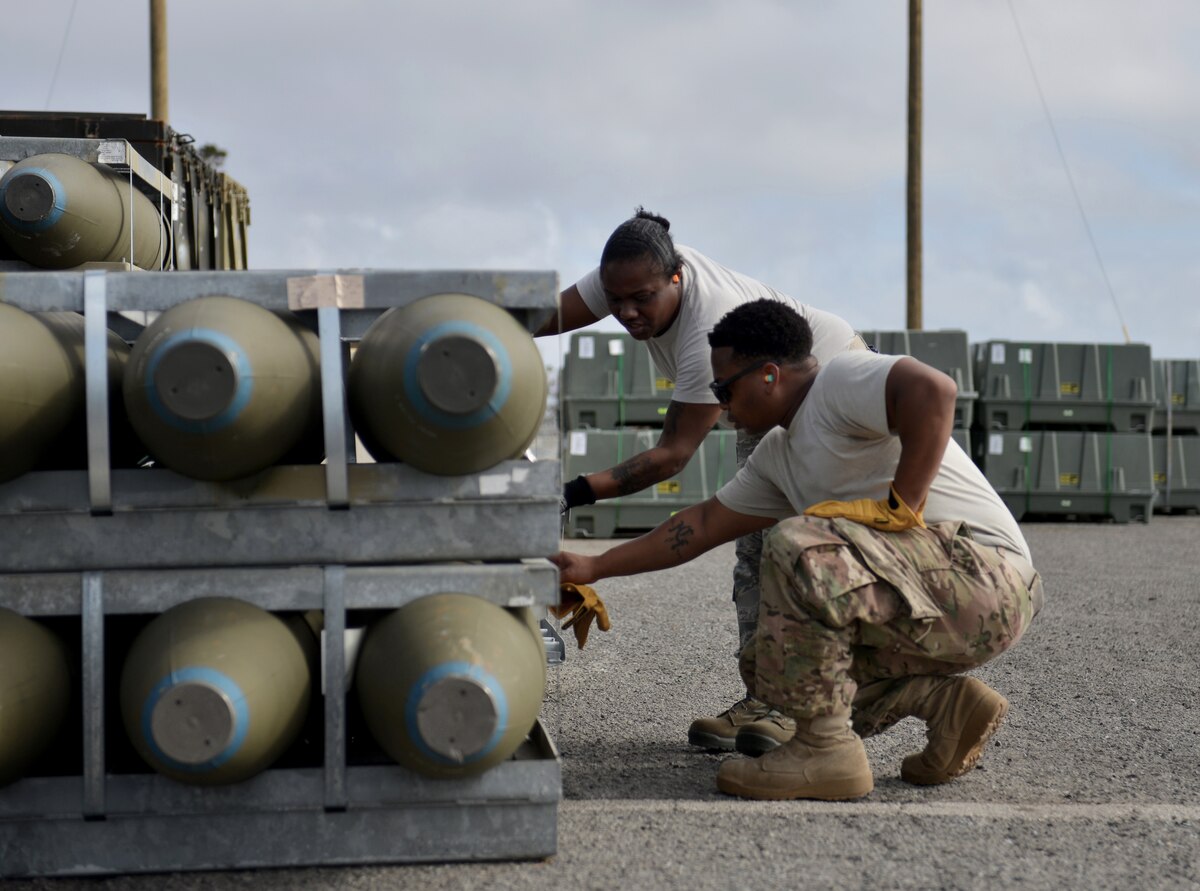
The "Contested Logistics" framework assumes that once hostilities begin, sea-lift capacity will be prioritized for fuel and food. By flooding the theater with "smart" munitions during peacetime, the U.S. ensures that the initial 30 to 60 days of high-intensity kinetic operations are self-sustaining.
The Economic Calculus of Attrition
The strategic shift toward mass-produced drones and cheaper missiles is a response to a failing economic equation. Currently, the U.S. often uses a $2 million interceptor to neutralize a $50,000 one-way attack drone. This is a mathematically certain path to defeat in a war of attrition.
The move to build "closer to the flashpoint" incorporates a specific focus on Low-Cost Attreadable Aircraft (LCAA).
The Cost Function of Defense
Success in the Indo-Pacific depends on shifting the burden of cost onto the aggressor. By deploying thousands of autonomous systems (Project Replicator), the U.S. forces an adversary to expend high-value interceptors against low-value targets.
- Fixed Costs: Large platforms like Carrier Strike Groups (CSGs) represent concentrated risk.
- Variable Costs: Thousands of small, locally produced drones represent distributed risk.
When production occurs in Japan or Australia, the shipping cost—both in terms of fuel and the requisite naval escort—drops to near zero. This increases the "Kinetic Density" of the region, making it more difficult for an opposing force to find a "gap" in the defensive screen.
Technical Barriers and Interoperability Friction
While the logic of distributed production is sound, the execution faces a significant hurdle: Technical Data Package (TDP) Sovereignty.
For a Japanese firm to manufacture a U.S.-designed missile, the U.S. must share proprietary schematics and software source code. Historically, the International Traffic in Arms Regulations (ITAR) has acted as a barrier to this level of integration. Overcoming this requires a new classification of "Interoperable-by-Design," where weapons systems are built with modular open systems architectures (MOSA) that allow different nations to plug in their own localized sub-components without compromising the core IP of the prime contractor.
Structural Vulnerabilities in Distributed Manufacturing
Distributed manufacturing introduces a new attack surface. While it solves the problem of a single point of failure in the U.S. mainland, it creates multiple localized vulnerabilities.
- Workforce Scarcity: Australia and Japan face aging populations and a shortage of specialized aerospace engineers. Building a factory is faster than training the technicians required to run it.
- Raw Material Bottlenecks: Most precursor chemicals for explosives and rare-earth magnets for guidance systems are currently sourced from or processed in China. Localizing the assembly of a missile does nothing if the ingredients are controlled by the adversary.
- Cyber-Kinetic Convergence: Smaller, regional manufacturers often have lower cybersecurity budgets than major U.S. primes (Lockheed Martin, Raytheon), making them prime targets for industrial espionage or remote sabotage.
The Displacement of Forward Presence
We are witnessing the transition from "Presence-based Deterrence" to "Capability-based Deterrence." In the previous era, the presence of a Carrier in the South China Sea was the primary signal. In the new era, the signal is the existence of a hardened, underground automated factory in Northern Australia capable of churning out 500 long-range strike missiles per month.
This shift changes the escalation ladder. If an adversary knows that sinking a ship does not stop the flow of munitions—because those munitions are being built in five different countries simultaneously—the incentive for a "bolt-from-the-blue" strike diminishes.
Strategic Operational Play
The most critical move for the U.S. and its allies is the immediate standardization of Universal Launch Interfaces. If a drone manufactured in the Philippines can be controlled by a Japanese destroyer and armed with an Australian-made warhead, the alliance achieves a level of "Composability" that no single-nation military can match.
The focus must remain on the Second-Order Logistics:
- Establish "Iron Mountains" of spare parts in the Philippines.
- Standardize fuel requirements across all UAS platforms to simplify the "liquid logistics" chain.
- Prioritize the "Software-Defined Missile" where the hardware is printed locally and the guidance logic is updated via secure cloud link moments before launch.
The winner of a conflict in the Indo-Pacific will not be the side with the best initial plan, but the side that can regenerate combat power within the theater faster than the adversary can destroy it. The globalization of the kill chain is the only viable counter to a localized hegemon.