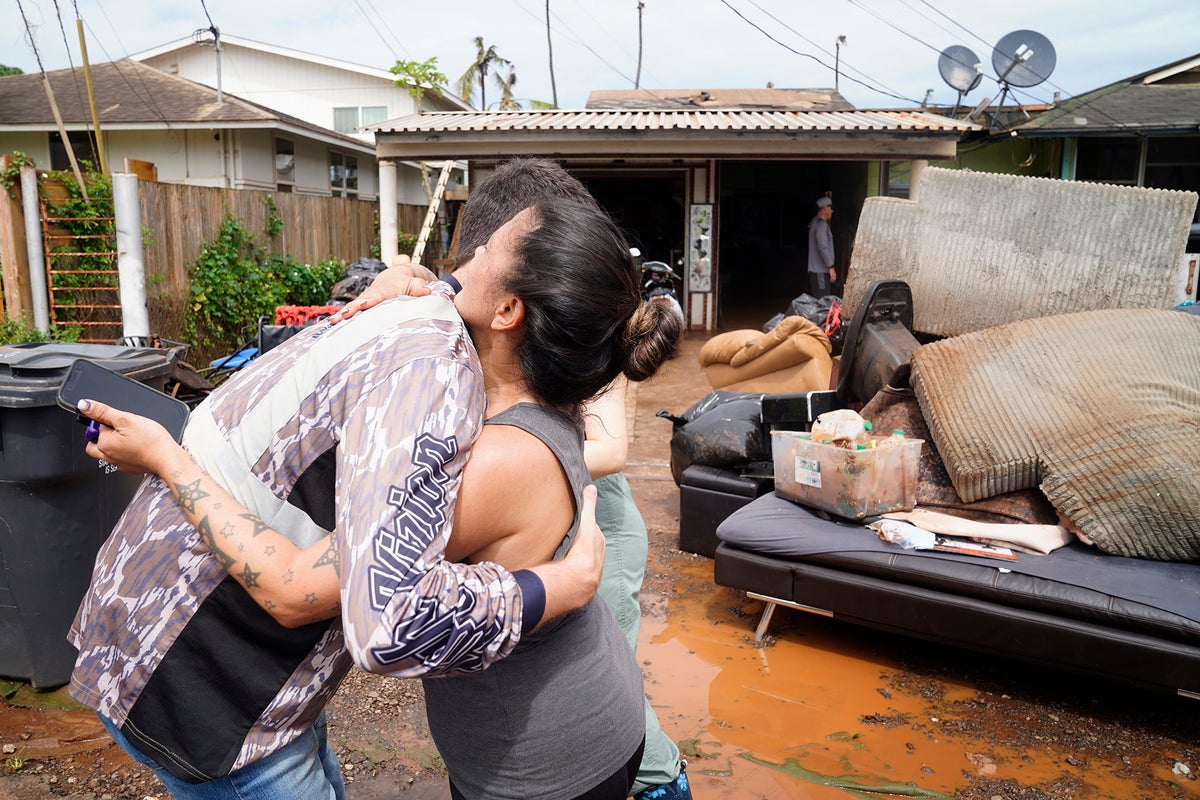
Water doesn't care about your property lines or your architectural dreams. When the sky opened up over Hawaii recently, it didn't just bring rain. It brought a brutal reality check that many residents and officials are still trying to process. We’re seeing a pattern of "once-in-a-century" storms happening every few years now. If you think this was just a streak of bad luck, you're missing the bigger picture.
The damage across the islands—from Kauai’s North Shore to the streets of Oahu—is more than just mud and broken asphalt. It’s a systemic failure. We’ve spent decades building in places where water naturally wants to go, and now we’re acting surprised when the bill comes due. The scope of the damage is becoming clearer, but the solution isn't just about clearing debris. It’s about admitting that our current approach to land management is broken.
Why the Mud Stays Long After the Rain Stops
The immediate aftermath of a flood is chaotic. You see the photos of collapsed roads and flooded living rooms. But the real story is what happens three weeks later. In Hawaii, the volcanic soil creates a specific kind of nightmare. When it gets saturated, it doesn't just get wet; it loses its structural integrity. That’s why we see hillsides simply melting away.
This isn't just about "cleaning up." It’s about the massive cost of stabilizing land that was never meant to be paved over. When the state assesses the scope of damage, they aren't just looking at the holes in the road. They’re looking at the long-term viability of entire neighborhoods. Some of these areas might never be the same.
Public officials often talk about "resilience." It’s a nice word. It sounds proactive. In reality, it usually means "we hope the next one isn't as bad because we can't afford to fix the underlying problem." We need to stop treating these floods like freak accidents. They are the new baseline.
The Massive Economic Toll Nobody Is Calculating Yet
When the news cycle moves on, the local economy keeps bleeding. It’s easy to count the number of houses destroyed. It’s much harder to track the lost wages of people who can't get to work because the only road in or out of their valley is gone.
Small businesses in affected areas often don't have the cash reserves to survive a month of zero foot traffic. Insurance rarely covers the full extent of the "business interruption" that happens when an entire region is paralyzed.
- Road infrastructure: Millions of dollars are gone in a single afternoon when a culvert fails.
- Agriculture: Local farms lose entire harvests, and the topsoil—the literal lifeblood of the land—is washed into the ocean.
- Tourism: Canceled bookings don't just affect hotels; they hit the tour guides, the rental car agencies, and the local restaurants.
The ripple effect is staggering. We’re looking at a recovery timeline that spans years, not months. If you live on an island, there is no "next town over" to source supplies from easily. Everything is more expensive and takes longer.
The Problem With Our Drainage Systems
Most of Hawaii’s drainage infrastructure was designed for a climate that doesn't exist anymore. We’re using mid-20th-century engineering to fight 21st-century storms. The math doesn't add up.
Engineers use something called the "100-year flood" metric to design pipes and channels. The problem? That data is based on historical rainfall patterns. Those patterns are now obsolete. If a "100-year event" happens twice in five years, the metric is useless. We are essentially building umbrellas for a monsoon and wondering why we’re getting soaked.
What Homeowners Get Wrong About Flood Prep
I’ve talked to dozens of people who thought they were safe because they weren't in a "high-risk" flood zone on a map. Those maps are often outdated and don't account for recent development. When you build a new shopping center or a housing tract uphill, you change the way water flows for everyone below you.
Concrete doesn't absorb water. It redirects it. Your neighbor’s new driveway might be the reason your garage is now a swimming pool.
If you're waiting for the government to fix the drainage in your neighborhood, you'll be waiting a long time. The state’s backlog of infrastructure projects is already miles long. You have to take ownership of your own property’s hydrology.
- Check your gutters: It sounds simple, but diverted roof water is a leading cause of localized foundation flooding.
- Look at your slope: If the land around your house doesn't fall away at least six inches over the first ten feet, you’re asking for trouble.
- Hydro-barriers: Don't wait for the sandbag line at the fire station. Keep your own reusable barriers on hand.
The Coastal Erosion Connection
We can't talk about inland flooding without talking about the coast. When heavy rain hits, all that water has to go somewhere—the ocean. But if the sea level is higher and the swells are pushing in, the water has nowhere to go. It backs up into the stream mouths and the drainage pipes.
This is the "squeeze." You’re getting hit from the sky and the sea at the same time. The damage we’re seeing in coastal communities is a preview of the next fifty years. It’s a slow-motion disaster that speeds up every time a storm rolls through.
We have to start having the hard conversation about "managed retreat." That’s a fancy way of saying we need to stop rebuilding in places that the ocean is clearly reclaiming. It’s a political third rail, but ignoring it won't make the water go away.
Fixing the Response Gap
The time between the disaster and the arrival of aid is where the most "hidden" damage occurs. Mold doesn't wait for an insurance adjuster. It starts growing within 24 to 48 hours. If a family is stuck waiting for a FEMA declaration to start tearing out wet drywall, the house might be a total loss by the time the check arrives.
We need a faster, more localized response system. Community-led disaster networks are often more effective than big state agencies in those first critical hours. They have the chainsaws, the trucks, and the knowledge of who needs help most.
The scope of the Hawaii floods is a warning. We can keep patching the holes and pretending things will go back to "normal," or we can start building for the reality we actually live in.
Start by auditing your own property. Don't look at a flood map; look at the ground. See where the water moves when it pours. Buy the supplies you need before the storm is on the radar. Expect that the road will close and the power will go out. The most "comprehensive" recovery plan is the one you start before the clouds turn gray.