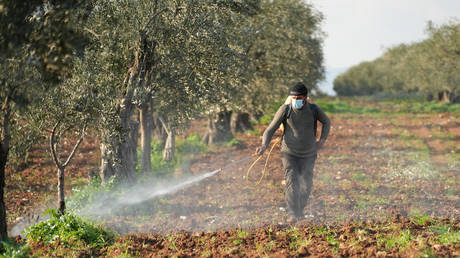
Nearly half of the planet's agricultural workforce faces unintentional poisoning every single year. That is not a marginal occupational hazard. It is a slow-motion public health catastrophe that underpins the modern food supply.
Recent data published in Frontiers in Public Health reveals that an estimated 402 to 433 million farmers and farmworkers suffer acute pesticide poisoning annually out of a global farming population of roughly 934 million. Around 11,000 of those cases result in death, with more than half of those fatalities concentrated in India alone.
We have built an agrochemical treadmill that rewards volume over safety. Global pesticide use has more than doubled since 1990, crossing 3.8 million tonnes annually. Every percentage point increase in crop yield achieved through heavy chemical application carries an uncalculated human receipt, paid primarily by smallholder farmers in the Global South.
The Anatomy of an Invisible Epidemic
Acute pesticide poisoning manifests within hours of exposure. Victims experience severe headaches, relentless vomiting, blurred vision, neurological tremors, and chemical skin burns. Yet these immediate symptoms represent only the visible tip of an enormous iceberg. Chronic, low-level exposure is tied to long-term neurological degeneration, endocrine disruption, and various cancers.
The geographical distribution of these poisonings maps neatly onto existing global inequities. Southern Asia, Southeast Asia, and eastern Africa bear the heaviest non-fatal burdens. In nations like Burkina Faso, field estimates suggest that up to 84 percent of agricultural workers experience acute poisoning symptoms annually.
Standard protective gear offers little practical defense in these regions. Consider a hypothetical farmer working a cotton plot under a punishing forty-degree Celsius sun. Wearing full chemical-resistant personal protective equipment is virtually impossible without risking heatstroke. Respirators, rubber aprons, and heavy gloves quickly become sweat traps, forcing workers to strip away barriers just to breathe and function.
Market Forces and Regulatory Failures
Agrochemical corporations continue to push highly hazardous formulations into markets with weak regulatory oversight. Chemicals restricted or outright banned in the European Union are routinely exported to developing nations. Local distribution networks frequently lack adequate safety instructions, and packaging often features instructions printed in languages foreign or unreadable to the end user.
Illiteracy compounds the danger. When safety labels cannot be read, mixing ratios are guessed. Knapsack sprayers leak onto bare skin during application, and contaminated work clothing is washed alongside family garments in local water sources. Women, who comprise a massive share of the agricultural labor force engaged in weeding and harvesting, face heightened risks while lacking access to proper training or medical care.
Local clinics rarely possess the diagnostic tools or clinical training required to identify chemical poisoning correctly. Symptoms are frequently misdiagnosed as routine heat exhaustion, malaria, or ordinary viral infections. Consequently, official health statistics drastically undercount the true incidence rate.
The Economics of Chemical Dependency
Why do farmers keep using compounds that poison them? The answer lies in structural dependency. Agrarian supply chains and credit systems often mandate specific chemical inputs as a condition for loans or cooperative membership. Yield pressures leave little room for experimentation.
Agroecological alternatives exist, but they require structural investment, localized knowledge transfer, and institutional support that national governments rarely prioritize. Pest management without heavy synthetic chemistry demands labor-intensive practices, crop rotation, and biological controls. When credit is tight and survival is daily, farmers default to the chemical juggernaut because it offers a predictable short-term shield against total crop loss.
The transition away from highly hazardous pesticides requires more than voluntary corporate pledges or token phase-out targets set decades into the future. It demands an aggressive restructuring of international trade standards, strict liability for chemical manufacturers exporting restricted substances, and direct financial support for workers shifting toward sustainable farming practices. Until those systemic changes occur, millions of agricultural workers will continue to absorb the true toxic cost of our daily bread.