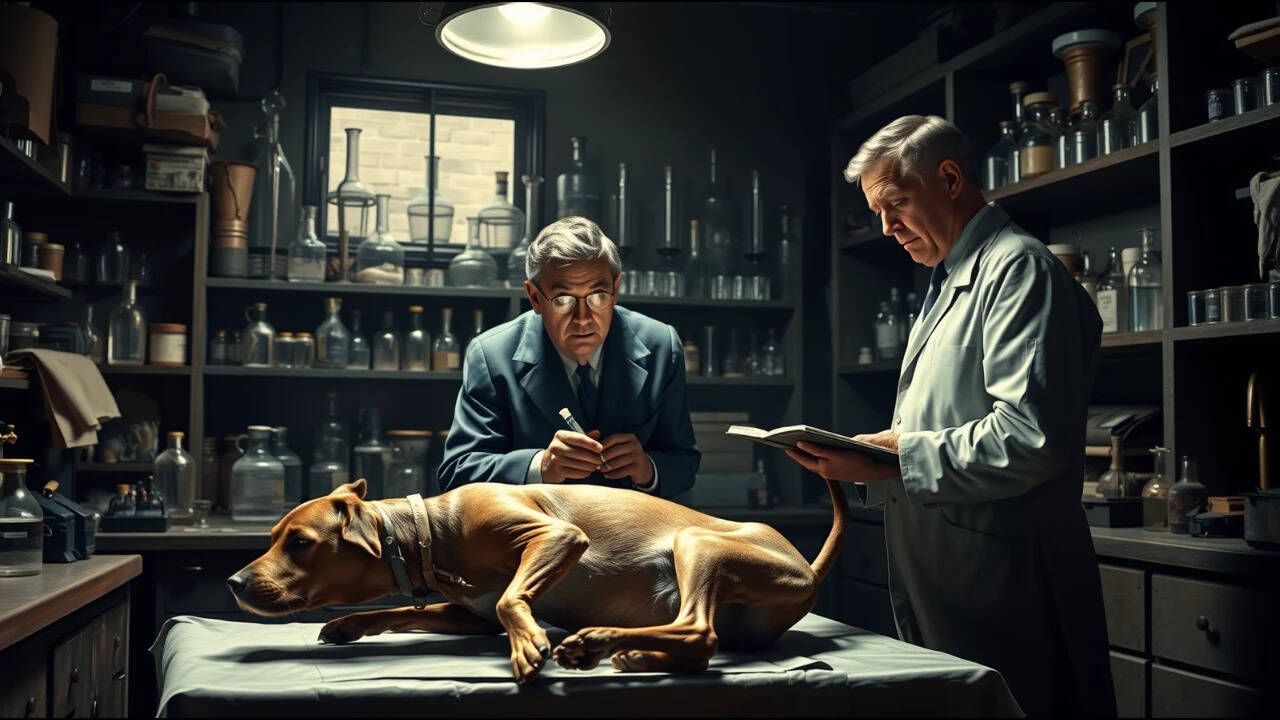
History loves a fuzzy-wuzzy narrative. Give the public a suffering dog, a pair of earnest young doctors in a Toronto lab, and a miraculous recovery, and you have a legend that lasts a century. The lazy consensus of medical history tells us that in 1921, a diabetic dog named Marjorie or one of her canine ward-mates reacted to a crude pancreatic extract, paving a golden road toward the salvation of millions of humans with type 1 diabetes.
It is a neat, tidy story. It is also fundamentally misleading, historically distorted, and designed to obscure the messy, cutthroat reality of how modern endocrinology was actually forged.
If you look past the sentimental mythology of the barking beagle in the University of Toronto basement, you find a story of academic turf wars, overlooked European pioneers, and a Nobel Prize awarded for engineering a administrative coup rather than the foundational science. The dog didn't pave the way. The dog was simply a convenient prop in a high-stakes race where the finish line had already been drawn by men history forgot.
The Myth of the Accidental Canine Miracle
The standard telling goes like this: Frederick Banting, an obscure surgeon with a half-baked idea, teamed up with medical student Charles Best in the scorching summer of 1921. They tied off pancreatic ducts in dogs, waited for the digestive enzymes to degenerate, extracted the remaining internal secretions, and injected it into pancreatectomized animals. Blood sugar plummeted. Miracle achieved.
Except Banting and Best did not invent the core hypothesis, nor were they even the first to successfully lower blood sugar with pancreatic extracts.
Decades earlier, in 1889, Oskar Minkowski and Joseph von Mering proved the pancreas regulated sugar metabolism by removing the organ from dogs and watching them develop severe diabetes. By the early 1900s, researchers across Europe were hot on the trail. Nicolae Paulescu in Romania had successfully isolated an anti-diabetic substance from pancreatic tissue—which he called pancreine—and demonstrated its glucose-lowering effects on diabetic dogs months before Banting and Best ever tied their first duct.
Paulescu published his findings in French and Romanian journals in 1921. His extracts worked. His science was sound. Yet, because he was working in post-war Eastern Europe without the slick institutional backing of a major North American university, history relegated him to a footnote while the Toronto PR machine went into hyperdrive.
When the Nobel Committee awarded the 1923 Prize in Physiology or Medicine to Banting and John Macleod, they egregiously snubbed Best—whom Banting rightly or wrongly resented—and completely bypassed Paulescu. A furious scientific controversy erupted immediately, but the press preferred the romantic image of the scrappy Canadian doctors saving a canine patient. The dog became the mascot of a stolen narrative.
Why the Animal Model Distorts the Modern Reality
We cling to the 1921 dog narrative because it comforts us. It suggests that medical breakthroughs happen in cinematic bursts of inspiration, tested on loyal beasts, leading directly to human salvation.
The truth is far more bureaucratic and brutal. Animal models in early endocrinology were notoriously crude. The extracts Banting, Best, and biochemist James Collip injected into those early dogs were toxic sludge compared to what we use today. They contained impurities that caused horrific abscesses, sterile fevers, and violent allergic reactions. The first human patient given the extract, a 14-year-old boy named Leonard Thompson, suffered a severe allergic reaction in January 1922 because the extract was too impure. It was only when Collip applied rigorous biochemical fractionation that a usable therapeutic emerged.
Yet, modern medical marketing still relies on the "heroic animal test" trope to sanitize the pharmaceutical pipeline. We pretend that translational research is a straight line from a howling hound in a lab to a pharmacy shelf.
It is not. It is a meat grinder of patent disputes, corporate buyouts, and institutional ego. Banting himself was notoriously insecure about his lack of formal physiological training. He threatened to physically assault Best on multiple occasions, and his relationship with Macleod—who provided the lab space, the funding, and the scientific oversight—deteriorated into bitter public feuds over who deserved the glory.
If you want to understand why our current drug development ecosystem is broken, look right here. We reward the person who held the syringe, not the person who mapped the architecture. We celebrate the flashy public relations victory while burying the systemic theft of intellectual property.
Dismantling the Insulin Industrial Complex
Fast forward a century, and the legacy of 1921 has morphed into something entirely antithetical to what science should be. The descendants of those Toronto extracts are now locked behind a corporate fortress that prices life-saving molecules beyond the reach of the people who need them.
The standard narrative tells us we should be eternally grateful to the inventors of insulin. I hear this argument constantly from pharma apologists: Without the discovery, millions would die, so stop complaining about the cost.
This is a false dichotomy designed to protect predatory pricing models. Banting and Best infamously sold their patent for one dollar to the University of Toronto, declaring that insulin belonged to the world, not to them. They wanted it to be accessible. They understood that a molecule synthesized by the human body should not become a luxury commodity.
Yet today, three massive corporate entities control the global insulin market, engaging in synchronized pricing strategies that would make a 19th-century cartel blush. They use the nostalgic memory of 1921 as a shield. Every time a congressional hearing questions why the price of a synthetic analog has skyrocketed by over a thousand percent without significant structural reformulation, the industry invokes the noble tradition of Canadian discovery.
They weaponize our historical sentimentality to justify modern extortion.
The Uncomfortable Truth About Metabolic Disease
If we are going to talk honestly about diabetes, we need to stop treating insulin as a magical moral redemption for a failing metabolic system.
In 1921, insulin was a definitive miracle because the patients arriving at Toronto General Hospital were essentially walking skeletons. Type 1 diabetes was an absolute death sentence; children were placed on near-starvation diets until they wasted away to nothing. In that context, an extract that restored even temporary glycemic control was nothing short of resurrection.
Today, the vast majority of people with metabolic dysfunction do not have type 1 autoimmune destruction of their beta cells. They have type 2 diabetes—a condition driven by chronic hyperinsulinemia, ultra-processed food environments, and systemic cellular resistance.
Yet, our medical establishment treats type 2 diabetes with the exact same 1921 playbook: pump more of the hormone into a body that is already drowning in it.
We hand out insulin prescriptions like candy to type 2 patients without addressing the upstream drivers of metabolic inflammation. We give them a drug to manage the symptoms of a poison while the food industry continues to pump that poison into every grocery aisle in the developed world. The medical-industrial complex loves this loop. It ensures lifelong customers. You eat garbage, your pancreas struggles, you take insulin, you gain more weight, you need more insulin.
The dog in the Toronto lab didn't teach us how to prevent metabolic disease. It taught us how to manage the wreckage after it happens. And for a century, we have mistaken management for a cure because management is profoundly profitable.
Re-Engineering How We View Medical History
It is time to strip the romantic varnish off the history of medicine.
When you read about a monumental breakthrough, look past the PR firms and the university press releases. Ask who got pushed out of the footnotes. Ask who funded the lab. Ask how a public-domain discovery engineered for the common good was weaponized into a multi-billion-dollar rent-extraction scheme.
Banting and Best did not pull a miracle out of thin air in 1921. They stood on the shoulders of European scientists whose work they conveniently ignored, backed by a university that aggressively protected its brand, and aided by a dog whose suffering was sensationalized to cement a national myth.
Stop buying the fairy tale. The real history of medicine isn't a heartwarming movie about a doctor and his dog. It's a brutal, cutthroat war for priority, profit, and control—a war that continues to claim victims every single day at the pharmacy counter.