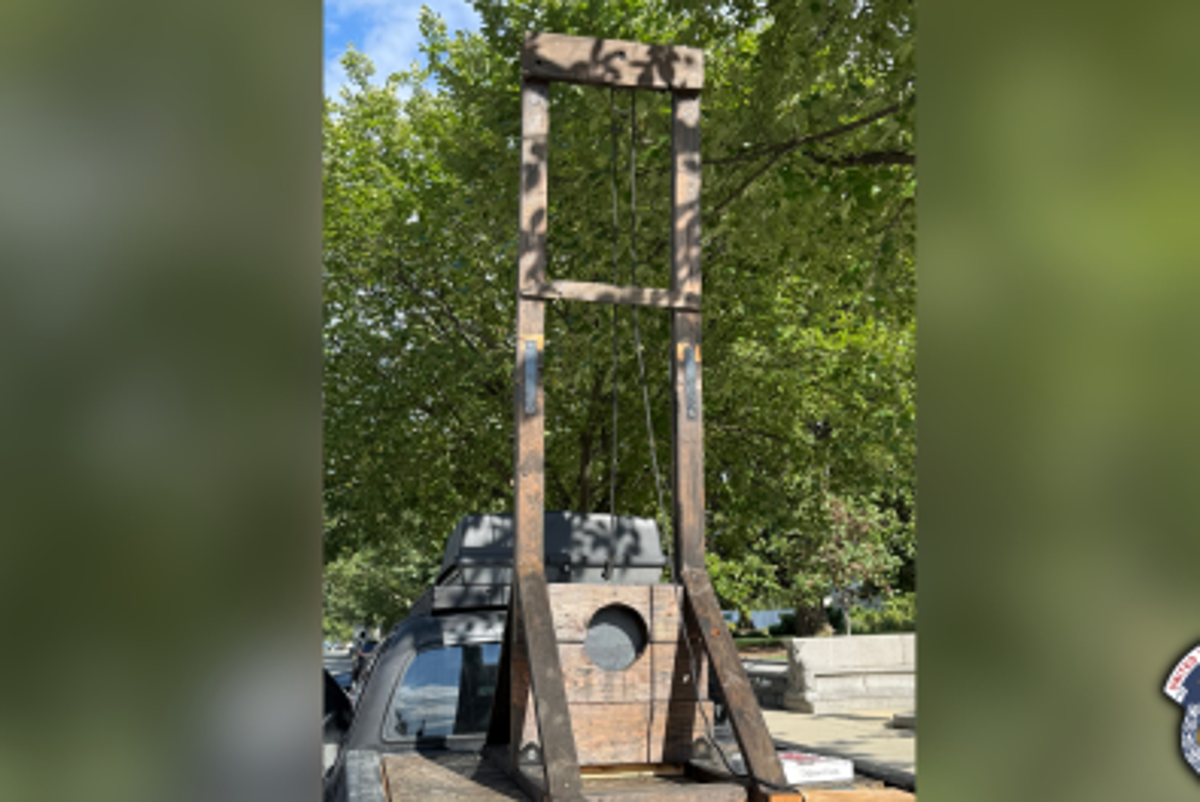
When 35-year-old Philan-Tam-Duy Le guided his pickup truck across thousands of miles of American interstate highway, he was not hauling standard cross-country cargo. In the open bed of his vehicle stood a fully assembled, functional wooden guillotine.
By the time United States Capitol Police intercepted the vehicle near the Supreme Court building, the stunt had transitioned from an eccentric highway sighting to an explicit federal security breach. Le, hailing from the mountain community of Julian, California, was promptly arrested and charged with carrying a dangerous weapon. Law enforcement officials were left staring down an instrument historically reserved for the Reign of Terror, suddenly parked in the heart of American democracy.
This bizarre spectacle provides more than a strange headline for the evening news cycle. It serves as a symptom of a deeper, more fractured political psyche in contemporary America, where theatrical rage increasingly translates into tangible, physical acts of escalation.
The Anatomy of a Cross-Country Protest Stunt
Driving across the continental United States requires endurance, planning, and a significant financial investment in fuel. Doing so with a towering wooden execution device strapped into your truck bed transforms that journey into a rolling performance piece.
Investigators are currently piecing together the timeline of Le’s route from Southern California to Washington, D.C. Highways connecting the Pacific coast to the mid-Atlantic span roughly three thousand miles of changing landscapes, quiet towns, and indifferent motorists. How an individual manages to transport a towering symbol of revolutionary decapitation across state lines without triggering immediate local interdiction speaks volumes about the insular bubble of long-distance driving.
It is easy to dismiss the incident as an isolated performance by a deeply troubled individual. Yet, public demonstrations involving mock execution devices have slowly crept into the perimeter of modern political discourse. From effigies hanging from gallows outside state capitols to theatrical guillotines hauled to the gates of elected officials, the line between protected hyperbole and threatening intimidation has worn razor-thin.
When a prop moves from a localized rally to a federal enclave like the U.S. Capitol, the legal threshold changes entirely. Capitol Police officers do not need to wait for a blade to drop to recognize an immediate public safety hazard. The mere presence of an operable dangerous weapon within a security zone designed to protect lawmakers and jurists invites swift containment.
The Psychology of Escalation and Symbolic Violence
Why a guillotine?
As an artifact, the device carries a specific, unavoidable semiotic weight. Invented during the French Revolution as a supposed humanitarian alternative to drawn-out forms of capital punishment, it quickly transformed into the ultimate emblem of elite downfall and civic bloodletting. It tells a story of absolute rejection of authority. It whispers of a total reset achieved through lethal theatre.
When modern protesters adopt these historical tropes, they are attempting to borrow the gravity of past revolutions. They want the aesthetic of radical overthrow without always reckoning with the chaos that follows. Yet, translating historical French iconography into modern American protest culture exposes a profound disconnect from functional civic change.
Political analysts spend countless hours mapping polarization through voting patterns, polling data, and social media echo chambers. They measure anger via algorithm. They rarely capture anger in raw, physical timber and steel.
The suspect's reported grievances—directed broadly at political figures across the partisan spectrum, including Donald Trump and California Governor Gavin Newsom—highlight a generalized fury that refuses to align with traditional left-right binaries. This is not partisan activism in the traditional sense. This is an anti-systemic nihilism, where the targets are interchangeable as long as they represent institutional power.
The Security Dilemma at the Heart of Washington
Securing an open capital city against mobile threats remains an impossible puzzle for federal law enforcement. Millions of visitors pass through the District of Columbia every year. Thousands of commercial trucks enter the metropolitan area daily, hauling everything from construction supplies to consumer goods.
When a threat arrives not as an anonymous package or a digital manifesto, but openly displayed in daylight atop a standard pickup truck, it forces a re-evaluation of perimeter defense. Capitol Police officers rely heavily on visual cues and behavioral detection in public zones. Spotting an eight-foot wooden blade assembly does not require advanced counter-terrorism intelligence; it requires basic pattern recognition of what does not belong on East Capitol Street.
Yet, the fact that Le navigated thousands of miles before interdiction raises hard questions. Local highway patrols across multiple states crossed paths with or ignored a vehicle carrying a medieval execution instrument. Was it viewed as a quirky roadside novelty? Did onlookers simply assume it was a movie prop or a misguided art installation?
In a culture desensitized by shock value and viral stunts, the boundary between dangerous intent and performance art has blurred for the general public just as much as it has for the extremists.
The Broader Cultural Reckoning
We have built a media ecosystem that rewards scale over substance, where extreme imagery guarantees immediate visibility. When political expression demands an escalating ante to break through the noise, individuals pushed to the margins of sanity find themselves tempted to build bigger, louder, and more dangerous manifestations of their grievances.
The wooden frame seized by federal authorities will eventually be logged into an evidence locker, photographed for case files, and ultimately destroyed. The truck will be reclaimed. The interstate will continue to carry millions of indifferent commuters from coast to coast.
The underlying rot remains untouched. A society that watches a man drive a guillotine across a continent with a mixture of dark humor and numb resignation is a society that has normalized the theater of cruelty. Until we confront the structural exhaustion driving people toward these dark, performative extremes, the next truck will simply carry a different weapon down the same highway.