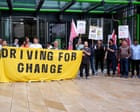
Transport for London is facing a landmark High Court challenge over systemic administrative failures that leave thousands of private hire drivers legally barred from working while waiting for routine licence renewals. Julius Mugabo, a 55-year-old Uber driver who has held a TfL licence since 2016, took the statutory authority to court after renewal delays pushed him thousands of pounds into debt and nearly caused his family's eviction. While public attention often fixates on corporate giants like Uber or Bolt, the real crisis unfolds behind the scenes in bureaucratic backlogs that deny working-class motorists their fundamental right to earn a living.
Under the Private Hire Vehicles (London) Act 1998, operating without a valid, TfL-issued licence is a criminal offense. Drivers cannot simply keep working on an expired badge while paperwork crawls through the queue. When administrative inertia stalls an application, the financial collapse for a sole trader is immediate and absolute.
The Mechanics of Administrative Collapse
The architecture of London's private hire licensing system relies entirely on timely regulatory oversight. Drivers are instructed to submit their renewal paperwork months in advance to ensure continuous authorization. Yet, thousands of applicants find themselves trapped in a prolonged bureaucratic limbo.
Administrative delays are rarely born out of simple laziness. Instead, they stem from a collision between antiquated internal workflows, digital platform updates, and chronic understaffing within municipal processing departments. When a driver submits a renewal, files must undergo enhanced background checks, medical verifications, and right-to-work audits.
If a single document gets misfiled or flagged by automated filters, the application is dropped into a secondary review queue. In this digital purgatory, communication breaks down entirely. Drivers receive automated holding messages or demands for paperwork they already submitted weeks prior.
Consider a hypothetical scenario to illustrate the scale of vulnerability. A driver earning a modest weekly income relies entirely on continuous employment to cover vehicle financing, residential rent, and family provisions. If administrative processing stretches three months past the expiration date, that worker faces total asset liquidation. Savings vanish within weeks. Debt accrues exponentially through high-interest loans or frozen tax obligations. By the time the regulatory body issues the physical badge, the driver's financial stability has been utterly dismantled.
Quantifying the Human and Financial Toll
The legal action brought by Mugabo, supported by the Independent Workers' Union of Great Britain and law firm Deighton Pierce Glynn, exposes a widespread pattern rather than an isolated administrative glitch. Freedom of Information data reveals that nearly 18,000 drivers have received goodwill payments ranging between three and five hundred pounds due to processing delays.
Small financial compensation packages fail to address structural devastation. A payment of four hundred pounds does not resolve accumulated tax penalties, mounting council tax arrears, or court fees incurred during housing eviction proceedings. Mugabo watched a manageable tax obligation swell dramatically because he was legally prohibited from generating income to clear the balance.
Mr Justice Sweeting, granting permission for a full judicial review, noted that the delays caused immediate and severe consequences for the claimant and his household. The legal challenge focuses on two primary arguments. First, whether Parliament intended for a statutory authority to maintain a competent system capable of determining applications before existing credentials expire. Second, whether the failure to do so violates the legitimate expectations established by the regulator's own published guidance.
Structural Vulnerabilities in the Gig Economy Workforce
The demographic makeup of London's private hire sector adds urgency to the controversy. A vast majority of app-based drivers belong to migrant communities or working-class backgrounds with limited safety nets. Public institutions often treat these workers as disposable units of urban infrastructure.
When platform companies face regulatory pressure, they adjust algorithms or lobby policymakers. When independent drivers face administrative paralysis, they absorb the total loss. The regulatory machinery operates with absolute immunity from the financial consequences it inflicts. If a corporate entity misses a filing deadline, financial penalties apply. When a public regulator misses a statutory processing window by months, the affected worker bears the criminal liability and the debt burden.
Internal changes at TfL, including the introduction of updated digital licensing portals and recovery efforts following technical disruptions, have failed to clear the backlog permanently. Temporary stopgaps, such as the occasional issuance of short-term licences, arrive only after legal representation intervenes or public protests gain traction.
Systemic reform requires accountability mechanisms that penalize bureaucratic failure just as severely as unauthorized driving. Until the courts compel regulatory authorities to respect the economic survival of the workforce they oversee, administrative delays will remain an invisible tax on London's most vulnerable earners.