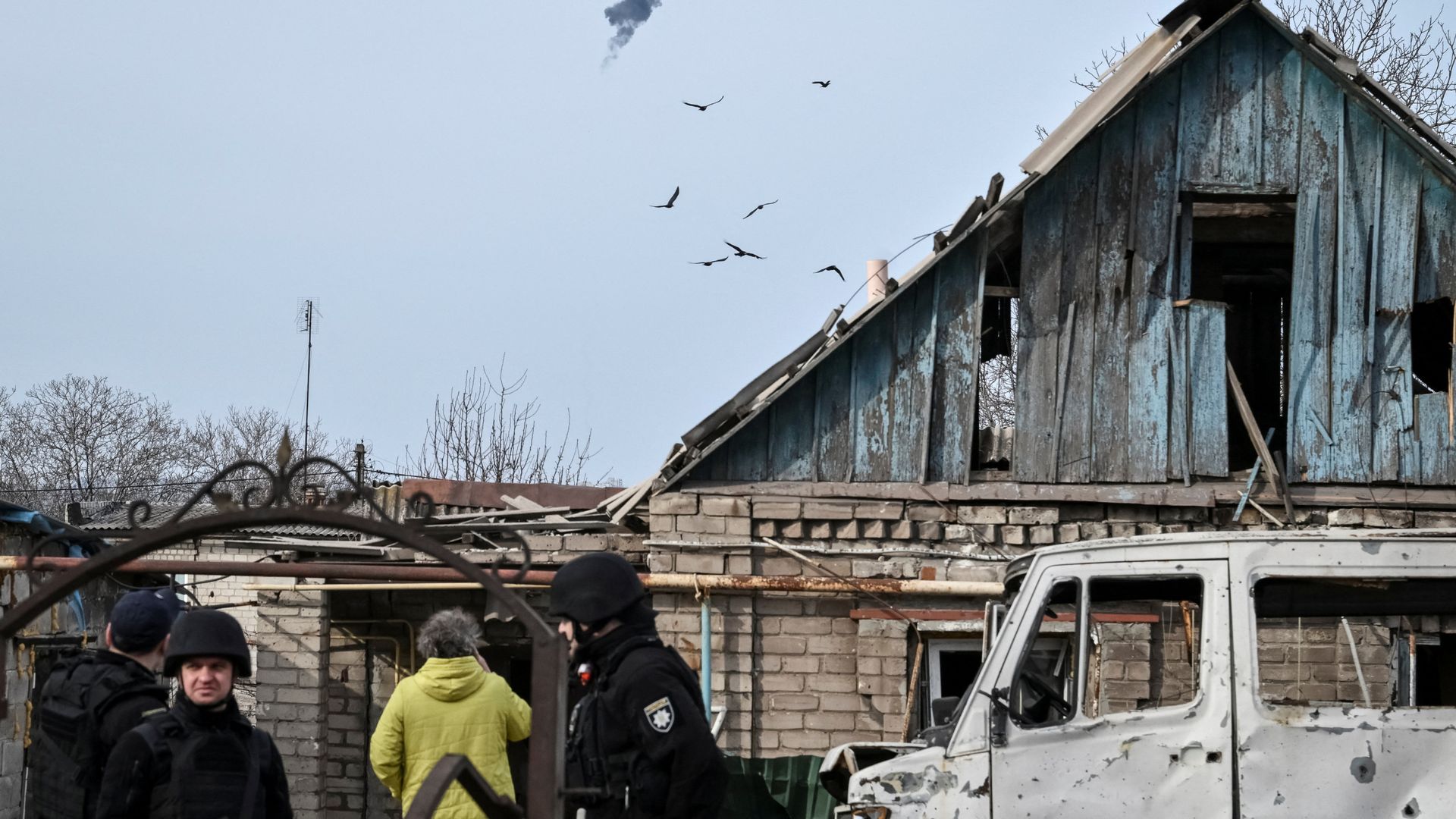
The current Russian aerial campaign against Ukrainian infrastructure has transitioned from a strategy of broad psychological terror to a disciplined program of kinetic attrition. This shift is defined by the utilization of low-cost loitering munitions, specifically the Geran-2 (Shahed-136 derivative), to exploit the widening gap between the cost of offense and the cost of defense. By targeting the electrical transmission nodes and civilian population centers simultaneously, the Russian military is not merely seeking "hits" but is executing a calculated disruption of the National Energy Entropy, forcing the Ukrainian state to divert finite air defense resources away from the front lines to protect static economic assets.
The Triad of Tactical Objectives
To understand the efficacy of recent strikes—which have resulted in at least two confirmed fatalities and significant power outages—one must categorize the impact into three distinct operational pillars: You might also find this related article useful: The $2 Billion Pause and the High Stakes of Silence.
- Grid Degradation: The primary objective is the destruction of non-redundant transformers and switching stations. Unlike generating plants, which are often hardened, transmission infrastructure is exposed and difficult to replace due to long-lead manufacturing times for high-voltage equipment.
- Saturation of Interceptors: Every $20,000 drone that forces the launch of a $2,000,000 interceptor missile represents a net loss in the "Defensive Capital Ratio."
- Psychological Friction: By introducing lethality into civilian zones, the attacker increases the political pressure on the Ukrainian government to prioritize urban defense over tactical military support, creating "safe" corridors for Russian ground maneuvers.
The Physics of Grid Vulnerability
The vulnerability of the Ukrainian energy sector is not a product of poor engineering but a legacy of Soviet-era centralized architecture. The grid functions as a high-inertia system; it requires a constant balance between generation and load. When a drone strike severs a primary transmission line or destroys a substation, the system experiences a transient frequency deviation.
If the deviation exceeds specific thresholds, protective relays trigger automatic shedding, leading to the "cascading failures" observed in recent reports. The destruction of a single 750kV transformer can isolate entire regions because these components are not modular; they are bespoke industrial assets. Replacing them requires specialized logistics that are easily tracked and targeted during the installation phase. As highlighted in latest reports by NPR, the results are significant.
Economic Asymmetry in Loitering Munitions
The Russian reliance on the Geran-2 platform demonstrates a mastery of Asymmetric Cost Imposition. The drone’s architecture is intentionally primitive:
- Propulsion: A basic four-cylinder two-stroke engine.
- Navigation: Civil-grade GNSS modules supplemented by inertial navigation systems (INS) to counter electronic warfare (EW) jamming.
- Payload: Approximately 40kg of high explosives, sufficient to rupture the cooling jackets of industrial transformers.
The "Cost-to-Kill" ratio is heavily skewed in favor of the attacker. While Western-supplied systems like NASAMS or IRIS-T possess high intercept probabilities ($P_k > 0.9$), the sheer volume of incoming targets creates a "depletion bottleneck." The defender eventually faces a binary choice: allow the drone to hit the target or exhaust the missile stockpile, leaving the airspace open for more sophisticated cruise missiles or ballistic threats.
Electronic Warfare and the Signal-to-Noise Barrier
A critical variable in these engagements is the efficacy of Ukrainian Electronic Warfare (EW). To mitigate drone strikes, defenders employ "spoofing" and "jamming" to disrupt the GPS/GLONASS signals the drones rely on.
The technical struggle follows a predictable cycle:
- Phase 1 (Jamming): High-power noise is broadcast to drown out satellite signals.
- Phase 2 (Hardening): The attacker integrates CRPA (Controlled Reception Pattern Antennas) to ignore noise coming from the ground.
- Phase 3 (Optical Navigation): The latest iterations of these drones have begun utilizing rudimentary machine vision to recognize terrain features, rendering traditional EW obsolete.
This evolution suggests that the "two fatalities" mentioned in recent reports may be the result of drones that were successfully jammed but subsequently fell into residential areas, or drones that utilized backup inertial navigation to hit approximate coordinates when their primary signals were lost.
The Humanitarian Burden as a Strategic Variable
The loss of life in these strikes functions as a force multiplier for Russian strategic goals. In a data-driven analysis of conflict, civilian casualties are often categorized as "collateral," but in the context of an energy war, they serve a specific function: Resource Redirection.
When a drone hits a residential building, the immediate response requires:
- Search and rescue (SAR) units.
- Emergency medical services.
- Localized power restoration.
- Political communication efforts.
Each of these actions consumes "State Bandwidth." By maintaining a steady cadence of low-level lethality, the Russian military ensures that the Ukrainian state remains in a reactive posture, unable to consolidate the quiet periods necessary for long-term infrastructure hardening or economic recovery.
Quantifying the Defensive Ceiling
There is a theoretical limit to how many drones a localized air defense can engage before a "Leakage Event" occurs. This is defined by the Service Rate vs. Arrival Rate formula:
$$\mu > \lambda$$
Where $\mu$ is the rate at which the defense can identify, track, and destroy targets, and $\lambda$ is the rate at which drones enter the protected airspace. If $\lambda$ exceeds $\mu$ for even a short duration (a "swarm" tactic), the probability of a hit on a high-value target approaches 100%. Recent strikes indicate that Russian commanders are optimizing their launch intervals to specifically test these local saturation points, particularly in regional hubs like Zaporizhzhia or Sumy, where defensive density is lower than in Kyiv.
Strategic Recommendation: Decentralization and Active Hardening
To counter this persistent threat, the Ukrainian strategy must move beyond "Interception" and toward "Resilience." Relying on expensive missiles to stop cheap drones is a losing long-term economic play. The focus must shift to:
- Passive Defense (Berming): Constructing physical barriers around transformers. While a drone can penetrate a roof, Hesco bastions and reinforced concrete walls can mitigate the lateral blast fragments that cause the most damage to sensitive cooling fins.
- Micro-Grid Proliferation: Reducing the reliance on large, centralized substations. By deploying modular, containerized energy solutions and industrial-scale battery storage, the impact of a single kinetic hit is localized rather than regional.
- Low-Cost Kinetic Interceptors: Deploying anti-aircraft cannons (e.g., Gepard or Viktor systems) and "First-Person View" (FPV) interceptor drones. These systems bring the "Defensive Capital Ratio" back toward parity by using $500–$1,000 solutions to kill $20,000 targets.
The persistence of the Russian drone campaign confirms that the "Energy Front" is now as critical as the "Donbas Front." The objective is no longer the total collapse of the grid—which has proven resilient—but the steady, grinding exhaustion of Ukraine's technological and human capital. Success for the defender will be measured not by the number of drones shot down, but by the speed at which the "Cost of Defense" can be lowered to a sustainable level.
Would you like me to generate a comparative analysis of the specific interceptor systems currently deployed against these loitering munitions?