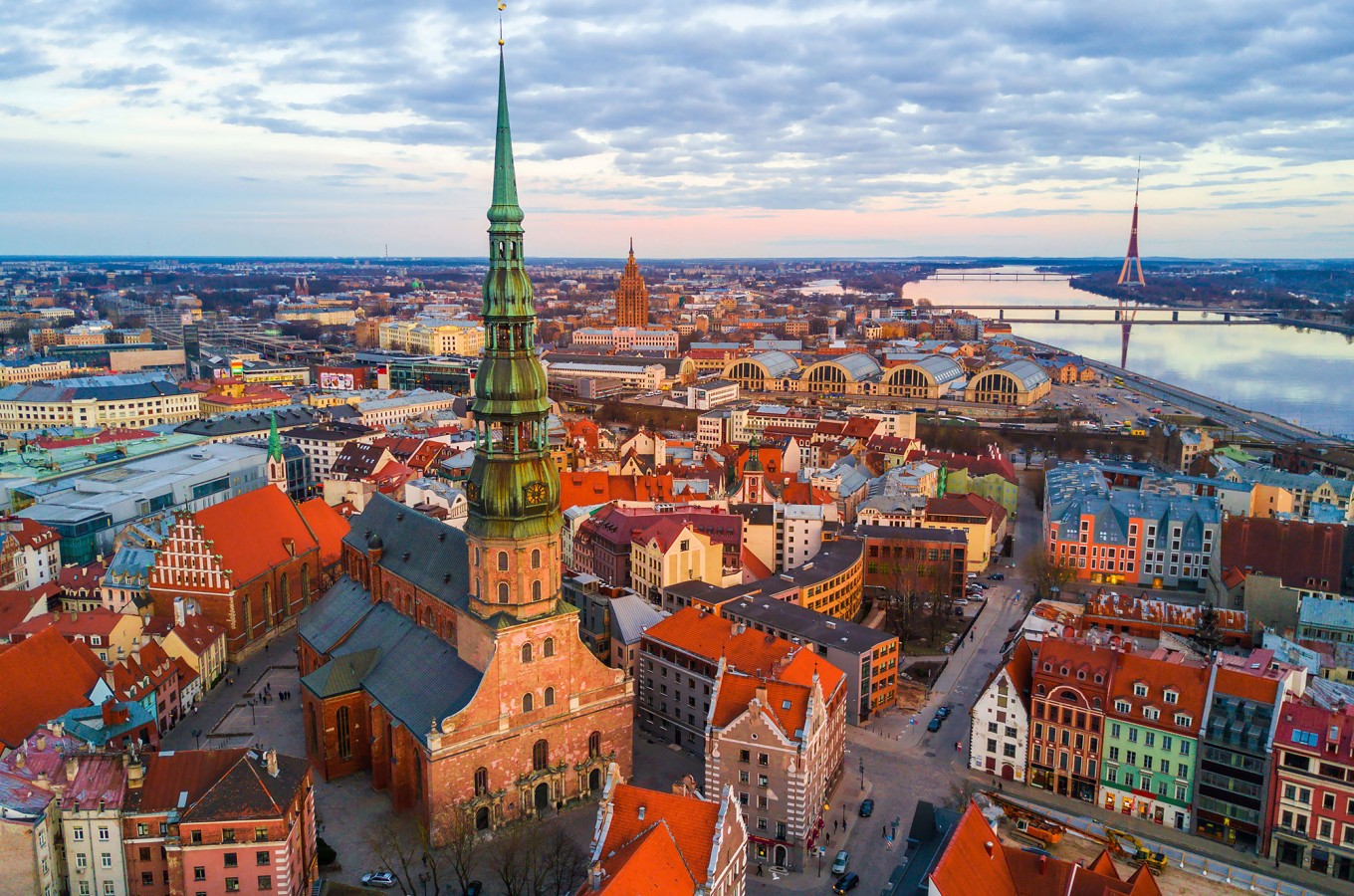
Political realignment in Riga is rarely an ideological event; it is an exercise in fiscal triage. When Latvia’s Saeima (parliament) confirms a new governing coalition with an explicit mandate to prioritize the economy, the underlying reality is a structural collision between stagnant productivity, demographic contraction, and escalating security expenditures. Standard political reporting frames cabinet confirmations around personality shifts and party compromises. Operational analysis requires looking at the balance sheet the incoming administration inherits and the narrow corridor of policy instruments available to alter it.
To understand the viability of Latvia’s economic pivot, one must separate political rhetoric from macroeconomic constraints. As a small, open economy operating within the Eurozone, Latvia lacks independent monetary policy. The European Central Bank dictates interest rates and money supply. Consequently, the Latvian cabinet cannot devalue its currency to boost export competitiveness, nor can it print money to finance domestic stimulus. Every economic lever available to Riga sits firmly within the domains of fiscal allocation, regulatory friction, tax architecture, and state-owned enterprise management. Discover more on a connected issue: this related article.
The Trilemma of Latvian Fiscal Policy
Any governing coalition in Latvia immediately confronts an intractable fiscal trilemma. The administration must simultaneously satisfy three competing demands without breaching European Union debt and deficit thresholds:
- Mandatory Defense Escalation: Bordering Russia and Belarus, Latvia treats defense spending not as discretionary fiscal policy, but as an existential fixed cost. Pushing military expenditure toward and beyond three percent of Gross Domestic Product diverts billions of euros away from productive domestic infrastructure and human capital development.
- Social Welfare Stabilization: Latvia faces severe demographic headwinds, characterized by an aging population and persistent net emigration over the past two decades. Maintaining pension solvency and healthcare delivery requires a growing share of the state budget, funded by a shrinking ratio of active taxpayers to retirees.
- Tax Competitiveness: Neighboring Estonia and Lithuania aggressively compete for the same pool of foreign direct investment and regional headquarters. Raising corporate or labor taxes to fund defense and welfare immediately triggers capital flight and incentivizes informal economic activity.
When a newly confirmed government declares an economic focus, it is signaling an attempt to break out of this trilemma by expanding the denominator—GDP growth—rather than endlessly redistributing a stagnant tax base. Achieving this requires dismantling structural bottlenecks that previous administrations left intact. More reporting by The Washington Post explores similar views on the subject.
Deconstructing the Baltic Growth Divergence
Over the past decade, Latvia’s economic trajectory has consistently trailed that of its Baltic peers, Lithuania and Estonia. While all three nations share similar post-Soviet institutional histories and Eurozone membership, their structural outputs have diverged due to differences in capital allocation and regulatory velocity.
The Cost of Capital and Credit Contraction
Latvia’s banking sector remains heavily risk-averse following sweeping anti-money laundering reforms enacted in the late 2010s. While those reforms successfully purged illicit non-resident financial flows and restored international compliance credibility, they also produced an unintended secondary effect: severe credit rationing for legitimate domestic small and medium-sized enterprises. Commercial lending to the private sector as a percentage of GDP sits significantly below the Eurozone average. A government focused on economic expansion must address this credit bottleneck by expanding state-backed development finance instruments, such as Altum, to de-risk private bank lending for industrial modernization and export scaling.
The Shadow Economy Drag
Informal economic activity—specifically underreported wages ("envelope salaries") and value-added tax evasion—consumes roughly one-fifth to one-quarter of Latvia’s potential economic output, according to recurring studies by the Stockholm School of Economics in Riga. This creates a destructive feedback loop. High labor taxes incentivize businesses to pay workers under the table; lower tax collection forces the state to maintain high statutory rates on compliant businesses, penalizing the exact firms capable of scaling transparently. Reforming the labor tax wedge—the difference between what an employer pays and what an employee takes home—is the primary mechanism for formalizing this hidden capital.
State-Owned Enterprise Inefficiency
Large state-owned enterprises (SOEs) dominate critical sectors of the Latvian economy, including energy (Latvenergo), forestry (Latvijas valsts meži), telecommunications (Tet and LMT), and transport (airBaltic and Latvijas dzelzceļš). Historically, political coalitions have treated these entities as steady dividend-generating utilities to plug annual budget deficits, rather than engines of capital market development. Listing minority stakes of profitable SOEs on the Nasdaq Baltic exchange serves a dual operational purpose: it enforces strict international corporate governance standards on management, and it deepens local capital markets, giving domestic pension funds liquid regional assets to invest in rather than exporting Latvian savings to Western European equities.
Operational Execution and Coalition Friction
Forming a parliamentary majority in Latvia’s fragmented multiparty system requires assembling coalitions across ideological fault lines—often pairing center-right fiscal conservatives with agrarian populists or centrist technocrats. This parliamentary arithmetic introduces execution risk at every stage of legislative implementation.
Consider the mechanics of bureaucratic deregulation. Every coalition agreement promises to reduce administrative overhead for businesses. Yet, ministries are frequently divided among competing coalition partners, creating institutional silos. When the Ministry of Economics proposes streamlining construction permits or environmental impact assessments to accelerate industrial investment, the Ministry of Environmental Protection and Regional Development—often controlled by a rival party—retains procedural veto power. Without centralized prime ministerial enforcement and strict key performance indicators tied to ministerial budgets, deregulation initiatives stall in inter-ministerial working groups.
Furthermore, the absorption of European Union structural funds and Recovery and Resilience Facility grants represents the single largest source of public capital expenditure in Latvia. Historically, EU fund disbursement suffers from back-loaded execution: slow procurement design in the first years of a funding cycle, followed by a frantic rush to spend capital before expiration deadlines, which artificially inflates construction costs and degrades project quality. An economically competent cabinet treats EU fund deployment as a supply-chain management problem, standardizing procurement templates and penalizing municipal delays early in the cycle.
The Energy and Infrastructure Imperative
Economic growth in Northern Europe is tethered to energy pricing and physical connectivity. Following the decoupling from Russian gas and electricity grids—culminating in the synchronization of the Baltic power grid with Continental Europe via Poland—Latvia’s industrial competitiveness depends on securing abundant, low-cost baseload and renewable energy.
High industrial electricity tariffs act as a direct tax on manufacturing. While Latvia possesses substantial hydroelectric capacity along the Daugava River, seasonal water flow variations leave the country dependent on imports during dry periods and peak winter demand. Accelerating the permitting and grid-connection timelines for onshore and offshore wind projects, alongside battery storage infrastructure, is not merely an environmental target; it is an industrial survival requirement. If energy costs in Riga exceed those in Vilnius or Tallinn, energy-intensive manufacturing will bypass Latvia entirely.
Simultaneously, the Rail Baltica high-speed rail project illustrates the perils of megaproject mismanagement. Intended to integrate the Baltic states into the European standard-gauge rail network, the project has suffered from severe cost overruns, governance disputes, and shifting timelines. For the incoming government, resolving Rail Baltica’s financing gap without cannibalizing domestic road maintenance and regional transit budgets is a critical test of fiscal discipline. The strategic priority must be securing maximum EU co-financing while ruthlessly stripping non-essential architectural scope from station designs to preserve core track-laying budgets.
Limitations of Domestic Policy Levers
Even if the new Latvian cabinet executes every structural reform flawlessly, external variables impose hard ceilings on growth velocity:
- Trading Partner Stagnation: Latvia’s export sector relies heavily on demand from the Nordic countries, Germany, and its Baltic neighbors. When high interest rates depress construction in Sweden or industrial output in Germany, Latvian timber, metalworking, and machinery exports contract immediately, regardless of domestic tax policy.
- Demographic Asymmetry: Workforce shrinkage cannot be reversed within a single four-year parliamentary term. Raising birth rates takes two decades to impact the labor force, while large-scale immigration remains politically sensitive and culturally contentious within Latvian society. Productivity gains must therefore come entirely from automation, digitalization, and upskilling the existing workforce.
- Geopolitical Risk Premium: International institutional investors apply a geographic risk discount to assets located on NATO’s eastern flank. Until the regional security architecture stabilizes, private equity and greenfield manufacturing capital will demand higher projected returns to justify locating physical plants in Latvia compared to Central Europe.
The Strategic Mandate for the Incoming Cabinet
To convert parliamentary backing into measurable economic output, the Latvian government must avoid dispersing political capital across dozens of minor legislative tweaks. It must concentrate execution on three high-leverage structural interventions within its first 180 days:
- Execute an Immediate Labor Tax Shift: Lower personal income tax and social security contributions on low-to-middle income brackets to compress the shadow economy, offsetting the short-term revenue dip through targeted consumption taxes and aggressive digital auditing of high-risk sectors like construction and hospitality.
- Mandate Minority IPOs for Tier-One SOEs: Establish a binding timetable to float 15 to 25 percent equity stakes in state telecommunications and energy enterprises on the Baltic stock exchange, unlocking trapped state capital for reinvestment and forcing transparent operational benchmarking.
- Establish a Single-Window Industrial Permitting Authority: Strip overlapping municipal and ministerial veto points for capital investments exceeding ten million euros, guaranteeing binding zoning and environmental decisions within 90 days.
Political survival in Riga will ultimately be determined not by parliamentary rhetoric, but by whether private capital formation, industrial electricity prices, and formal workforce participation show positive trajectory shifts before the next election cycle begins.


