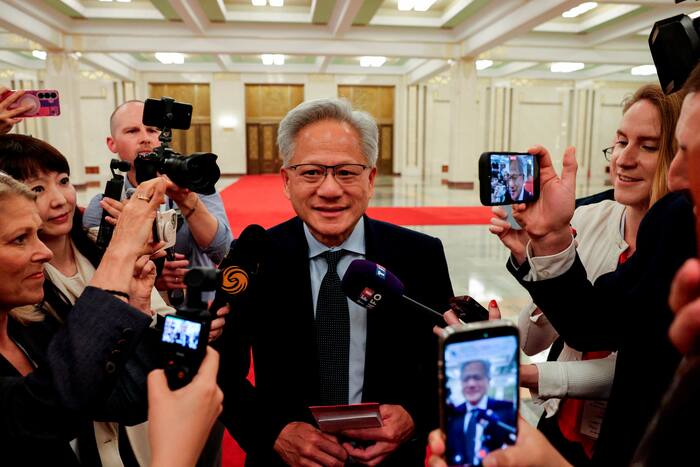
Silence.
When a three-trillion-dollar empire loses its architect overnight, the first thing you notice is not the panic on the trading floor, nor the frantic red banners scrolling across financial news networks, but the sudden, suffocating quiet that descends upon the engineering labs in Santa Clara. For more than three decades, the identity of Nvidia and the persona of its co-founder, Jensen Huang, were fused so tightly that separating them felt like trying to peel paint off wet canvas. Now, triggered by a chilling, unverified rumor claiming the chief executive had stepped down amid a shadowy espionage scandal, the entire global technology sector just experienced a collective cardiac arrest. Don't miss our recent coverage on this related article.
Let us clear the air immediately before the fiction outruns the truth. Jensen Huang has not resigned, and there is no confirmed spy scandal tearing apart the executive suite of the world’s most valuable chipmaker. Yet, the fact that a single, unsourced headline could send tremors through pension funds in Mumbai, server farms in Virginia, and supply chains in Hsinchu reveals a vulnerability far more terrifying than any corporate espionage plot. We have built the entire modern economy on the shoulders of one man in a black leather jacket, and we have no idea what happens when he eventually walks out the door.
To understand why this phantom headline struck such a raw nerve, you have to step out of the clean, air-conditioned boardrooms and look at the invisible machinery humming beneath your daily life. Consider a hypothetical scenario, grounded entirely in how modern hospital networks actually operate today. Picture Dr. Ananya Sharma, an oncologist in Bengaluru, staring at a high-resolution scan of a patient’s lung at two in the morning. The diagnostic software highlighting microscopic anomalies in the tissue is not running on magic; it is running on clusters of Nvidia H100 graphics processing units rented from a cloud data center thousands of miles away. If the company designing those chips were suddenly paralyzed by a federal espionage investigation and a leadership vacuum, Dr. Sharma’s screen would not go black tomorrow morning. Instead, the software updates would stall, the next generation of faster diagnostic models would be delayed by eighteen months, and the quiet, relentless march of medical discovery would hit an invisible brick wall. To read more about the background of this, CNET offers an in-depth breakdown.
The Anatomy of a Modern Panic
Why do we believe bad news so effortlessly when it involves the titans of Silicon Valley? History offers a sobering answer. Whenever a single company achieves near-total dominance over an essential resource, paranoia becomes the default currency of the market.
In the late nineteenth century, whispers about John D. Rockefeller’s health or secret railroad rebates could trigger bank runs across New York because Standard Oil controlled the literal fuel of the industrial age. Today, compute power is that fuel, and Nvidia holds roughly eighty to ninety percent of the market for the specialized accelerators required to train modern artificial intelligence. When you concentrate that much geopolitical and financial leverage into a single corporate entity, every shadow on the wall looks like an assassin.
And the shadows in the semiconductor world are undeniably real. Over the past few years, the United States Department of Commerce has tightened export controls on advanced microchips destined for China, turning silicon wafers into the defining weapons of twenty-first-century statecraft. Smuggling rings have been busted trying to tape high-end processors to their bodies across borders, and shell companies have popped up overnight in Southeast Asia to bypass trade restrictions. Against this backdrop of genuine geopolitical intrigue, a fabricated story about the Nvidia CEO resigning amid a spy scandal does not sound like science fiction. It sounds like Tuesday.
I have watched technology cycles rise and crash for twenty years, sitting in fluorescent-lit server rooms smelling of ozone and stale coffee, watching engineers worship hardware architectures that were obsolete five years later. Never in that time have I seen a hardware vendor command the near-religious devotion that Huang inspires today. Usually, chief executives are interchangeable suits who speak in sanitized quarterly projections. Huang, by contrast, is an electrical engineer who co-founded the company at a Denny’s roadside diner in 1993, survived near-bankruptcy multiple times, and famously maintains a flat organizational structure where roughly sixty vice presidents report directly to him.
That management style is brilliant when the founder is at the helm, steering the ship through uncharted waters with intuitive brilliance. It is terrifying the moment you ask who grabs the wheel if he vanishes.
The Myth of the Indispensable Founder
There is an old metaphor in corporate governance known as the bus factor—the minimum number of team members that have to suddenly disappear before a project stalls due to lack of knowledgeable or competent personnel. For a company worth trillions of dollars, Nvidia’s perceived bus factor is uncomfortably close to one.
Let us look closely at why a spy scandal specifically hits the Achilles' heel of a semiconductor giant. Unlike a social media platform, whose primary asset is user attention, or a retail giant, whose moat is logistics, a chip designer’s entire existence rests on intellectual property that takes years and billions of dollars to verify.
Think of designing a modern graphics processor like writing a symphony with ten billion individual notes, where a single misplaced sharp or flat causes the entire concert hall to collapse. That blueprint—the register-transfer level code and the proprietary CUDA software ecosystem that locks developers into Nvidia’s hardware—is the most valuable corporate secret on earth. If a foreign intelligence service or a rival state-backed consortium were to compromise the top leadership of the company, they wouldn't just steal a product; they would steal a decade of human ingenuity.
When the rumor of Huang's resignation circulated without an accompanying verified source or an official filing with the Securities and Exchange Commission, seasoned institutional investors knew within minutes that it was likely a hoax or a misinterpretation. Yet, the algorithms that execute high-frequency trades on Wall Street do not read for nuance, nor do they pause to verify context. They scan for keywords: Nvidia, CEO, resigns, spy, scandal. Within milliseconds, automated trading systems begin dumping shares, retail investors watching their brokerage apps panic-sell to protect their savings, and a phantom narrative manifests real financial destruction.
We are living through an era where the distance between a baseless rumor and a market correction is measured in microseconds. It is exhausting, and if we are being completely honest with ourselves, it is deeply unsettling. Nobody wants to admit that their retirement portfolio or their company’s multi-year technology roadmap rests on the stability of a single executive's reputation, yet here we are.
Inside the Machine That Cannot Stop
To truly grasp the human cost of this fragility, leave Wall Street behind and walk down the corridors of a modern data center in Navi Mumbai or Chennai. The noise is the first thing that hits you—a deafening, physical wall of sound generated by thousands of high-speed fans pushing cold air across racks of humming servers. The air feels dry, metallic, and sterile.
Inside those black metal cabinets sit thousands of Nvidia processors, wired together with copper and optical fiber, working around the clock to translate regional Indian languages, predict monsoon weather patterns for farmers in Maharashtra, and power customer service bots for banks. The engineers maintaining these facilities do not care about Silicon Valley gossip. They care about thermal throttling, power draw, and delivery lead times.
Right now, if an Indian enterprise or a university research lab orders a cluster of next-generation Blackwell chips, they are stepping into a queue that stretches months into the future. Every single component in that supply chain—from the extreme ultraviolet lithography machines built in the Netherlands by ASML, to the precision wafer fabrication done in Taiwan by TSMC, to the final assembly and software optimization—is choreographed with razor-thin margins for error.
Now, imagine what happens to that choreography if the conductor is suddenly accused of treason or espionage.
Even if the charges were eventually proven false, the mere existence of an active investigation freezes decision-making. Government contracts are suspended pending security clearances. International partners halt joint ventures to avoid secondary sanctions. Engineers, terrified of having their visas revoked or their career prospects tainted by association, quietly update their resumes and leave for competitors. In the high-stakes race of artificial intelligence, losing six months of momentum is equivalent to losing the war.
How We Got Here and Why It Hurts
We did not arrive at this precarious cliff by accident. We walked here willingly, seduced by the convenience of a single, unified platform.
A decade ago, artificial intelligence research was a chaotic, fragmented wilderness. Academics wrote code in a dozen different languages, running experiments on mismatched hardware that crashed constantly. Then Nvidia made a bet that almost killed the company: they poured billions of dollars into building CUDA, a software layer that allowed programmers to tap directly into the parallel processing power of graphics cards without needing a doctorate in hardware architecture.
For years, Wall Street hated the strategy. Analysts complained that Huang was burning cash on a niche science project while competitors focused on lucrative smartphone chips. Huang refused to budge. When the deep learning revolution finally exploded in 2012 and accelerated into the generative AI boom a decade later, Nvidia was the only company holding the keys to the kingdom.
By solving the hardest engineering problems for everyone else, Nvidia inadvertently created a monoculture. And as any farmer or ecologist will tell you, a monoculture is extraordinarily productive right up until the moment a single blight sweeps through the field.
When we treat CEOs like infallible superheroes, we strip away the institutional checks and balances that keep corporations resilient. We stop asking hard questions about succession planning. We ignore the warning signs of extreme supply chain concentration. Worse still, we become gullible consumers of sensationalist clickbait because our brains are wired to look for dramatic narratives—the fall of the king, the betrayal from within, the sudden collapse of an empire.
The Quiet Truth Behind the Noise
So where does that leave you, the reader trying to separate genuine geopolitical risk from digital smoke and mirrors?
First, it requires developing a healthy, practiced skepticism toward breaking news that lacks verifiable provenance. In legitimate corporate crises—think of the sudden ouster of Sam Altman at OpenAI in late 2023, or the real accounting scandals that brought down Enron and Wirecard—the breadcrumbs appear almost simultaneously across regulatory filings, multiple independent tier-one newsrooms, and official company statements. When a story claims the leader of a top-three global public company has resigned over espionage, yet the URL leads nowhere and the wire services are silent, you are looking at information warfare or algorithmic spam, not journalism.
Second, it demands that we look past the leather jacket and examine the underlying bedrock of the industry. Nvidia is not one man, no matter how charismatic his keynote speeches may be. Beneath Jensen Huang sits an army of forty thousand of the sharpest engineers, mathematicians, and supply chain logisticians on the planet. Their work is embedded in the silicon of gaming consoles, autonomous vehicles, supercomputers, and medical imaging devices across every continent.
More importantly, the monopoly we fear today is already beginning to fracture through the quiet, relentless pressure of capitalism. Cloud giants like Google, Amazon, and Microsoft are pouring tens of billions of dollars into designing their own custom silicon to reduce their dependence on Santa Clara. Rival chipmakers like AMD are clawing back market share with competitive hardware, while open-source software initiatives are slowly chipping away at the walls of the CUDA fortress.
The transition will not happen overnight, nor will it come in the form of a dramatic Hollywood thriller filled with double agents and midnight resignations. It will happen the way real technological shifts always happen: incrementally, awkwardly, through thousands of unglamorous engineering compromises made in labs around the world.
Late at night, long after the markets in New York have closed and the traders in London have gone to sleep, the cooling fans in the server rooms keep spinning. Inside a quiet office in Santa Clara, a black leather jacket hangs over the back of an ergonomic chair, waiting for morning. The empire is still standing, humming with the collective ambition of millions of people who rely on its silicon to build their futures—and entirely too fragile to be left in the hands of a single rumor.