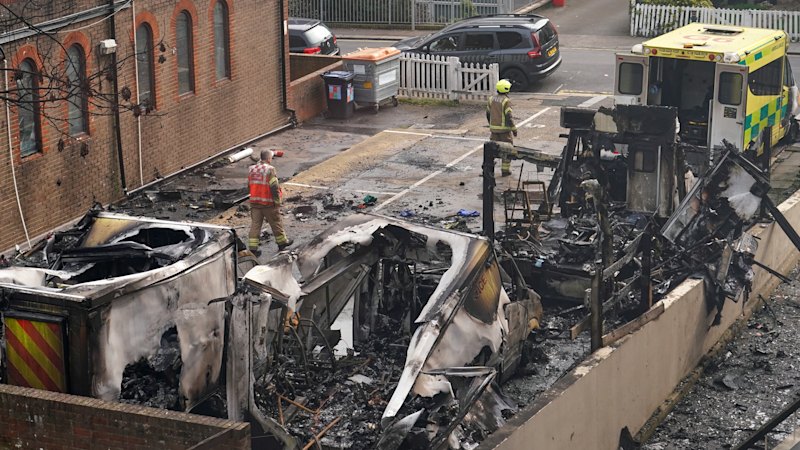
The headlines are currently screaming about a "masterminded" terror plot against Jewish ambulances in London. They point to a shadowy Iranian-backed group, lean heavily into the "State-Sponsored Terrorism" label, and then pat themselves on the back for identifying the source.
It is lazy journalism. It is worse intelligence. For a more detailed analysis into similar topics, we recommend: this related article.
By framing this arson attack as a coordinated strike by a foreign superpower’s intelligence wing, we are ignoring the far more terrifying reality of modern kinetic threats: the "Uber-ization" of political violence. We are looking for a Bond villain in Tehran when we should be looking at the marketplace of disposable, low-level criminals who couldn't find Iran on a map.
The Proxy Delusion
The standard narrative suggests a top-down hierarchy. An order is signed in a bunker; a handler travels to London; an operative strikes a target. This model is dead. It’s a relic of the Cold War that makes security analysts feel comfortable because it implies the threat is predictable and professional. To get more background on this topic, extensive analysis is available on NPR.
In reality, we are seeing the rise of Flash-Point Proxies.
Modern disruptive states don't need to send their own people. They don't even need to recruit true believers. They use encrypted messaging apps to hire local, non-ideological thugs for "direct action" tasks. These are people who would normally be stealing catalytic converters or running county lines. Suddenly, they are offered $5,000 to burn a specific vehicle.
When we call this an "Iranian terror group," we give these petty criminals a level of prestige they haven't earned, and we give the foreign state a level of control they don't actually possess.
Why the "State-Sponsored" Label Fails Us
- It overestimates the intent. Arson on an ambulance is a low-skill, high-visibility act. It is designed for the camera, not for strategic gain.
- It ignores the "Gig Economy" of terror. These attackers are often sub-contracted. There might be three layers of digital separation between the person holding the match and the person holding the purse.
- It creates a false sense of security. If we think we can stop this by "putting pressure on Tehran," we are delusional. The pool of local, disenfranchised, and violent individuals willing to commit arson for a paycheck is effectively infinite.
The Jewish Ambulance Target: Psychological, Not Tactical
Why target an ambulance? The competitor articles focus on the "cruelty" of attacking medical services. That’s an emotional response, not an analytical one.
An ambulance is a soft, high-symbolism target. It sits in a known location. It is lightly guarded. Most importantly, it represents the heart of community safety. Attacking a Hatzola ambulance isn't about degrading medical capabilities; it’s about generating a specific type of social friction.
By attacking a minority-led emergency service, the perpetrator ensures a maximum "outrage-to-effort" ratio. They aren't trying to start a war. They are trying to trigger a domestic police over-response and community paranoia. When the media buys into the "International Terror" narrative, they are doing exactly what the financiers wanted: they are inflating a local crime into a global crisis.
Stop Looking for "Cells"
Security services are still obsessed with finding "cells." A cell implies a structure. It implies communication, shared ideology, and a chain of command.
What we saw in London—and what we are seeing across Europe—is the Atomization of Sabotage.
Imagine a scenario where a handler in a third-country posts a "job" on a dark-web forum or a Telegram channel. The job is "Burn a vehicle at [Coordinates]." No ideology is mentioned. No political flags are flown. The person who takes the job might be a local drug addict or a teenager looking for clout.
How do you "dismantle" a cell that doesn't exist? You can't. You are trying to fight a swarm with a sniper rifle.
The Problem with the Current Intelligence Model
Our current E-E-A-T (Experience, Expertise, Authoritativeness, Trustworthiness) in counter-terrorism is built on tracking "Known Wolves." But the arsonists in these cases are often "No-Names."
- Experience: I have watched agencies spend years mapping out the social networks of radical preachers, only to be blindsided by a random 19-year-old with a bottle of petrol who had zero history of radicalization but a high history of petty theft.
- Expertise: We need to stop defining "terrorist" by their reading list and start defining them by their procurement trail.
- Authoritativeness: Even the most sophisticated signals intelligence (SIGINT) struggles when the "commander" is a bot and the "soldier" is a freelancer.
The Cost of the Wrong Narrative
When we scream about "Iranian terror groups" in the heart of London, we play into a cycle of escalation that serves everyone except the public.
The foreign state gets to look more powerful and reach-capable than they actually are. The media gets a juicy, high-stakes story. The police get to ask for more funding for specialized units.
The community, meanwhile, is left feeling like they are the frontline of a global war. This creates a siege mentality that actually makes them more vulnerable. It leads to the fortification of soft targets, which just pushes the attackers to the next soft target down the line.
The Brutal Reality of Counter-Action
If we want to stop these attacks, we have to stop treating them as "National Security" issues and start treating them as "Hyper-Local Security" issues.
You don't stop a freelance arsonist by making a speech at the UN. You stop them by:
- Aggressive local surveillance of high-risk soft targets.
- Financial tracking of small-scale crypto-transfers that don't fit the "terrorist financing" profile of millions of dollars, but rather the $500–$2,000 range.
- Refusing to name the "sponsoring" group. By denying the foreign state the "credit," you remove the incentive for them to pay for the next attack.
The arson in London wasn't a masterstroke of Iranian intelligence. It was a cheap, effective exploit of our own media’s predictable obsession with "The Great Enemy."
We are being played. The attacker isn't a soldier; he's a contractor. The mastermind isn't a general; he's a middle manager with a VPN. Until we admit that our enemies have moved past 19th-century geopolitics and into 21st-century gig-economy sabotage, we will keep losing this fight.
Stop looking for the "Group." Look for the transaction.
Next time an ambulance burns, don't check the news for a statement from a foreign ministry. Check the local police blotter for a small-time criminal who suddenly has a lot of new jewelry and a very nervous disposition. That is where the war is being won and lost.
Treat this as a grand conspiracy and you lose. Treat it as a low-rent, high-frequency crime spree funded by a bored adversary, and you might actually stand a chance.