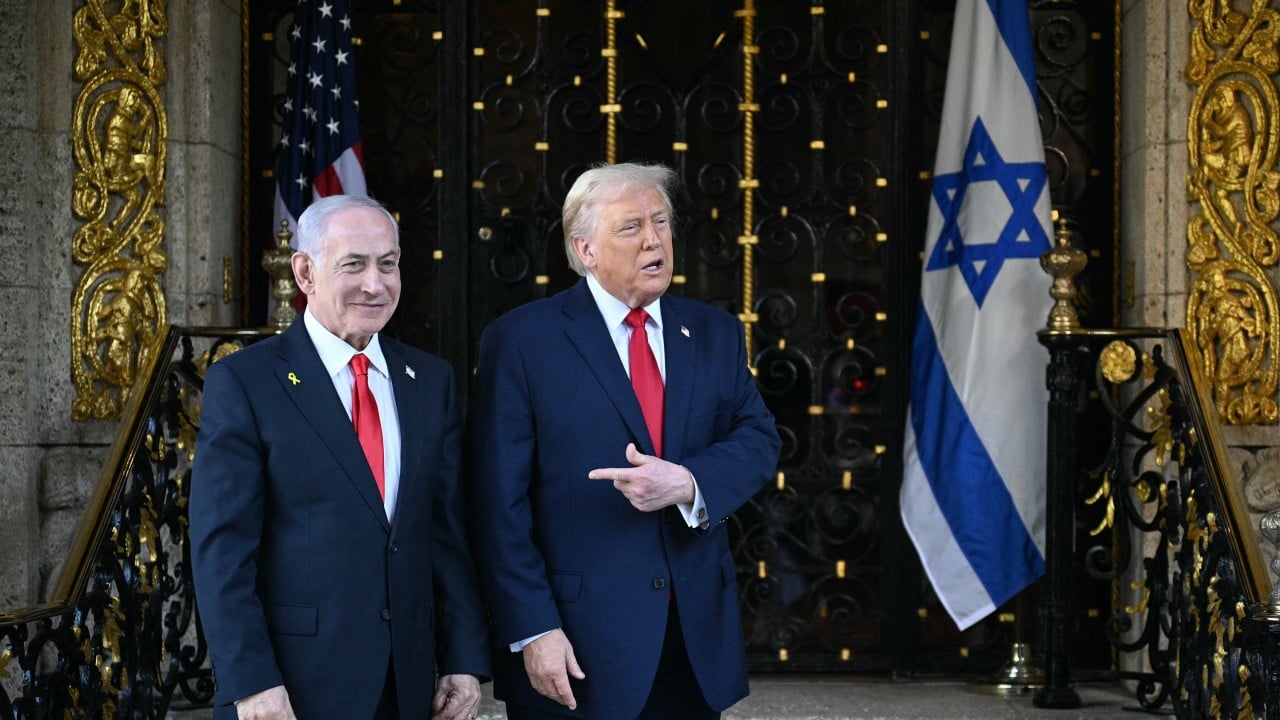
The assassination of Ayatollah Ali Khamenei was not the result of a long-deliberated American grand strategy. It was the product of a high-stakes sales pitch delivered in the gold-leafed corridors of Mar-a-Lago and a frantic, 48-hour intelligence scramble that subverted decades of U.S. foreign policy.
While official briefings describe Operation Epic Fury as a clinical response to "imminent threats," the reality is far more transactional. Prime Minister Benjamin Netanyahu did not just share intelligence; he weaponized a personal grievance. By framing the strike as "poetic justice" for alleged Iranian plots against Donald Trump’s own life during the 2024 campaign, Netanyahu bypassed the cautious institutional friction of the Pentagon and the CIA. He gave a president who prides himself on the "art of the deal" a closure he couldn't refuse.
The Saturday Morning Pivot
For years, the U.S. military avoided "decapitation strikes" against sovereign heads of state, fearing the unpredictable vacuum they create. Trump himself had spent much of late 2025 and early 2026 advocating for a "Peace Through Strength" posture that relied on sanctions rather than sorties. He wanted a deal, not a quagmire.
That changed during a series of private communications in late February 2026. Sources familiar with the calls reveal that Netanyahu presented a "now-or-never" window. Intelligence indicated that Khamenei and his inner circle were convening at a specific compound in Tehran. Crucially, the meeting was moved from Saturday night to Saturday morning.
Netanyahu’s argument was surgical. He contended that the Iranian regime was at its weakest point since 1979, reeling from the "January Uprising" that saw thousands of protesters killed by security forces. He argued that killing the "Great Satan’s" chief antagonist would not only neutralize the nuclear threat but would serve as the ultimate retaliation for the Pakistani-led murder-for-hire plot targeting Trump two years prior.
The President, who had scuttled an earlier strike due to bad weather, gave the order. On February 28, the first bombs fell. By evening, Trump was on Truth Social, declaring the "evil" era of Khamenei over.
The Intelligence Blind Spot
The White House expected a "Berlin Wall moment." They envisioned a grateful Iranian populace rising to embrace a new, negotiable government. Instead, they got a fortress.
While the strike successfully eliminated Khamenei, Ali Larijani, and several IRGC commanders, the "decapitation" failed to sever the body of the state. The Islamic Revolutionary Guard Corps (IRGC) did not fracture; it contracted. Within days, Mojtaba Khamenei—the late leader's son—was elevated to power. He is widely regarded by analysts as more ideologically rigid and less prone to the pragmatic retreats his father occasionally used to preserve the regime.
The CIA’s internal warnings, which were largely sidelined during the final 48-hour push, have proven prophetic. The agency argued that killing a martyr-figure like Khamenei would unify the hardliners and alienate the very middle-class protesters the U.S. hoped to embolden. Today, millions of Iranians remain under a brutal, high-tech lockdown, and the "new dawn" promised by the administration looks increasingly like a long, dark night of regional attrition.
The Economic Backfire
If the political goal was regime change, the economic goal was stability through dominance. Both have been elusive.
By killing a head of state, the U.S. triggered a symmetrical escalation that traditional deterrence failed to stop. The Iranian response was not a token gesture. It was a calculated assault on the world’s energy jugular.
- The Hormuz Chokehold: Iran’s closure of the Strait of Hormuz has sent global oil prices into a vertical climb.
- Energy Sabotage: The drone strikes on Saudi Aramco’s Ras Tanura refinery proved that even with U.S. "Devastating Combat Power" in the region, infrastructure remains vulnerable.
- The Price of War: The Treasury’s recent 30-day waiver on Iranian oil sanctions—an attempt to cool the market—is a tacit admission that the "maximum pressure" of Operation Epic Fury has created an unbearable vacuum in the global supply chain.
The Shadow Diplomacy of 2026
We are now seeing a characteristic Trumpian pivot. After authorizing the most aggressive act of the 21st century, the President is already signaling a desire to exit.
His recent claims that "a top person" in Tehran has reached out for talks are being viewed with intense skepticism by the intelligence community. There is no evidence of a formal channel. Instead, this appears to be a form of "psychological warfare via press conference." By suggesting that someone in the new regime is "selling out" the hardliners, Trump is attempting to sow the very internal discord that his bombs failed to ignite.
It is a high-stakes gambit. If it fails, the U.S. is left with a $200 billion war bill and a more radicalized adversary. If it works, it will be because the Iranian state, deprived of its patriarch, finally collapses under the weight of its own paranoia.
The tragedy of the Mar-a-Lago agreement is that it prioritized the elimination of a man over the dismantling of a system. Killing a dictator is easy for a superpower. Managing the chaos of his ghost is a much longer, bloodier task.
Would you like me to analyze the specific IRGC command structures that have survived the strikes?