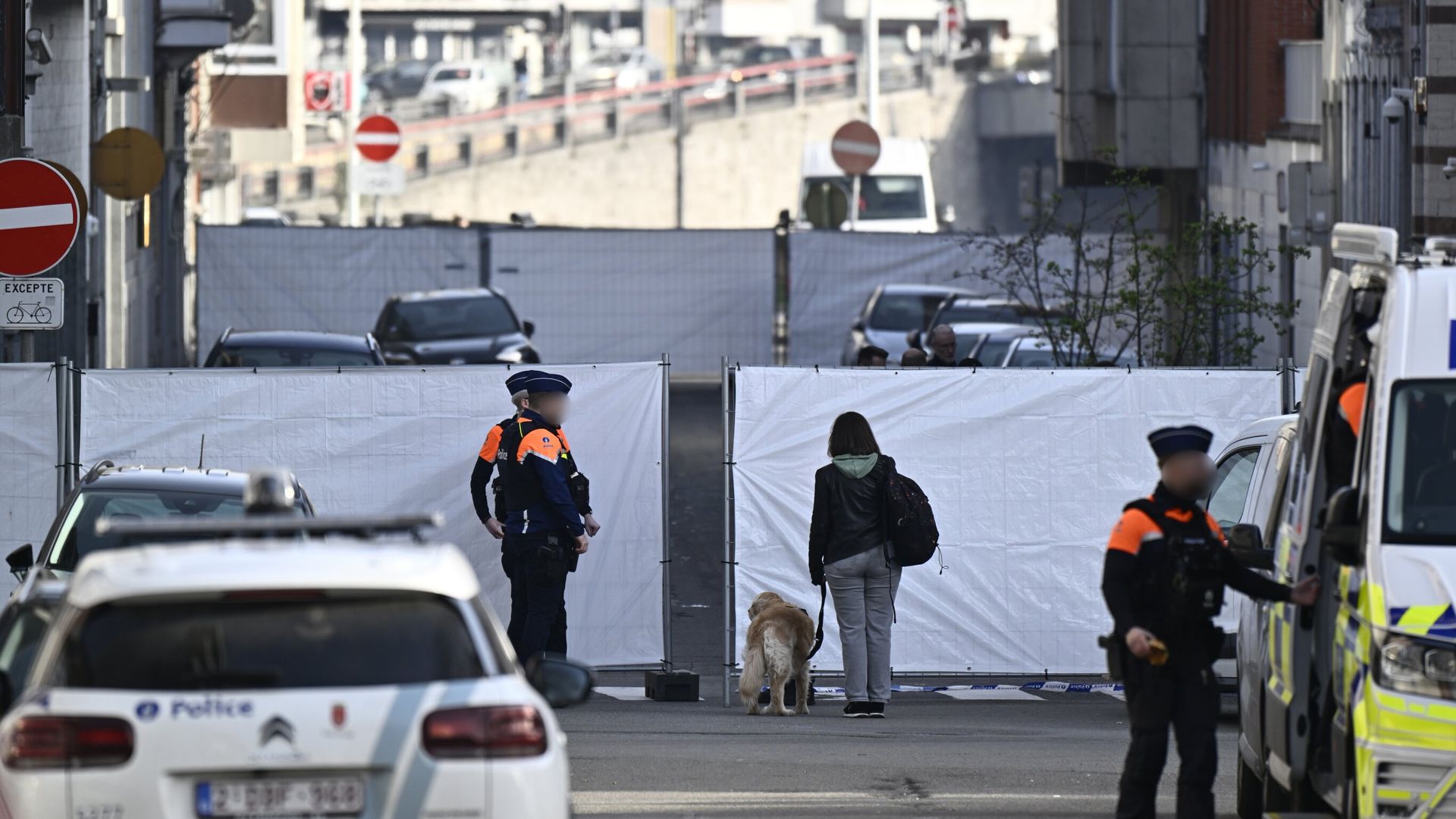
The detonation at a synagogue in Belgium represents more than a localized security breach; it is a calculated disruption of the socio-political equilibrium in Western Europe. When an explosive device targets a religious institution, the impact is measured through three distinct vectors: physical structural degradation, psychological fallout within the immediate demographic, and the subsequent stress test on state intelligence frameworks. Analyzing this event requires stripping away the emotive rhetoric often found in standard reporting to examine the kinetic and symbolic variables at play.
The Kinetic Profile of Urban Explosions
In any urban explosion, the damage is a function of the peak overpressure and the duration of the blast wave. While specific technical data on the Belgian device remains under investigation, the structural damage reported suggests a specific classification of explosive force.
The damage to a masonry structure like a synagogue typically follows a predictable failure chain:
- Reflected Pressure: The blast wave hits the facade, creating a pressure spike significantly higher than the incident pressure.
- Diffraction Phase: The wave wraps around the building, creating pressure differentials between the front and rear walls.
- Fragment Penetration: Non-structural elements, such as glass and decorative masonry, become secondary projectiles.
In this instance, the "success" of the attack from a tactical standpoint is not measured by the total collapse of the building, but by the breach of a high-value perimeter. This breach signals a failure in the Detection-to-Response Loop, the critical time window between a threat appearing on surveillance and the kinetic intervention by security forces.
The Triad of Institutional Vulnerability
Securing religious sites involves managing a paradox: they must remain accessible to the public while maintaining a hardened posture against asymmetric threats. This creates a friction point in urban planning and private security. We can categorize the vulnerability of the Belgian synagogue through three primary pillars.
The Geographic Fixedness Constraint
Unlike corporate entities that can relocate or harden perimeters through expansive setbacks, urban synagogues are often legacy structures integrated into dense residential or commercial grids. This proximity to public thoroughfares eliminates the "buffer zone" necessary to mitigate blast effects. The lack of standoff distance means that even a small-scale improvised explosive device (IED) can achieve high lethality or significant structural damage.
The Intelligence Asymmetry
State actors and local police forces operate under a "defense of everything" mandate, whereas an attacker only needs to optimize for a "single point of failure." In the Belgian context, the complexity of multi-layered government—spanning federal, regional, and communal levels—often results in data silos. These silos prevent the synthesis of low-level "noise" into a high-fidelity threat picture.
The Symbolic Value Multiplier
The selection of a synagogue is a strategic choice intended to produce a disproportionate psychological response. In risk management, this is known as a High-Impact, Low-Probability (HILP) event. While the statistical likelihood of being caught in an explosion is low for the average citizen, the symbolic resonance of the target forces a massive reallocation of state resources toward static defense, often at the expense of proactive intelligence gathering.
Quantifying the Socio-Economic Aftershocks
The damage to the synagogue triggers a cascade of costs that extend beyond the repair of physical masonry. These costs are often neglected in standard news cycles but are central to understanding the true "price" of the event.
- Security Premiums: Following such an event, insurance actuary models for similar institutions across Europe are recalibrated. This leads to an immediate increase in overhead for all high-risk religious and cultural sites.
- The Policing Tax: The Belgian state must now deploy static guards—often military personnel—at dozens of similar locations. This creates a "sunk cost" in human capital, where elite units are used for observation rather than intervention.
- Demographic Flight and Real Estate Volatility: Sustained targeted violence leads to "neighborhood cooling," where the perceived risk of living near a targeted institution outweighs the benefits of the location, shifting local market dynamics.
The Failure of Current Mitigation Strategies
The Belgian incident highlights a critical flaw in current "Hardened Target" philosophies. Most security protocols are reactive, focusing on the hardening of the specific site after a threat is identified. However, this creates a Displacement Effect. When one synagogue is hardened with bulletproof glass and concrete bollards, the threat does not dissipate; it simply migrates to a softer target within the same category or a different minority group.
This displacement indicates that the current strategy is not reducing the total volume of threat, but merely reshuffling the geography of the risk. A more effective analytical framework would prioritize "Neural Defense," which focuses on the logistical networks—funding, procurement of precursors, and digital radicalization—rather than just the physical perimeter.
The Geopolitical Context of Belgian Security
Belgium occupies a unique and difficult position in the European security landscape. As the headquarters for both NATO and the European Union, it is a high-density target environment. However, its internal police and intelligence structures have historically struggled with the "Brussels Paradox"—a city with immense international importance but fragmented local administration.
The synagogue explosion acts as a diagnostic tool, revealing that the post-2016 security reforms in Belgium may have reached a point of diminishing returns. The transition from "Level 3" to "Level 4" threat assessments is a blunt instrument that slows down the economy and exhausts the police force without necessarily uncovering "lone actor" or "small cell" plots that bypass traditional surveillance.
Forecasting the Security Trajectory
The Belgian synagogue explosion is a signal that the era of "static defense" is failing. To move toward a more resilient model, the following strategic shifts are necessary:
- Transition to Dynamic Perimeters: Instead of static bollards, urban environments require "smart" surveillance that utilizes behavioral analytics to identify anomalies in pedestrian and vehicular flow long before they reach the target facade.
- Horizontal Intelligence Integration: Belgium must dissolve the administrative barriers between its six police zones in Brussels and federal intelligence. A centralized, real-time threat dashboard is no longer a luxury but a functional requirement for urban stability.
- Blast-Resilient Retrofitting: For legacy structures where standoff distance is impossible, the focus must shift to internal reinforcement—using polyurea coatings and anti-shatter films—to minimize secondary fragment casualties, which account for the majority of injuries in urban bombings.
The event in Belgium is a reminder that in the contest between a fixed institution and a mobile threat, the institution must adopt the fluidity of the threat to survive. The focus should remain on the "Kill Chain" of the attack—procurement, reconnaissance, and execution—rather than the symbolic aftermath. Failure to integrate these tactical realities will result in a perpetual cycle of reactive hardening that is both economically unsustainable and strategically ineffective.
The immediate priority for European security stakeholders is the auditing of "Soft-Point Proximate" sites. If a synagogue can be targeted despite the heightened awareness in the region, then any institution sharing a public wall with a high-traffic thoroughfare is currently operating at an unacceptable risk level. The strategic play is a mandatory shift from "Visible Deterrence" (guards and gates) to "Invisible Detection" (signal intelligence and behavioral analysis). Only by making the cost of reconnaissance prohibitively high can the frequency of these kinetic events be reduced.