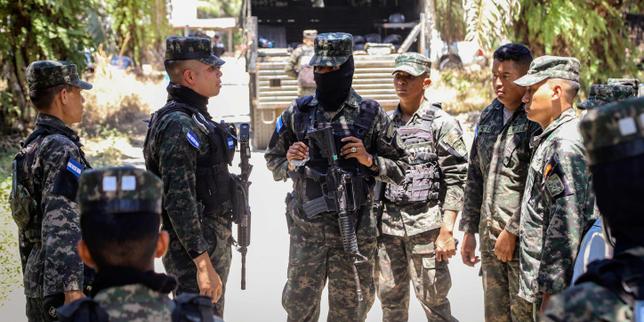
Mass violence in northern Honduras, exemplified by the coordinated execution of twenty-five individuals including six police officers in the Sula Valley region, is routinely mischaracterized as sporadic criminal brutality. This diagnostic failure obscures the structural drivers of systemic insecurity. To understand the persistence of high-end violence in the department of Cortés, analysts must move past descriptive reporting and evaluate the situation through a rigorous framework of territorial contestation, state capacity deficits, and illicit supply chain logistics.
The northern corridor of Honduras operates as a high-value logistical bottleneck. When violent equilibrium breaks down in this specific geography, it is rarely due to random escalation. Instead, it signals a systemic realignment between non-state armed groups and local power structures. Analysing these events requires breaking down the crisis into three distinct operational vectors: the logistics of the transit corridor, the breakdown of informal deterrence mechanisms, and the institutional failure of localized militarized policing. If you liked this piece, you might want to look at: this related article.
The Tri-Border Logistics Network and the Value of Cortés
The concentration of lethal violence in northern Honduras is directly correlated with the economic geography of the region. The department of Cortés, anchored by the industrial hub of San Pedro Sula and the deep-water port of Puerto Cortés, represents the critical infrastructure bottleneck for both legitimate commerce and transnational illicit flows.
Non-state armed groups do not seek to destroy this infrastructure; they seek to tax and control it. The economics of this territorial control can be evaluated through three distinct revenue-generation mechanisms: For another angle on this development, check out the recent coverage from Al Jazeera.
- Extraction Rate (Micro-Level): The systematic extortion of local businesses, transport networks, and manufacturing operations. This provides the baseline cash flow required to sustain low-level foot soldiers and intelligence networks.
- Transit Rents (Macro-Level): Fees levied on transnational illicit cargo moving northward toward the Guatemalan border. The Sula Valley serves as a consolidation and repackaging zone for bulk commodities.
- Sovereignty Premiums: The financial value derived from establishing total physical dominance over a specific neighborhood or municipality, allowing the group to operate logistical safe houses, training grounds, and recruitment pools with zero state interference.
When a competing faction or a state offensive disrupts one of these revenue streams, the structural equilibrium collapses. The sudden death toll observed in northern Honduras points to a violent recalibration of these transit rents, rather than a simple breakdown in public order.
The Friction of Symmetric Contestation
A common analytical error is treating the Honduran criminal landscape as a homogenous monolith or a chaotic free-for-all. The market for violence in the Sula Valley is highly structured, dominated by a duopoly of long-standing transnational gangs alongside localized, hyper-violent drug trafficking organizations (DTOs).
Under normal operating conditions, these groups maintain a hostile peace dictated by a balance of power. Violence spikes exponentially when this balance shifts from asymmetric dominance to symmetric contestation.
[Dominant Faction Control] -> (External Shock / State Offensive) -> [Symmetric Contestation] -> [Exponential Spike in Homicides] -> [Subjugation or New Equilibrium]
This transition occurs through a predictable sequence. First, an external shock—such as the extradition or assassination of a high-ranking cartel leader—creates a power vacuum. Second, rival factions attempt a hostile takeover of the vulnerable territory. Because neither side possesses a decisive tactical advantage, the conflict shifts from targeted assassinations to mass-casualty events designed to terrorize the civilian population and erode the adversary's economic base.
The inclusion of six police officers among the casualties highlights a critical operational reality: in zones of symmetric contestation, state security forces lose their status as neutral arbiters or absolute deterrents. Instead, compromised elements within the security apparatus are drawn into the friction, acting as force multipliers for one faction or becoming high-priority targets for another.
The Failure of State Saturation Strategies
The standard policy response to surges in northern Honduras has historically relied on the declaration of localized states of exception and the deployment of military-police units to saturate contested zones. This approach suffers from a fundamental design flaw: it treats a systemic governance deficit as a temporary resource scarcity problem.
The deployment of militarized forces produces a highly predictable decay curve in operational efficacy.
The Suppression Phase
Immediately following deployment, open-air violence drops as criminal factions alter their operational posture. Armed actors avoid direct confrontation with heavily armed state patrols, shifting their logistics underground, decelerating their supply lines, and temporarily halting public executions.
The Adaptation Phase
Non-state armed groups exploit the structural limitations of the state's deployment. Military-police forces are inherently static; they rely on checkpoints and highly visible patrols. Criminal networks adapt by shifting their operations to adjacent, unpatrolled sectors, utilizing encrypted communication channels, and leveraging deep-rooted intelligence networks within the local population to monitor troop movements.
The Institutional Decay Phase
Long-term occupation of a civilian space by low-wage security forces introduces severe corruption risks. The massive financial reserves of the local DTOs are deployed to systematically compromise the lower and middle tiers of the military-police hierarchy. Over time, the state presence shifts from an active containment mechanism to an expensive, passive layer of infrastructure that criminal groups bypass or co-opt.
This decay cycle explains why sudden, large-scale massacres occur even within departments under active emergency decrees. The state presence creates an illusion of control while the underlying structural drivers—impunity, institutional corruption, and absolute economic deprivation—remain completely unaddressed.
Deconstructing the Victim Profile and Tactical Execution
A granular analysis of the tactical execution of these mass casualties reveals a high degree of operational planning that contradicts the narrative of chaotic gang warfare. The simultaneous or rapid-succession execution of twenty-five individuals across a specific geographic corridor requires sophisticated command-and-control capabilities, actionable intelligence, and significant logistical mobilization.
The targeting matrix deployed by these organizations serves distinct strategic objectives:
- Civilian Non-Combatants: Targeted not out of random malice, but to disrupt the social fabric of neighborhoods providing passive support to a rival faction, or to signal the total failure of state protection to the local business community.
- Rival Foot Soldiers: Executed in highly public, brutal ways to demoralize the adversary's rank-and-file, accelerate defections, and force tactical retreats from contested distribution points.
- State Security Actors: Targeted when they actively disrupt a high-value logistical operation, or when a specific unit shifts its alignment toward a competing faction. The execution of six officers in this context indicates a deliberate decision to eliminate state-level operational friction, signaling that the cost of interfering with the cartel's supply chain exceeds the state’s capacity to protect its own personnel.
The Governance Deficit and Alternate Dispute Resolution
The survival and expansion of these criminal networks are directly tied to their ability to exploit the absolute absence of legitimate state governance. In the outer rings of San Pedro Sula and the rural stretches of Cortés, the formal state exists almost exclusively as an extractive or punitive force. It fails to provide basic citizen security, contract enforcement, or dispute resolution.
Non-state armed groups fill this institutional vacuum by establishing a brutal form of parallel governance. They enforce a rudimentary order, regulate local markets, and settle civil disputes through immediate, lethal arbitration. For the local population, compliance with the dominant criminal faction is not a reflection of ideological loyalty, but a rational calculation for survival in an environment where the state is both predatory and impotent.
When the state launches sporadic, heavy-handed incursions without establishing permanent, trustworthy civil institutions, it merely dismantles the existing parallel governance structure without replacing it. This leaves the population exposed to the violent competition that inevitably follows a power vacuum, guaranteeing a resurgence of mass-casualty events once the state forces inevitably withdraw due to budgetary or political constraints.
A Realignment of Strategic Countermeasures
To break this cycle of violence in northern Honduras, regional strategy must pivot away from high-visibility, low-impact military saturation campaigns and focus on the systematic disruption of the criminal business model.
The primary line of effort must target the financial architecture that funds these operations. This requires establishing specialized, insulated financial intelligence units tasked with mapping and seizing the local assets, front companies, and real estate portfolios used to launder transit rents within the formal Honduran economy.
Simultaneously, the state must transition its security posture from static territorial occupation to targeted, intelligence-led disruption of the high-level command structures directing these massacres. This pivot demands a comprehensive overhaul of judicial security, ensuring that prosecutors and judges operating in high-risk zones are completely insulated from local intimidation and corruption through institutional anonymity and international oversight.
Finally, physical control over the Sula Valley corridor must be reclaimed not through temporary states of exception, but through the permanent re-establishment of accountable, civilian-led municipal policing units that live within and are accountable to the communities they protect. Without stripping these criminal factions of their financial liquidity and their structural monopoly on local governance, any reduction in violence will remain a temporary pause before the next inevitable escalation.