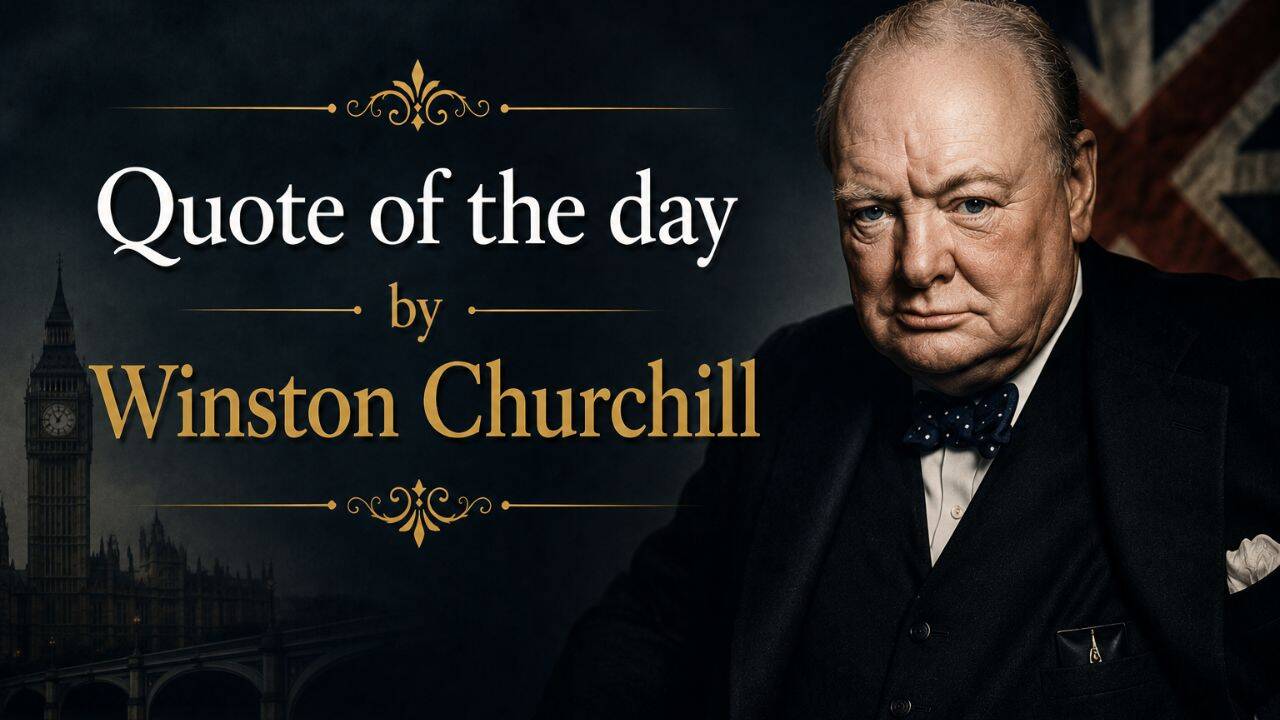
The room smelled of stale cigar smoke, damp wool, and the sharp, unmistakable tang of old age. It was 1949. A room packed with journalists hung on every word of a man who looked, by all medical accounts, like he should have been quiet. He was seventy-five. His skin possessed that translucent, fragile quality of old parchment, and his shoulders, which had literally carried the psychological weight of the Western world less than a decade prior, were visibly bowed.
Then he spoke.
The voice was still a growl, a low-frequency rumble that had once rallied a terrified nation when the bombs were falling on London. He looked at the gathered press, blinked his heavy eyelids, and delivered a line that was less of a philosophical reflection and more of a dare.
"I am prepared to meet my Maker," he said, pausing just long enough to let the gravity of the statement settle over the room. "Whether my Maker is prepared for the great ordeal of meeting me is another matter."
The room erupted. It was classic Winston Churchill. But beneath the laughter and the scratch of fountain pens on notebooks lay a profound, almost terrifying psychological truth. This was not just a witty old man making a joke for the papers. This was a manifestation of an unyielding ego, a specific brand of defiance that defined an entire era of human survival.
To understand the weight of that single remark, we have to look past the caricature of the bulldog statesman with the Homburg hat and the V-sign. We have to look at the anatomy of defiance itself.
The Architecture of Defiance
Most people approach the end of life with a quiet, retreating humility. As the physical body fails, the ego usually shrinks along with it. We begin to apologize for our presence, to take up less space, to prepare for a reckoning with whatever lies beyond the veil.
Churchill did the exact opposite.
Consider the sheer audacity required to view an interview with the creator of the universe not as a judgment, but as an ordeal for the creator. It requires a specific mental architecture. Throughout his entire life, Churchill operated under the absolute, unwavering conviction that he was a man of destiny. This was not a belief he adopted when he became Prime Minister in 1940; it was a deeply ingrained worldview he carried as a young, reckless cavalry officer in India and the Sudan.
He survived bullet wounds, plane crashes, political exiles, and massive strokes. He spent decades wrestling with what he called his "black dog"—a heavy, paralyzing depression that routinely threatened to swallow him whole. When you have stared into the abyss of your own mind for fifty years, and when you have stood on the cliffs of Dover looking out at an armada of fascist conquerors, the prospect of facing God ceases to be intimidating. It becomes just another meeting with a high-ranking official.
Humor, for a man like that, is not entertainment. It is armor.
The Armor of Wit
There is a distinct difference between a joke meant to amuse and a joke meant to conquer. The "Maker" quote falls squarely into the latter category. It is a psychological defensive mechanism known to therapists as a high-level sublimation. Instead of succumbing to the natural terror of mortality, the mind reframes the ultimate vulnerability as an act of supreme confidence.
Think about a time when you felt completely out of your depth. Perhaps it was a job interview that felt like an interrogation, or a medical diagnosis that made the world spin on its axis. In those moments, the human instinct is to shrink. We become agreeable. We try to appease the forces that hold power over us.
Now, imagine doing the reverse. Imagine looking at the ultimate authority and saying, You think you are ready for me?
That shift in perspective changes everything. It takes the power back. By turning his own death into a hypothetical bureaucratic headache for God, Churchill stripped the grave of its victory long before he ever stepped into it. He refused to be a passive participant in his own fading out.
But this kind of defiance comes with a hidden cost.
The Solitude of the Unyielding
It is easy to romanticize this level of ego, to view it as a heroic posture from a bygone age. But living inside that mindset is a brutal, exhausting endeavor.
Imagine never being able to let your guard down. Imagine believing, at every waking moment, that the universe is watching you, testing you, and perhaps a little bit afraid of you. The people who lived and worked alongside Churchill during the darkest days of the Second World War often spoke of the collateral damage of his personality. He was demanding, temperamental, and utterly convinced of his own infallibility. He kept his staff awake until three in the morning, pacing the floor, dictating memos, fueled by champagne and an unshakeable belief that if he stopped moving, the world would stop turning.
When a man like that reaches his seventies, the world does start to slow down around him. The war is won. The enemies are gone or changed. The political offices are lost to younger men. The silence that follows a great historical storm can be deafening.
For Churchill, the post-war years were not a peaceful retirement. They were a slow, frustrating realization that his greatest enemy was no longer a foreign dictator, but time itself. His body was failing him. The strokes were coming more frequently, each one stealing a little bit more of his speech, a little bit more of his mobility.
The quote about his Maker was a flash of the old fire. It was a sign to the world, and perhaps to himself, that the core of who he was remained entirely untouched by the decay of his flesh.
The Great Ordeal
What does it actually mean to be a "great ordeal" for the Almighty?
If we take the metaphor seriously, it implies a conversation between two entities who both believe they run the place. One can imagine Churchill arriving at the pearly gates, cigar in hand, immediately complaining about the quality of the refreshments and demanding to see the blueprints for the architecture of heaven. He would want to know why the management allowed certain historical disasters to occur, and he would almost certainly have a few suggestions on how to improve the efficiency of the angelic choir.
It is a funny image, but it reveals something deep about the human need for agency. We want to believe that we matter. We want to believe that our lives, our struggles, and our individual personalities are loud enough to echo in the halls of eternity.
Most of us live with a quiet dread that we will be forgotten, that our presence on this planet is a drop of rain in a vast, indifferent ocean. Churchill rejected that premise entirely. He operated under the assumption that his life was a boulder thrown into a still pond, creating ripples that would disturb the water forever.
He was right, of course. We are still talking about him now.
But the real lesson of his defiance is not that we should all try to be world leaders with massive egos. The lesson is much more intimate. It is about how we choose to face our own limitations.
The Choice of the Final Act
We all reach a point where we have to confront things that are entirely outside of our control. It might not be death; it might be the end of a relationship, the loss of a career, or the realization that a dream we chased for decades is simply not going to happen.
In those moments, we are faced with a choice. We can allow the circumstance to break us, to make us small, to turn us into victims of a fate we didn’t ask for. Or we can find that small, stubborn spark of defiance within ourselves and refuse to give up our dignity.
You don't need to be a Prime Minister to tell the universe that you are going to be an ordeal. You just need the courage to look at a bad situation and say, You might beat me, but you are going to have to fight for every single inch.
That is what Churchill was doing in that smoke-filled room in 1949. He knew the end was coming. He wasn't stupid, and he wasn't blind to his own mortality. He was simply refusing to bow his head before he absolutely had to. He was choosing to go out on his own terms, with his wit intact and his ego unbruised.
When he finally did pass away in 1965, at the age of ninety, the world stopped to watch his funeral. It was a massive, somber affair, filled with kings, queens, and presidents. But one can't help but wonder if, somewhere beyond the clouds, an administrative assistant in the afterlife was looking at a clipboard, sighing heavily, and turning to the creator to announce that the guest of honor had finally arrived, and that he was already demanding a better seat.