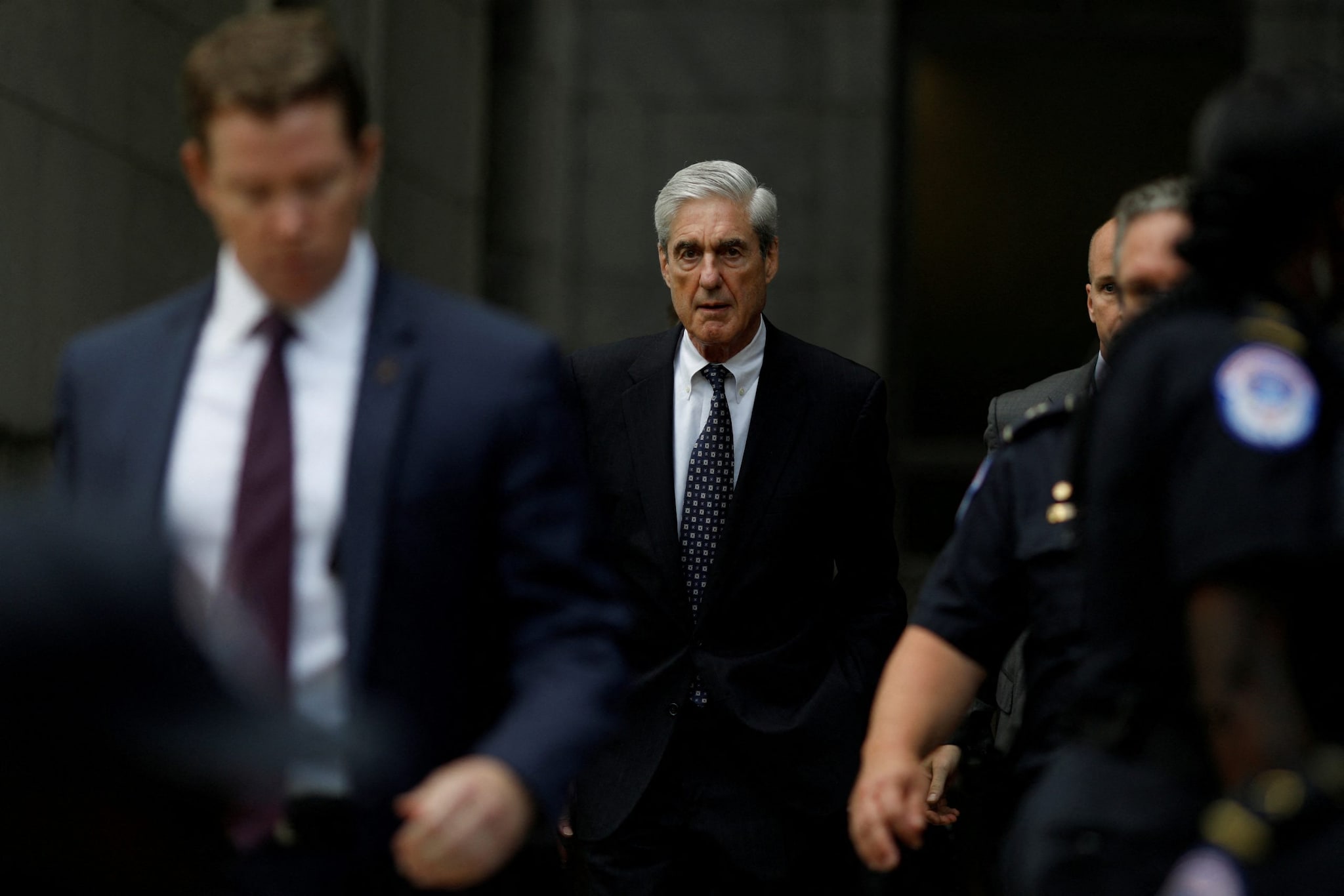
Robert Mueller’s tenure as Special Counsel remains the definitive case study in the friction between high-stakes investigative mandates and the rigid architecture of the United States Department of Justice (DOJ). His passing at 81 marks the end of an era defined by "institutionalist" logic—a philosophy that prioritizes the preservation of departmental norms over the pursuit of political finality. While contemporary accounts often focus on the binary of "guilty" versus "not guilty," a structural analysis reveals that Mueller’s primary contribution was the stress-testing of the Special Counsel regulations ($28$ CFR $\S 600$), exposing a fundamental gap between public expectations of accountability and the legal reality of executive branch self-policing.
The Tripartite Constraint of the Mueller Investigation
The Mueller investigation operated within a three-dimensional constraint model that dictated its eventual output. Understanding these pillars explains why the final report (The Report on the Investigation into Russian Interference in the 2016 Presidential Election) was designed as a diagnostic tool rather than a prosecutorial hammer.
- The OLC Bottleneck: The Office of Legal Counsel (OLC) guideline, which posits that a sitting president cannot be indicted, acted as a hard ceiling. Mueller viewed this not as a suggestion, but as a jurisdictional boundary. This created a logical paradox: if the Special Counsel could not indict, a formal "accusation" without a trial would deprive the subject of their constitutional right to a defense.
- The Binary Evidentiary Standard: To bring charges, the DOJ requires a "substantial likelihood of conviction." Mueller applied this with clinical severity. While the investigation documented extensive "links" and "contacts," it failed to find a "conspiracy" as defined by an express or implied agreement to violate federal law.
- The Preservation Mandate: Mueller’s secondary objective was the protection of intelligence sources and methods. Every public filing was a calculated risk-benefit analysis between transparent justice and the integrity of the U.S. signals intelligence apparatus.
The Anatomy of Obstruction Analysis
Mueller’s treatment of obstruction of justice serves as a masterclass in modular legal reasoning. Rather than issuing a singular verdict, the Special Counsel’s office deconstructed eleven distinct episodes into a three-part evidentiary framework. This methodology was designed to survive judicial scrutiny, even if it failed to satisfy the appetite for a political resolution.
Each episode was weighed against:
- The Obstructive Act: Did the individual take an action that would impede a proceeding?
- The Nexus: Was there a direct link between the act and a specific pending or foreseeable grand jury or judicial proceeding?
- The Intent: Was the primary motivation "corrupt"?
This granular approach highlighted the "Execution Gap" in executive power. Mueller identified multiple instances where the President attempted to influence the investigation, but the orders were either ignored or countermanded by subordinates (e.g., Don McGahn). Legally, this meant the "Obstructive Act" remained incomplete or lacked the requisite "Nexus" to a specific proceeding, shielding the executive from traditional criminal liability while simultaneously creating a roadmap for congressional oversight.
The Economic Cost of Institutional Integrity
From a resource allocation perspective, the Mueller investigation was a high-yield operation. Despite the $32 million price tag frequently cited in political discourse, the investigation’s "Cost-to-Asset" ratio was technically positive. Through the prosecution of Paul Manafort and the subsequent forfeiture of real estate and financial holdings, the investigation recouped approximately $42 million for the U.S. Treasury.
Beyond the financials, the "Information Yield" included:
- 34 Individuals and 3 Corporate Entities Indicted: A high conversion rate for a two-year investigation.
- The Dismantling of the Internet Research Agency (IRA): Identifying the mechanics of "information warfare" as a distinct threat vector.
- The GRU Attribution: Forcing a public acknowledgement of specific Russian military intelligence units (Units 26165 and 74455) involved in cyber operations.
This data-driven success is often overshadowed by the "Null Result" regarding the President. However, in the realm of counterintelligence, a "Null Result" on a specific target is often as valuable as a "Positive Result" because it defines the perimeter of external influence.
The Structural Failure of the Special Counsel Regulations
The Mueller era proved that $28$ CFR $\S 600$ is a flawed instrument for checking executive power. The regulations require the Special Counsel to report to the Attorney General, who retains the ultimate authority over what is released to Congress and the public. This creates an "Agency Problem" where the investigator’s principal (the Attorney General) has interests that may diverge from the investigator’s mandate (the Law).
The 19-page "Barr Memo" and the subsequent four-page summary issued prior to the full report's release demonstrated how the "First-Mover Advantage" in communications can override two years of factual accumulation. Mueller’s decision to adhere strictly to the chain of command, refusing to hold a press conference or clarify his findings until compelled by subpoena, allowed a competing narrative to solidify. This was not a failure of character, but a feature of Mueller’s "Institutionalist" logic: he believed the system would process the facts correctly if he followed the rules exactly.
The Legacy of the Mueller Methodology
Robert Mueller’s career, spanning the Vietnam War, the DOJ’s war on the Mafia, and the post-9/11 transformation of the FBI, culminated in an investigation that remains a Rorschach test for the American legal system. His methodology was defined by "Clinical Isolation"—the belief that an investigation can and should exist in a vacuum, shielded from the heat of the political environment.
His passing necessitates a cold-eyed reassessment of how the U.S. handles high-level corruption and foreign interference. The "Mueller Model" suggests that the Law is an insufficient tool for resolving political crises. If the evidentiary standard is not met, the investigator must remain silent; however, in a hyper-polarized information economy, silence is interpreted as an invitation for speculation.
The strategic takeaway for future oversight is the necessity of "Real-Time Transparency." The lag between the conclusion of the investigation and the public release of the findings created a vacuum that was filled by political theater. Future mandates must address the "Reporting Lag" and the "Interpretation Gap" by embedding public-facing milestones into the investigative process, rather than relying on a singular, massive data dump at the end of a multi-year cycle.
The definitive forecast for the post-Mueller era is an inevitable move toward "Legislative Primacy" in oversight. The Mueller investigation demonstrated that when the Executive Branch investigates itself, the "OLC Ceiling" prevents a final legal resolution. Therefore, future inquiries of this magnitude will likely shift away from the Special Counsel model and toward congressional commissions with independent subpoena power and a direct mandate to the public, bypassing the DOJ's internal bottlenecks entirely.
Institutionalists like Mueller are a vanishing breed. His insistence on the "Process" above the "Result" was his greatest strength as a prosecutor and his greatest weakness as a public figure. The framework he left behind provides the data, but it requires a different kind of architecture—one not constrained by the executive's own rules—to act upon it.