The pine needles underfoot did not snap; they disintegrated. For three months, the hills overlooking the French Riviera had surrendered every drop of moisture to a relentless Mediterranean sun. By mid-August, the landscape of Bormes-les-Mimosas was no longer green. It was tinder.
Then came the wind.
When the Mistral blows in southern France, it usually brings a welcome relief from the suffocating summer heat. It sweeps down from the Alps, clearing the sky until the sea turns an impossible, brilliant blue. But on this night, the wind arrived as an accelerant. A single spark, struck by a passing car or a discarded cigarette near the commune of La Londe-les-Maures, was all the gale required. Within minutes, a localized brush fire transformed into a wall of moving flame. It marched across the ridges toward the sea, devouring centuries-old oak trees and luxury campsites alike.
Ten thousand people were about to lose their sanctuary.
The Smell of Burning Resin
To understand a wildfire, you must first understand the sound. It does not roar, not at first. It hisses. It whispers through the dry scrub—the maquis—like a hidden river.
Consider a hypothetical traveler named Elena. She had saved for two years to bring her children to a campsite near the beach at Levandou. To Elena, and to the thousands of British, German, and French tourists sleeping in nylon tents that night, the Var region was paradise. It was a place of rosé wine, cicadas, and slow afternoons.
By 2:00 AM, the cicadas were silent.
Elena woke to a shift in the air pressure, a sudden, violent drop that made the tent walls shutter. Then came the smell. It wasn’t the comforting scent of a campfire. It was chemical, sharp, and heavy with the resin of boiling pine. When she unzipped the tent flap, the night sky was no longer black. The horizon was a deep, pulsing orange, casting long, frantic shadows across the campground.
Panic is a quiet thing before it becomes loud. At first, people simply stared. They stood in their pajamas, holding flashlights, looking at the ridgeline. The fire was miles away. Surely the local firefighters, the famous Sapeurs-Pompiers, would stop it.
They did not understand the speed of the Mistral. The wind was gusting at sixty miles per hour. In those conditions, embers travel faster than a running man. They leap over roads. They jump firebreaks. The fire was not marching; it was flying.
The Geography of an Evacuation
When the sirens finally cut through the wind, the reality shifted. Siren wails in Europe are distinctive—two-tone, piercing, urgent.
The order was absolute: Evacuate. Immediately.
The logistics of moving ten thousand people in the dead of night along narrow, winding coastal roads are terrifying. The Var coastline is a labyrinth of hairpin turns, flanked by steep hillsides on one side and the Mediterranean Sea on the other. There is only one main artery, the localized departmental routes, which are barely wide enough for two passing SUVs in broad daylight.
Now, imagine those same roads choked with thousands of rental cars, camper vans, and pedestrians carrying nothing but their passports and their children.
[The Progression of a Coastal Wildfire]
Spark ignited near inland scrub -> Fueled by 60mph Mistral winds ->
Rapid advance down coastal ridges -> Choking of narrow escape routes ->
Mass evacuation toward the shoreline
The sheer volume of people transformed the escape routes into gridlock. Headlights stretched into the darkness, a stagnant river of red and white lights beneath an orange sky. Ash began to fall like warm snow, melting onto windshields, coating the tongues of those who fled on foot.
For the authorities, the priority was avoiding a trap. If the fire reached the roads before the cars cleared, the vehicles would become steel coffins. This was not a theoretical fear. The memory of the 2017 fires in Portugal, where dozens of people died in their cars on a blocked highway, haunted every emergency responder in southern France.
The Last Line of Defense
While the tourists fled toward the beaches, more than five hundred firefighters drove directly into the smoke.
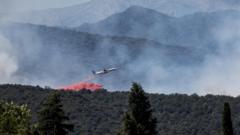
The Sapeurs-Pompiers are unique. Many are volunteers, locals who know every ravine and goat path in the hills. They operated Tracker water-bomber airplanes and heavy-duty trucks designed to withstand extreme heat. But air support is useless in the dark. The planes cannot fly safely through the turbulence of a mountain fire at night.
The battle had to be fought on the ground, hand-to-hand, with hoses and axes.
Firefighters described the heat as a physical blow. It radiates hundreds of feet ahead of the actual flames, hot enough to blister skin through protective clothing. The wind-driven fire created its own weather system, sucking oxygen out of the air and replacing it with carbon monoxide.
The firefighters stood their ground at the perimeters of historic villages, spraying water onto the stone walls of homes built in the Middle Ages. They were not trying to extinguish the fire—that was impossible. They were trying to steer it. They were buying time for the ten thousand people retreating to the coast.
The Beach as a Sanctuary
By 4:00 AM, the beaches of Bormes-les-Mimosas had become refugee camps.
Thousands of people sat on the sand, wrapped in beach towels to protect themselves from the cooling night air and the falling ash. The contradiction was jarring. This was the same sand where, twelve hours earlier, people had been sunbathing and building sandcastles. Now, it was the only safe place left. The sea was their backstop; the water offered the ultimate protection if the flames reached the shoreline.
There was a strange, muted solidarity among the displaced. Language barriers dissolved. A German tourist shared a bottle of water with a French family. Parents took turns watching each other’s sleeping children on the sand. Everyone kept their eyes on the hills.
From the beach, the spectacle was magnificent and horrifying. The fire moved like a living creature, cresting the ridges, illuminating the silhouettes of burning villas on the cliffs. Every few minutes, a loud boom would echo across the water—the sound of a propane tank exploding at a campsite or a car engine catching fire.
The economic reality of the region was burning along with the pine trees. Tourism is the lifeblood of the Var department. August is the peak of the season, the single month that sustains local businesses for the entire year. In a single night, bookings were erased, infrastructure was destroyed, and the reputation of the region as a safe summer paradise was scorched.
The Morning After
Sunrises after a wildfire are eerie. The sun appears as a pale, sickly pink disc, stripped of its brilliance by the thick shroud of smoke hanging over the water.
By 8:00 AM, the wind began to die down. The immediate danger had passed, leaving behind a scarred, black moonscape where the vibrant green hillsides used to be. The air smelled of wet soot and burnt plastic.
The evacuation had been a success in the most important metric: no lives were lost. The coordination between the local prefect, the emergency services, and the camp managers had prevented a tragedy. But the psychological cost was heavy.
Elena and her children walked back toward their campsite later that day, escorted by officials. The tent was gone, reduced to a puddle of melted synthetic fabric and a charred metal frame. Their car was intact but covered in a thick layer of grey ash. They were alive, but the illusion of security had evaporated.
The Mediterranean basin is changing. Fires that used to occur once a generation are now annual events. The combination of prolonged summer droughts and violent wind systems has turned the idyllic coasts of southern Europe into a frontline of climate volatility.
The tourists would eventually go home, taking their stories of the night the sky turned orange with them. The locals would stay, looking up at the blackened hills, waiting for the next time the Mistral began to blow.