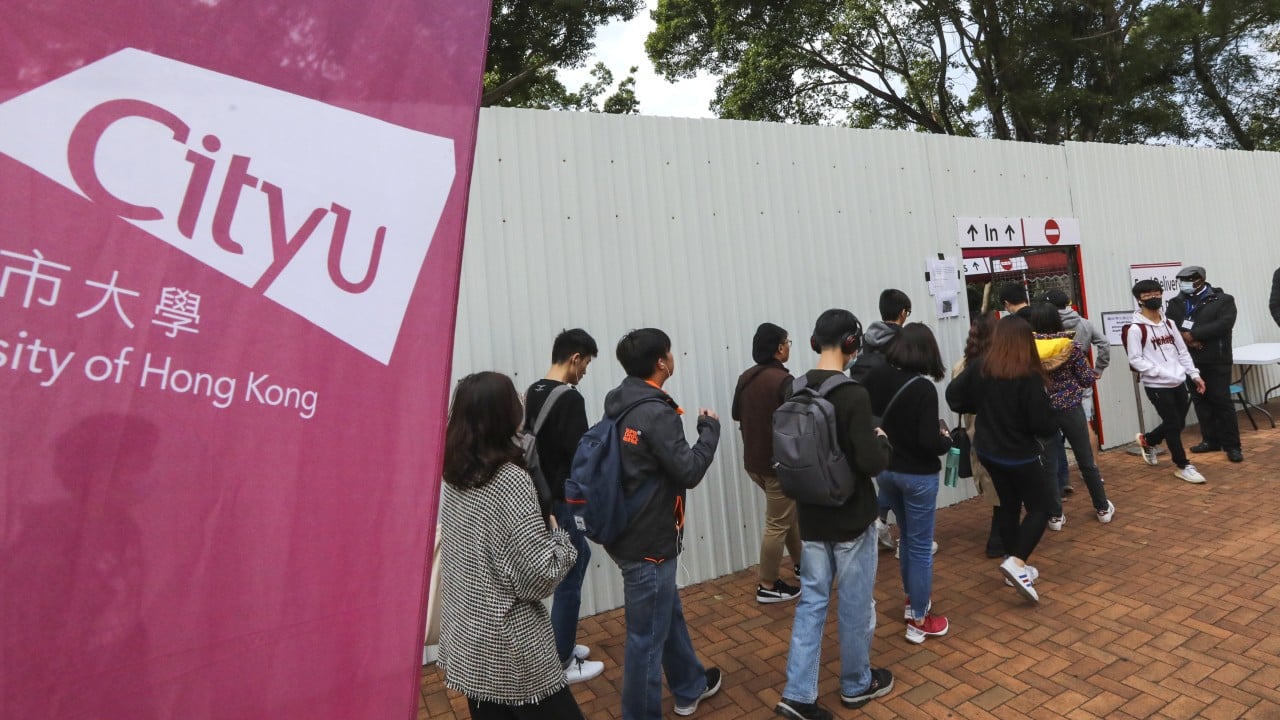
The walls of academia are built on the assumption of merit, but sometimes they are breached by a profound lack of judgment. Recently, Xuan Zhaohui, a 44-year-old former assistant professor at the City University of Hong Kong (CityU), learned that the distance between a prestigious faculty position and a prison cell is exactly one thousand Hong Kong dollars. His attempt to bribe an insurance agent into backdating a policy to cover a medical claim was not just a lapse in ethics. It was a spectacular career suicide that highlights the increasing desperation within the hyper-competitive world of international scholarship.
The West Kowloon Magistrates' Courts sentenced Xuan to four and a half months behind bars. The charges were straightforward: one count of offering an advantage to an agent and one count of conspiracy to defraud. While the sum of money involved—roughly $128 USD—seems almost insultingly small for a man of his professional standing, the legal system saw it as a direct assault on the integrity of the financial sector.
The Anatomy of a Failed Fraud
The mechanics of the crime were clumsy. In early 2023, Xuan found himself facing medical expenses that were not covered by his current insurance because the condition preceded the policy’s effective date. Instead of absorbing the cost, he approached an insurance agent with a proposition. He offered the agent HK$1,000 to manipulate the records. The goal was simple: make it look like the policy was active before the medical issue arose, thereby forcing the insurance company to foot the bill.
The agent refused. Not only did the agent decline the cash, but the incident was reported to the Independent Commission Against Corruption (ICAC). This is where the story shifts from a private mistake to a public reckoning. In Hong Kong, the ICAC operates with a level of autonomy and ferocity that often surprises expatriate professionals. They do not care about the size of the bribe; they care about the intent to subvert the system.
Why the Small Amount Matters
Critics might argue that a four-month prison sentence for a HK$1,000 bribe is Draconian. However, the judiciary viewed the "smallness" of the bribe as an aggravating factor rather than a mitigating one. It suggested a casualness toward corruption. If a professor is willing to risk his freedom for a thousand dollars, what would he do for ten thousand? Or a hundred thousand?
The court's decision signals that there is no "de minimis" defense for bribery in the financial hub of Hong Kong. The integrity of the insurance industry relies on the sanctity of the contract date. If dates become negotiable for the price of a nice dinner, the entire actuarial model collapses. Xuan’s mistake was thinking he was negotiating a service fee when he was actually committing a felony.
The Academic Pressure Cooker
To understand why a highly educated individual would make such a bottom-tier criminal move, one must look at the environment Xuan occupied. City University of Hong Kong is a high-ranking institution where the "publish or perish" culture is supplemented by the intense cost of living in one of the world's most expensive cities.
Professors are often under immense pressure to maintain an image of success and stability. When personal crises—like unexpected medical bills—hit, the fear of financial instability can lead to irrational shortcuts. This does not excuse the behavior, but it provides context. We are seeing a trend where the cognitive load of high-level research does not always translate to "street smarts" or an understanding of the legal consequences of "fixing" a problem.
The Ripple Effect on CityU
CityU moved quickly to distance itself from Xuan, terminating his employment following the conviction. The damage to the university’s reputation is localized but real. Every time a faculty member is embroiled in a fraud case, it casts a shadow over the department's vetting processes.
The university has since reinforced its internal ethics training, but the reality is that no amount of seminars can prevent an individual from making a private, illicit offer to a third party. The institution is left holding the bag for the reputational fallout, while the student body loses a teacher and a researcher over a sum of money that wouldn't cover a month's utility bill in a Kowloon apartment.
The Role of the Whistleblower
The hero of this story, if there is one, is the insurance agent. In many corporate cultures, a small bribe might be laughed off or pocketed as a "consultation fee." The fact that this agent immediately went to the ICAC reflects the success of Hong Kong’s decades-long campaign to de-normalize bribery.
For the insurance industry, this case serves as a warning. It demonstrates that the ICAC is actively monitoring even low-level interactions. Companies are now looking at their internal reporting structures to ensure that employees feel empowered to report "small" bribes without fear of losing a client or facing internal blowback.
A Comparative Look at Corruption Penalties
When we compare Xuan’s sentence to other white-collar crimes, the four-month stint appears consistent with Hong Kong's "Clean City" mandate.
- Low-level bribery: Usually results in 3 to 6 months.
- Corporate embezzlement: Can lead to 5 to 10 years.
- Public servant corruption: Often carries the heaviest weight, frequently exceeding 7 years.
Xuan fell into the first category, but because he also conspired to defraud the insurance company of a larger sum (the potential payout of the claim), the court had to balance the small bribe against the larger intended theft.
The Logistics of the Sentence
Xuan will serve his time in a standard correctional facility. For an academic, the transition from a lecture hall to a prison block is a total erasure of social capital. Upon release, he will likely find that his career in Hong Kong—and perhaps globally—is effectively over. Academic institutions are risk-averse; a conviction for fraud is a permanent "Do Not Hire" stamp on a CV.
The ICAC’s statement following the sentencing was a cold reminder of the stakes. They noted that "corruption is a cancer" that must be cut out regardless of the size of the tumor. It’s a harsh metaphor, but one that fits the clinical precision with which they dismantled Xuan’s life.
Beyond the Bribe
There is a broader conversation here about the vulnerability of the middle class in professional hubs. When a medical emergency occurs, the gap between "insured" and "bankrupt" can feel razor-thin. Xuan’s attempt to backdate his policy was a desperate attempt to bridge that gap.
However, the "why" becomes irrelevant once the law is broken. The legal system is designed to punish the act, not sympathize with the motive. By trying to save a few thousand dollars in medical fees, Xuan forfeited a lifetime of earnings that would have totaled millions. The math simply doesn't add up.
The Institutional Response
Moving forward, Hong Kong’s universities and professional bodies are expected to tighten their oversight on the external dealings of their staff. There is a growing concern that the "side-hustle" culture or "problem-solving" mentality of modern professionals is blurring the lines of what constitutes a legal transaction.
We are entering an era where data transparency makes this kind of fraud almost impossible to hide. Every digital footprint—from the time a policy is bought to the time a claim is filed—is logged. Xuan was trying to commit a 1970s crime in a 2020s digital ecosystem. He was always going to get caught.
Check your own policy dates and understand that in a world of digital ledgers, "backdating" is no longer a clerical favor; it is a digital trail leading straight to a prosecutor’s desk.