The fluorescent lights of a public hospital corridor in São Paulo do not hum. They buzz, a low, grating vibration that settles deep in the marrow of your bones. Anyone who has spent a night waiting in those chairs knows the smell. It is a mix of industrial bleach and sharp, human fear.
In June 2024, that fear took on a new, suffocating weight across Brazil.
A piece of paper moved through the lower house of Congress in Brasília. Officially, it was Bill 1904. Unofficially, it became known across the country by a much darker name: the "Criança Não É Mãe" (A Child Is Not a Mother) bill. The premise was stark. It sought to equate abortions performed after 22 weeks of pregnancy with homicide.
Think about that number. Twenty-two weeks.
To a lawmaker sitting in an air-conditioned office, surrounded by polished mahogany and the muffled sounds of political horse-trading, 22 weeks is a clean statistic. It is a line in the sand. But in the real world—the world of underfunded rural clinics, of long bus rides over dirt roads, of families trapped in the terrifying isolation of domestic abuse—that timeline is a trap.
Consider a hypothetical scenario, though one replicated in hundreds of tragic, documented cases across Brazil every year.
Let us call her Ana. She is eleven years old. She lives in a small town in the northeastern state of Bahia, hours away from any major medical center. Ana does not understand why her body is changing. She does not know how to articulate the horror of what an older relative has been doing to her in the quiet hours when her mother is away at work. She is a child. Her understanding of her own anatomy is rudimentary at best. By the time her mother notices the changes, asks the agonizing questions, and finally secures an appointment with a doctor who doesn't look at them with judgment, the calendar has flipped.
Twenty-three weeks.
Under the proposed legislation, if Ana were to terminate that pregnancy, she could face up to twenty years in a maximum-security prison. The man who assaulted her? Under Brazilian law, the maximum penalty for the rape of a vulnerable minor is fifteen years.
The math is as clear as it is grotesque. A victim could face a longer prison sentence than her rapist.
Brazil’s existing legal framework around abortion has been in place since 1940. It is already one of the strictest in the world. The procedure is legal in only three specific circumstances: when the pregnancy is the result of rape, when the mother’s life is in danger, or in cases of anencephaly, a fatal fetal brain defect. For decades, there was no legal time limit for abortions allowed under these exceptions. The law recognized, implicitly, that trauma and bureaucracy do not operate on a strict schedule.
Then came the political shift.
The powerful evangelical caucus in Brazil’s Congress, a formidable voting bloc that has grown increasingly sophisticated over the last decade, decided to push the envelope. They utilized an urgency procedure to bypass standard committee debates, fast-tracking the bill directly to the plenary floor. It was a swift, calculated legislative maneuver.
The justification presented by the bill’s authors was framed in the language of moral duty and the protection of viable life. But the immediate reaction on the streets of Rio de Janeiro, São Paulo, and Belo Horizonte suggested that millions of Brazilians saw it as something else entirely: an act of state-sanctioned violence against the most vulnerable.
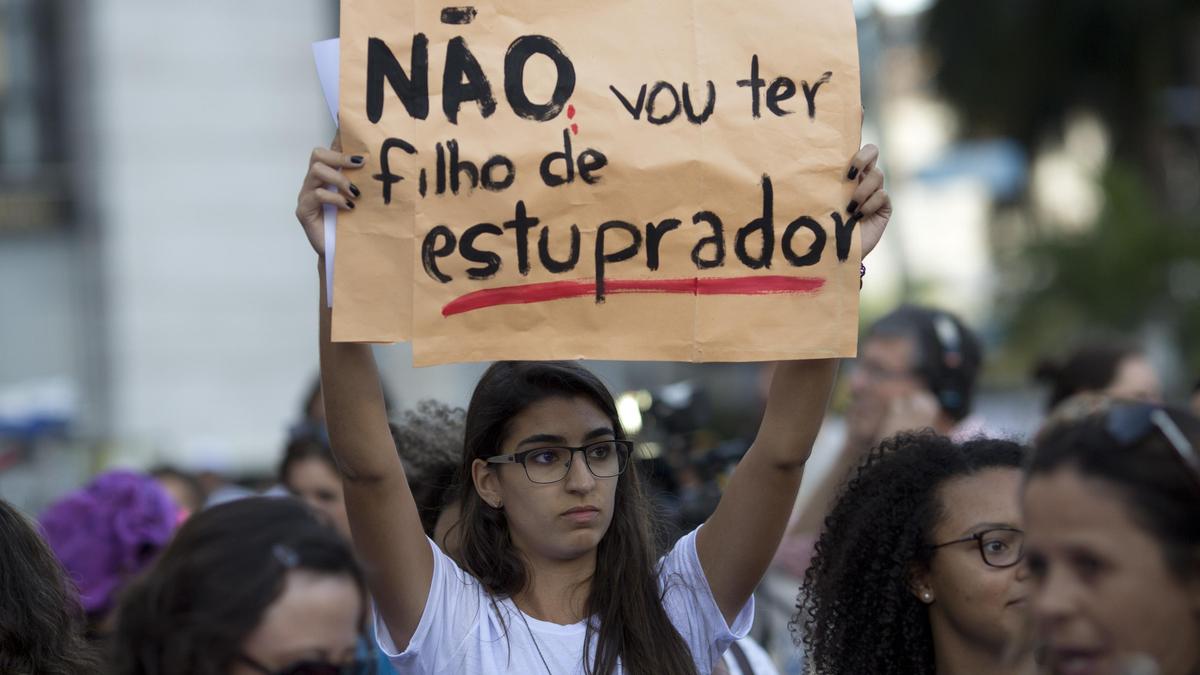
The protests began almost immediately. They were not quiet. Thousands of women, draped in green banners—the Latin American symbol for reproductive rights—marched through the rain. Their chants bounced off the concrete walls of the metropolis. The anger was palpable, a collective roar from a generation of women who refused to see their daughters dragged back into the shadows of back-alley clinics.
Because that is the reality that lawmakers so often ignore. Banning a procedure does not eliminate it. It merely changes who performs it, and how many women die as a result.
Medical professionals across Brazil quickly raised the alarm. The Brazilian Federation of Gynecology and Obstetrics Associations pointed out the obvious, devastating flaw in the logic of the 22-week cutoff. Children who are victims of sexual violence are precisely the demographic most likely to seek legal abortions late in pregnancy.
Why? Because their bodies are not fully developed. Their menstrual cycles are irregular or non-existent, making the early signs of pregnancy easy to miss. Furthermore, the psychological trauma of abuse often leads to deep denial, a survival mechanism where the mind simply refuses to acknowledge what is happening to the body. Add to this the systemic hurdles—the lack of information, the fear of retaliation, the sheer scarcity of hospitals that actually perform legal abortions—and the 22-week mark passes in a blink.
According to data from the Brazilian Public Security Forum, a sexual assault is reported in Brazil every eight minutes. More than 60 percent of those victims are girls under the age of fourteen. These are not statistics from a distant era. These are the numbers defining the present reality of the country.
The backlash was so intense, so visceral, that it caught the political establishment off guard. Arthur Lira, the powerful Speaker of the lower house, was forced to pause. He announced that the chamber would form a committee to debate the bill later in the year, effectively putting the brakes on a piece of legislation that had seemed destined to sail through. President Luiz Inácio Lula da Silva weighed in, calling the bill "insanity" and pointing out the inherent cruelty of punishing a victim of rape with a harsher sentence than the perpetrator.
But the pause is not a victory. It is a truce.
The bill remains on the table, a sword of Damocles hanging over the heads of millions of young girls. The debate has exposed a deep, jagged fracture in Brazilian society, a conflict between a rising tide of conservative religious politics and a fierce, grassroots feminist movement that has spent decades fighting for basic bodily autonomy.
To understand the true stakes of this legislative battle, one must look away from the green-domed congress building in Brasília and look instead at the faces in the protest crowds. Look at the older women, those who remember the days before the 1940 penal code was softened by modern medical guidelines, those who know friends who vanished into clandestine clinics and never came home. Look at the teenage girls holding signs that read, with devastating simplicity, "Protect our childhood."
The cold text of a bill can be debated, amended, or tabled. But the underlying message sent to the women of Brazil cannot be unsaid. It is a message that says their trauma is secondary to a political talking point. It says that a child's body is a battleground for adults who will never have to bear the consequences of the laws they write.
The streets eventually emptied, the banners were folded away, and the nightly news moved on to other scandals, other crises. But in the quiet, crowded waiting rooms of Brazil's public hospitals, the low buzz of the lights remains, and the waiting continues.