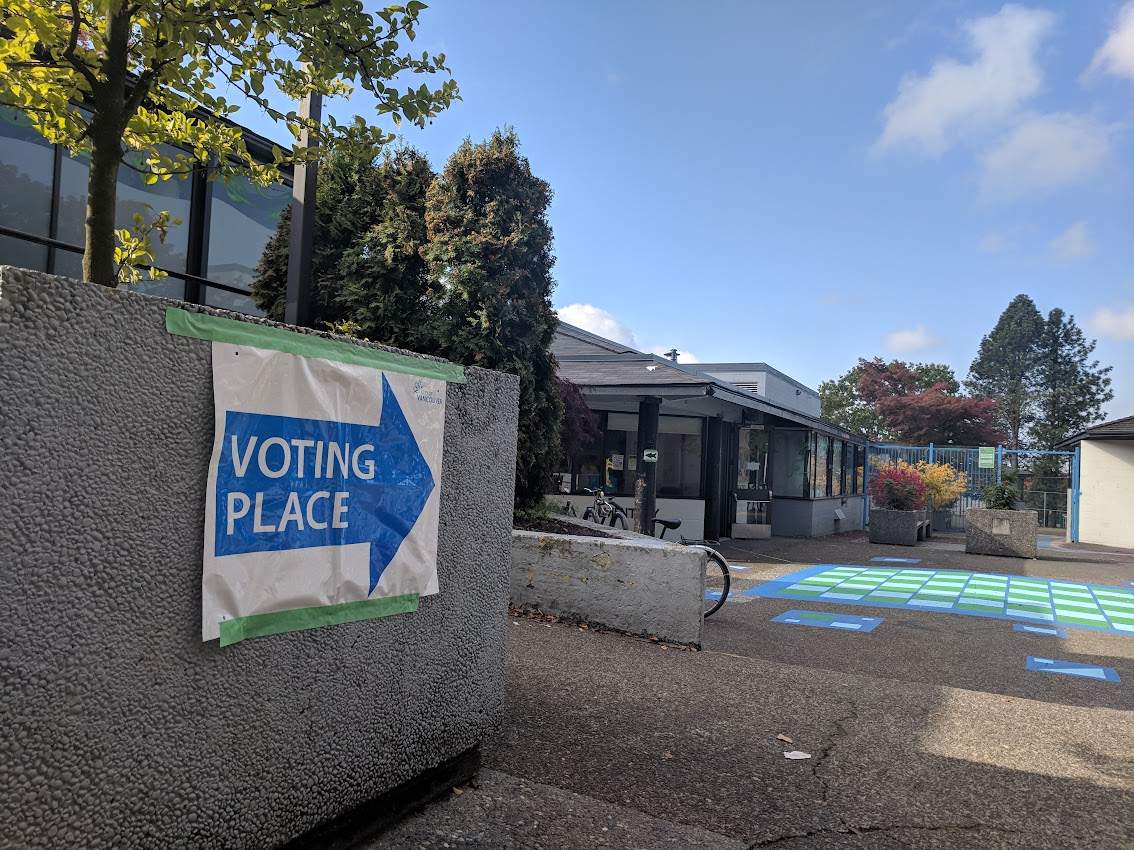
Rain hits the pavement in Prince George with a specific, flat sound, the kind that smells like cold wet cedar and exhaust. Outside the community center, a yellow sandwich board sways in the coastal draft. It holds a white poster board with black block lettering: Polls Open 8 AM to 8 PM.
Inside, a woman named Clara sits behind a folding table with a black ballpoint pen clipped to her collar. She has worked local elections across British Columbia for thirty-two years. She remembers when votes were marked with lead pencils on thick rag paper, folded twice, and dropped into wooden boxes with brass latches that clunked when they shut.
Today, the boxes are grey plastic. The paper is thinner. The names on the sheet—dozens of them, running down the page like an overdue invoice—represent every corner of municipal power. Mayors. City councilors. School board trustees. Regional district directors.
Most people who walk past Clara’s table have no idea what half these people actually do.
They know who wants to be mayor. They’ve seen the plastic lawn signs driven into the damp turf along the highway, bright orange and neon blue, promising fiscal sanity or vibrant communities or safer streets. But as their eyes move down the slip of paper, past the familiar names to the lower third, a quiet panic sets in.
Who runs the drainage ditch on 15th Avenue? Who decides whether the regional hospital district buys a third MRI machine or repairs the roof on the long-term care wing? Who determines if the zoning along the riverfront allows four-story wood-frame apartments or protects the eagle nesting grounds?
The answers are marked in tiny graphite ovals on a sheet of cardstock.
Municipal democracy in British Columbia is the most intimate form of power we possess, yet it is the one we treat with the greatest casual neglect. Every four years, across more than one hundred and sixty municipalities and regional districts, the administrative skeleton of the province is exposed, dismantled, and reassembled by whoever happens to show up on a rainy Saturday.
Power in a province as geographically vast as British Columbia does not flow from Victoria down to the valley floors. It rises from the gravel.
Consider a hypothetical neighborhood on the fringe of Kamloops. Call the main corridor Birch Street.
Birch Street has a pothole that has swallowed hubcaps since late February. It has a bus stop marked only by a metal pole leaning fifteen degrees to the west. It has three young families who want a crosswalk so their children don't have to dodge fully loaded logging trucks on their way to elementary school, and it has an elderly couple who have lived in the corner lot since 1974, terrified that a proposed townhouse development across the alley will block the afternoon light on their tomato plants.
None of these issues will ever be debated in the Legislative Assembly at Victoria. Premier David Eby will never answer a question about the sightlines at the intersection of Birch and 5th. No provincial minister will ever sign an order to install a yellow flashing pedestrian light.
The power to fix Birch Street resides entirely within the local riding—the specific ward, electoral area, or city boundary where municipal candidates run.
Yet when October rolls around every four years, voter turnout across B.C. municipalities routinely hovers around thirty percent. In some growing suburban centers, it dips into the high teens. That means seven out of ten people hand the keys to their street, their tax bill, their water purity, and their local police budget to a tiny minority of committed neighbors.
We tell ourselves local politics doesn't matter because it lacks the high-stakes theater of federal debates or the sweeping drama of international relations. There are no grand ideological battles over foreign policy at city hall.
Instead, there are three-hour public hearings over fence heights.
But fence heights are where philosophy touches dirt. A fence height regulation is a direct measurement of how much a community values individual property rights versus collective aesthetic harmony. A transit route decision is a moral statement about who has the right to move freely through a city—the teenager without a car, the senior who can no longer drive at night, or the commuter who wants six lanes of unobstructed asphalt.
Understanding B.C.’s municipal election grid requires stripping away the election-night graphics and looking at the structural machinery beneath.
The province is divided into two distinct administrative layers: municipalities (cities, towns, districts, and villages) and regional districts.
When you walk into a polling station in Vancouver, Surrey, or Kelowna, you are voting in a municipal structure. You elect one mayor and a slate of councilors who run "at-large." That means every councilor represents the entire city, not a specific neighborhood—a system distinct from the ward systems used in cities like Toronto or Calgary.
If you live outside a city boundary—in the unincorporated stretches of the Cariboo, the Kootenays, or the Peace River region—you do not have a mayor. You vote for a Regional District Director to represent your specific Electoral Area.
These electoral areas are the invisible ridings of B.C. They cover thousands of square kilometers of timberland, farmland, and lakefront. A regional director might represent six hundred people scattered across a territory larger than Prince Edward Island. They meet once or twice a month at a regional board table to negotiate waste management, fire protection, and regional parks with mayors from neighboring towns.
Then comes the school board.
School trustees are often treated as an afterthought on the ballot. Their names appear near the bottom, past the council candidates. Yet school districts manage multi-million-dollar operating budgets. They decide which schools stay open when rural populations shift, how special education resources are allocated, and how province-wide curricula are adapted to local communities.
When you look at a municipal election ballot, you are not looking at one contest. You are looking at three distinct governments printed on a single sheet of paper.
The counting begins the moment the doors lock at eight in the evening.
In small B.C. communities, the process remains intensely physical. The plastic seals on the ballot boxes are broken under the watchful eyes of candidate scrutineers—local residents hired to stand two feet away and watch every thumb move over paper.
In larger cities, paper ballots are fed into optical scan tabulators throughout the day. When the clock strikes eight, the machines print out long, paper memory strips that read like receipts from a hardware store.
The results flow into regional return offices, then onto provincial tracking dashboards, and finally onto the screens of newsrooms in Vancouver and Victoria.
Graphs flash green and blue. Incumbents are declared safe or dethroned. Percentages settle into permanent history.
Numbers, however, hide the human cost of defeat and the sudden weight of victory.
Running for municipal office is uniquely brutal because there is no distance between the candidate and the voter. A Member of Parliament spends half their time in Ottawa, insulated by parliamentary security and national media handlers. A Member of the Legislative Assembly disappears to Victoria for months at a time.
A city councilor goes to the grocery store on Sunday morning.
They are confronted in the produce aisle by a neighbor furious about a newly installed bike lane that eliminated three parking spots in front of the bakery. They are stopped at the hardware store by a landlord angry about a water rate hike. They see the family affected by a zoning decision at the local hockey rink every Tuesday night.
To take a seat at a B.C. municipal council table is to agree to live inside your decisions.
The modern B.C. municipal electoral arena is shifting under our feet.
For decades, local elections were quiet affairs dominated by ratepayer associations, local business owners, and retired professionals. Campaigns were run on lawn signs, local newspaper advertisements, and candidate meetings in church basements where twenty people sat on metal folding chairs drinking tepid coffee.
That world has evaporated.
Housing affordability has transformed municipal politics from a routine administrative duty into a fierce generational war. Decisions that used to pass through council in fifteen minutes—like approving a six-story building near a transit hub—now draw hundreds of speakers to public hearings that stretch across four consecutive nights.
Younger residents, locked out of ownership and facing soaring rents, are organizing. Older homeowners, anxious about neighborhood character and property values, are digging in.
The provincial government has intervened with sweeping housing legislation that strips certain zoning powers away from municipal councils, mandating automatic density near transit corridors and single-family lots.
This tension between Victoria’s top-down mandates and municipal autonomy is the central, unspoken contest beneath every municipal election banner.
When you choose a candidate, you are choosing how your town will navigate this pressure. Will your local government push back against provincial overreach, fighting to preserve local control over heritage and infrastructure? Or will it lean into rapid growth, bending municipal bylaws to build as much housing as possible, as fast as possible?
There is no middle ground that pleases everyone. Every vote cast for a mayor or councilor is an instruction on how to manage change.
Back inside the polling station in Prince George, the rain has turned to a fine mist.
An elderly man walks up to Clara’s table. He wears a heavy oilskin jacket that smells of wet canvas and timber. His hands are thick, knuckles scarred from years in the mills or the woods.
He takes his ballot. He moves behind the cardboard voting screen.
He stays there for a long time—four minutes, five minutes. Through the gap in the cardboard, Clara can see the back of his grey head tilted down, reading every line, weighing every name.
He is deciding who will manage the water treatment plant that feeds his grandchild’s tap. He is deciding who will hire the next fire chief. He is deciding whether the road past his farm will be paved this summer or left to wash out in the spring melt.
He folds his paper once, walks over to the grey box, and slides it into the slot.
He doesn't smile. He doesn't look around for applause. He simply pulls his collar up against the cold, steps through the heavy double doors, and walks back out into the British Columbia evening.
The election results will be posted by midnight. Percentages will be calculated, maps will be colored, and political analysts will talk about trends and voter fatigue.
None of that captures what just happened in that room. A single citizen walked into a quiet building, took a piece of paper, and claimed his share of the land.