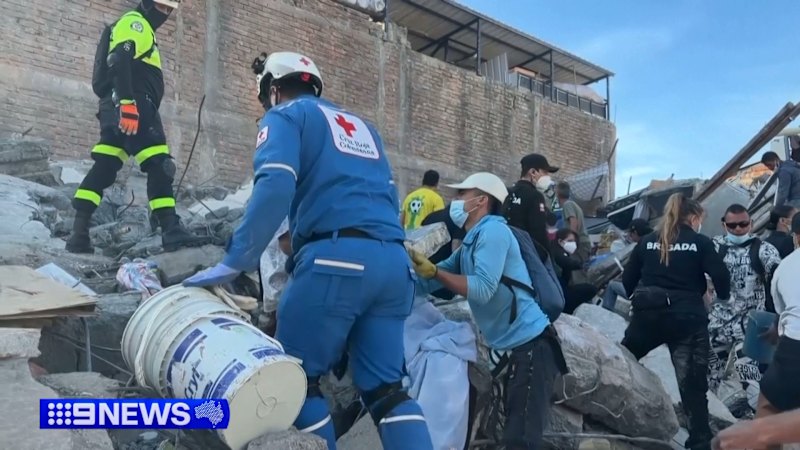
Every single time the ground shakes in the Andes, the media rolls out the exact same exhausted script. We get sweeping aerial shots of rubble, tearful interviews with politicians promising investigations, and a collective head-nod of tragic inevitability. Nature struck again. Mother Earth showed her fury. Seismic power crushed another innocent community.
It is a convenient lie.
Earthquakes do not kill people. Bad engineering, systemic corruption, and institutional poverty kill people. When a magnitude six or seven event flattens homes while leaving neighboring structures untouched, you are not looking at an act of God. You are looking at a paper trail of structural negligence.
Let us dismantle the lazy consensus dominating disaster coverage. The ongoing tragedy following the Colombian earthquake is not a failure of seismology or an unpredictable twist of fate. It is a predictable accounting failure. For decades, disaster risk reduction experts have watched governments prioritize short-term political budgets over mandatory seismic retrofitting. Then, when the inevitable tectonic slip occurs, they hide behind the word "natural" to dodge accountability.
The Myth of the Unpredictable Blow
Seismology is not astrology. We know precisely where the plates collide, where the fault lines run, and where historical stress accumulates. Colombia sits squarely within the Pacific Ring of Fire, one of the most volatile tectonic zones on the planet. This is not a surprise party. This is a recurring calendar event.
Yet urban expansion routinely outpaces building code enforcement. I have spent years walking through developing municipal zones across Latin America, watching unreinforced masonry go up like houses of cards because local inspectors can be bought for the price of a lunch. Contractors cut cement ratios. Steel rebar is substituted with thinner, cheaper gauges.
When the earth shifts, the physics are absolute. Unreinforced brick crumbles under lateral shear waves. The concrete gives way because it was poured with too much sand and too little structural integrity. The buildings were condemned by blueprint long before the tectonic plates ever moved.
"A disaster happens when hazard intersects with vulnerability. The hazard is a constant. The vulnerability is a choice."
When mainstream outlets focus exclusively on the rising death toll and the immediate humanitarian scramble, they perform a vital public service on the surface while masking the structural rot underneath. They make us feel pity when we should feel rage. Pity asks for donations. Rage demands prison sentences for corrupt developers and negligent city planners.
The Economics of Cheap Construction
Why do buildings collapse while modern high-rises stand tall a few blocks away? Money.
Retrofitting an older building to withstand high-magnitude lateral shaking is expensive. It requires steel bracing, base isolation systems, and concrete jacketing. For a cash-strapped municipality or a private landlord operating on razor-thin margins, that capital expenditure looks like a waste. Why spend money on something that might never happen?
This is the gambler's fallacy applied to civil engineering.
Property owners treat seismic safety as an optional feature, akin to granite countertops or hardwood floors. Insurance markets complicate this further by pricing risk based on historical averages rather than worst-case structural realities. When developers build cheap, they externalize the lethal cost of their thrift onto the occupants.
If you want to understand why the death toll climbs after every major tremor, look at the municipal zoning laws and the enforcement mechanisms backing them up. In many regions, building codes exist on paper to satisfy international lenders and municipal white papers, but enforcement is practically non-existent. Inspectors are underpaid, overwhelmed, and structurally incentivized to look the other way.
Dismantling the Humanitarian Band-Aid
When the dust settles and the body counts mount, the international community rushes in with bottled water, field hospitals, and temporary shelters. This is necessary, but it is also a systemic distraction.
Emergency aid treats the symptom while ignoring the disease. Pouring millions of dollars into post-disaster relief without mandating strict, verifiable reconstruction standards guarantees that the exact same communities will be destroyed the next time the fault line slips. It is a circular economy of catastrophe.
We do not need more disaster relief funds. We need a zero-tolerance policy for structural corruption.
Imagine a scenario where every contractor who cut corners on a collapsed public school or residential block faced immediate asset forfeiture and criminal manslaughter charges. Imagine if international aid was legally conditioned on independent, third-party engineering audits of every municipal building built in the last thirty years. The financial incentive to build safely would instantly outweigh the profit margin of cutting corners.
Instead, we treat building collapses as meteorological inevitabilities. We mourn the victims, rebuild the exact same fragile structures with the exact same cheap materials, and wait for the earth to move again.
The Hard Truth About Seismic Resilience
Let us be brutally honest about what true preparedness looks like. It is not cheap, it is not fast, and it is politically radioactive.
It means telling low-income families that their homes are unsafe and must be demolished or radically reinforced. It means displacing communities from high-risk floodplains and steep hillsides prone to liquefaction and landslides. It means holding developers legally liable for structural integrity for fifty years, not five.
Most politicians lack the political capital to enforce these measures because they yield no visible results during an election cycle. A bridge that does not fall down looks like a waste of money. A collapsed school is a tragedy that brings television cameras and temporary sympathy.
Until we stop accepting "natural disasters" as an excuse for human failure, the death tolls will keep rising. The earth is doing what it has done for billions of years. We are the ones failing the test of basic engineering. Stop funding the aftermath. Fix the foundations.