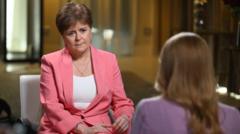
The media collective is currently hyperventilating over Nicola Sturgeon’s public declaration that she will not apologize for the actions of her former husband. Commentators are calling it a "tragic personal cross to bear" or, conversely, "a calculated political defense mechanism."
They are all missing the point.
The lazy consensus treats this as a private tragedy that spilled into the public sphere. It frames the collapse of the House of Murrell as a freak anomaly of political history. This is a fundamental misunderstanding of power dynamics.
The reality is far colder. Nicola Sturgeon's current predicament is not an aberration; it is the inevitable logical conclusion of modern high-stakes political branding. When you build a political movement entirely around a cult of personal rectitude and absolute centralized control, your private life is not a separate entity. It is a liability waiting to be liquidated.
To say "I will not apologize" is a structurally flawed attempt to retroactively decouple the leader from the machine she built. You cannot spend a decade demanding total compliance from your party, your cabinet, and your electorate, and then claim a boundary exists at the kitchen door.
The Myth of the Isolated Political Spouse
For years, political strategists have operated under the delusion that the "spouse shield" holds up under legal and systemic scrutiny. It never does. In the upper echelons of statecraft, a domestic partnership is a joint venture.
When Peter Murrell served as the Chief Executive of the Scottish National Party while Sturgeon was First Minister, it wasn't just a marriage. It was a duopoly. They held the two most powerful positions in the ruling party of Scotland simultaneously. To now treat the criminal investigation into party finances as a localized, spousal issue is an insult to basic institutional logic.
Consider how power actually aggregates. In any standard corporate governance model, if the CEO and the Chairman are married, and the Chairman is arrested for the alleged embezzlement of corporate funds, the CEO does not get to stand at a podium and claim immunity based on marital ignorance. The board would fire them before the press release hit the wire.
Yet, in politics, we are expected to accept the narrative of the blindsided partner.
- The Control Fallacy: You cannot be a micro-manager of a national independence movement and a passive bystander in your own home.
- The Transparency Paradox: The more a leader claims to have cleaned up the system, the more devastating the revelation of internal rot becomes.
- The Liability Loop: By refusing to apologize, Sturgeon isn't showing strength; she is admitting that the political and the personal were so deeply intertwined that an apology would be an admission of systemic failure.
I have watched corporate boards collapse under identical weight. A charismatic founder builds an empire, installs a trusted family member in the treasury, and assumes the sheer momentum of their public image will protect them from compliance failures. It never works. The entity always eats itself.
Dismantling the Victimhood Capital
The current media narrative tries to answer the wrong question. Pundits keep asking: Can Nicola Sturgeon survive this politically? That is a dead-end inquiry. The real question we should be asking is: Why do we allow leaders to use personal betrayal as a form of political currency?
Sturgeon’s defiance is an attempt to weaponize victimhood. By framing the situation as a personal grievance—a betrayal by a husband—she shifts the arena from institutional accountability to soap opera empathy. It is a brilliant, desperate pivot. If the public views her as a scorned wife, they stop viewing her as the former head of a government currently under police scrutiny.
Let’s be brutally honest about the mechanics of the Scottish National Party during her tenure. This was an organization known for its iron discipline. Dissent was ruthlessly suppressed. Policy was driven from the top down. The idea that hundreds of thousands of pounds in independence donations could become the subject of a major fraud investigation without the top political figure having an inkling of operational dysfunction requires a suspension of disbelief that no serious analyst should grant.
The Real Cost of the "Clean Hands" Strategy
The contrarian truth that nobody wants to admit is that Sturgeon’s refusal to apologize actually deepens the crisis for her movement.
When a leader says, "I have done nothing wrong, this is someone else's crime," they destroy the foundational myth of their own competence. You are left with only two possible conclusions:
- Complicity: You knew what was happening and allowed it to continue because it served the immediate needs of the party.
- Incompetence: You were completely oblivious to financial irregularities occurring under your own roof and within your own organization.
Neither option justifies the legacy Sturgeon spent a lifetime constructing. If you are incompetent regarding your closest associate and your own party's bank account, you had no business running a country or attempting to forge a new state. If you were complicit, the defiance is merely a performance before the inevitable fall.
There is a distinct downside to taking this analytical stance. It strips away the human element that makes politics digestible for the average voter. It forces us to look at political leaders not as people managing difficult lives, but as cold, calculating executives who failed their primary fiduciary duty: oversight.
Stop Asking for Apologies
The public obsession with political apologies is a waste of time. An apology in modern politics is never an act of contrition; it is a crisis management tool designed to close a news cycle.
When the press corps demands that Sturgeon apologize, they are participating in a theatrical ritual. They want the soundbite; she wants to deny them the footage. None of this has anything to do with the actual missing funds, the collapse of party membership, or the stagnation of the Scottish governance model.
If you want to understand where the real damage lies, look at the institutional trust numbers, not the emotional register of a press conference. The independence movement was built on the premise that Edinburgh was clean and London was corrupt. The moment that distinction blurred, the entire intellectual architecture of the movement cracked.
The Final Liquidation of the Legacy
The tragedy of Nicola Sturgeon isn't that she was betrayed by her husband. The tragedy is that she believed her own press. She believed that a political brand built on personal moral superiority could survive the contact reality of a financial scandal.
You cannot run a country via a two-person command structure and then file for divorce from the consequences when the books don't balance. The state is not a domestic dispute. The public purse is not a marital asset.
The era of the untouchable progressive icon is dead, killed not by political opponents, but by the basic laws of accountability that they claimed to champion. The microphone is off. The stage is empty. The investigation continues.


