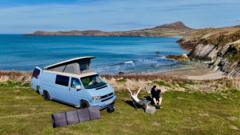
The transition from a fixed-asset urban existence to a mobile, caravan-based lifestyle is frequently framed as a pursuit of "freedom," yet from a structural perspective, it represents a radical shift in a household's balance sheet—trading long-term equity and predictable utility costs for high-depreciation assets and volatile operational expenses. Most narratives regarding "living the dream" fail to account for the compression of the hedonic treadmill; when the novelty of geographic fluidity stabilizes, the underlying success of the transition depends entirely on the efficiency of the individual's Mobile Operational Model.
The Capital Expenditure Fallacy in Mobile Transitions
The primary error in transitioning to caravan living is the miscalculation of Initial Capital Expenditure (CapEx) versus Long-term Asset Value. In a traditional 9-5 framework, a mortgage functions as a forced savings vehicle where a portion of the monthly outflow builds equity. In contrast, a caravan or motorhome is a rapidly depreciating vehicle.
- Depreciation Curves: New leisure vehicles can lose 20% to 30% of their market value within the first 12 months of deployment.
- Maintenance Loading: Unlike a static home, a caravan is subject to constant structural stress from vibration and movement (road-load), leading to accelerated wear on seals, chassis components, and internal cabinetry.
- The Opportunity Cost of Liquidity: Deploying significant cash into a depreciating mobile asset removes that capital from compound-interest environments (equities, index funds), creating a "shadow cost" that most nomadic narratives ignore.
The Triple Constraint of Nomadic Operations
The logistical reality of caravan living is governed by a strict relationship between three variables: Connectivity, Mobility, and Resource Autonomy. Optimizing one inevitably stresses the others.
- Connectivity: Professional viability for those "quitting the 9-5" usually relies on remote work. This requires proximity to cellular towers or clear sight-lines for satellite arrays (e.g., Starlink).
- Mobility: Frequent relocation increases fuel consumption and mechanical risk but satisfies the psychological "novelty" requirement of the lifestyle.
- Resource Autonomy: The capacity of the vehicle's "off-grid" systems—lithium battery banks, solar arrays, and fresh/waste water storage—determines how long a unit can remain in low-cost, remote locations without returning to expensive commercial campsites.
The "Dream" collapses when a practitioner fails to build a system that balances these. For instance, a nomadic couple seeking the aesthetic of a remote forest (High Mobility/Low Cost) may find their income stream severed by a lack of signal (Low Connectivity), forcing a retreat to a high-priced caravan park (Low Mobility/High Cost) just to maintain their employment.
The Geography of Cost: Strategic Arbitrage vs. Convenience Premiums
A common misconception is that "living in a caravan" is inherently cheaper than a traditional rental or mortgage. In reality, the cost-to-value ratio is highly sensitive to the Stay Duration Metric.
Commercial site fees in high-demand regions often exceed the daily pro-rata cost of a mid-tier apartment. To achieve a net-positive financial delta, the operator must utilize "Boondocking" or "Wild Camping"—parking on public or non-commercial land. This requires a significant upfront investment in Solar and Power Management Systems (SPMS).
The Break-Even Analysis of Power Autonomy
If a commercial campsite costs $40 per night and includes electricity, and an off-grid setup (Solar + LiFePO4 Batteries + Inverter) costs $4,000, the "payback period" for that system is 100 days of off-grid stays. Professionals who fail to perform this calculation often find themselves tethered to expensive campsites, effectively paying "rent" that equals or exceeds their previous fixed-housing costs, but with significantly lower square footage and fewer amenities.
Psychological Attrition and the Friction of the Mundane
The "Dream" narrative often omits the cognitive load of resource management. In a 9-5 urban existence, utility management is automated. In a caravan, the occupant becomes the Chief Operating Officer of their own life-support systems.
- Waste Management: The requirement to manually dump "black water" (sewage) and "grey water" (sink/shower) every 3-5 days introduces a recurring operational friction.
- Climate Control: Caravans have poor thermal mass. Without shore power to run high-draw Air Conditioning, internal temperatures can fluctuate wildly, impacting sleep quality and professional productivity.
- Space Compression: The move from 1,500 square feet to 150 square feet creates "interpersonal friction" that is not solved by scenery. Without a structured "Third Space" (cafes, libraries, or outdoor zones), the density of shared living becomes a psychological liability.
Professional De-risking in a Mobile Environment
For those who have "quit the 9-5," the transition usually involves a pivot to the "Gig Economy" or "Solopreneurship." This introduces a secondary layer of risk: Infrastructure Fragility.
A hardware failure (e.g., a broken water pump or a dead alternator) in a traditional home is an inconvenience. In a caravan, it is a catastrophic failure of the entire living and working environment. Successful long-term nomads mitigate this through Redundancy Protocols:
- Dual-WAN internet setups (combining two different cellular providers with satellite).
- Portable power stations (Jackery/EcoFlow) as a backup to the primary house batteries.
- A "Emergency Liquidity Fund" specifically allocated for mechanical repairs that exceed standard vehicle maintenance.
The Social Capital Deficit
While nomadic living provides high "Visual Capital" (sharable content, unique experiences), it creates a "Social Capital Deficit." Traditional careers often benefit from the proximity to mentors and local networks. Long-term mobile living can lead to professional stagnation if the practitioner does not aggressively pursue digital networking to offset the loss of physical presence.
Furthermore, the "Living the Dream" archetype often suffers from the Social Feedback Loop. Having publicly committed to a "better" lifestyle, individuals often feel a psychological pressure to suppress the realities of mechanical failures, bad weather, and loneliness to maintain the narrative. This creates a "sunk cost" bias where individuals persist in the lifestyle long after its utility has vanished.
Strategic Pivot: The Hybridization Model
The most sustainable iteration of this lifestyle is not a permanent exit from fixed housing, but a "Seasonal Mobility" model. This involves maintaining a low-cost, fixed "base" (perhaps in a lower-cost-of-living area) and utilizing the caravan for strategic 3-to-6-month deployments.
This model captures the tax and equity benefits of real estate while providing the geographic flexibility of the nomad. It allows for the accumulation of "fixed-site" resources while using the caravan as a specialized tool for exploration rather than a totalizing solution for existence.
The decision to move into a caravan should be treated as a Business Model Pivot rather than a "vacation that never ends." It requires a shift from passive consumption of services to active management of infrastructure. Those who treat it as a logistical optimization problem succeed; those who treat it as an escape from the "system" usually find themselves burdened by a new, more demanding system of their own making.
Establish a "Maintenance and Depreciation Fund" that accounts for at least 15% of the vehicle’s value annually. If the projected operational savings over traditional housing do not exceed this amount plus the lost interest on the capital used to purchase the vehicle, the move is a lifestyle luxury, not a financial optimization. Focus on maximizing the "off-grid" duration through lithium and solar upgrades immediately; every day spent plugged into a commercial pedestal is a day the nomadic model loses its competitive advantage against traditional renting.