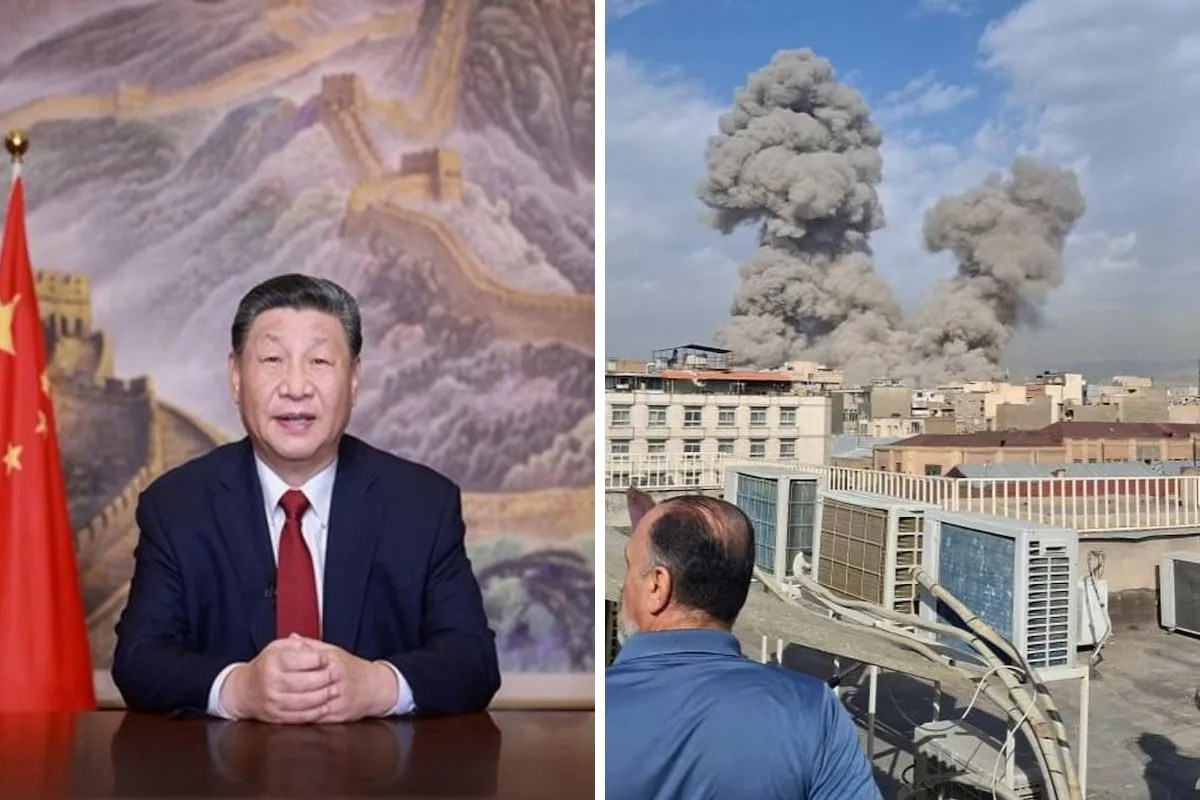
The strike on Iran’s strategic assets is not a singular event but the culmination of a decade-long economic and paramilitary siege. Donald Trump has consistently bet that maximum pressure—a blend of suffocating sanctions and targeted kinetic action—will force a regime change or a massive diplomatic surrender. This isn't just a military maneuver. It is a high-stakes play to rewrite the power dynamics of the Middle East by removing the primary challenger to the status quo.
The immediate logic is simple enough. By hitting high-value targets, the administration aims to signal that the old rules of "gray zone" warfare—where Iran used proxies to attack while maintaining plausible deniability—are dead. But the deeper reality involves a global energy market that is far more fragile than the White House suggests and a network of alliances that are fraying under the weight of unilateral American action.
The Economic Siege and the Strait of Hormuz
While the headlines focus on missiles and troop movements, the real war is fought in the ledgers of central banks. Iran has been systematically disconnected from the global financial system, a move that would have collapsed a lesser state years ago. Yet, the Iranian economy has developed a "resistance" model, relying on black-market oil sales to China and a complex web of front companies in the UAE and Turkey.
The primary leverage Iran holds remains the Strait of Hormuz. Roughly 20% of the world’s liquid petroleum passes through this narrow choke point. If Tehran decides that it has nothing left to lose because its oil exports have been zeroed out, the incentive to keep the Strait open vanishes.
A total blockage or even a significant disruption would send crude prices skyrocketing. For an American president, that is the ultimate political poison. The bet here is that Iran is too weak to actually pull the trigger on a global energy crisis, fearing a total conventional military response that would end the clerical establishment. It is a gamble on Iranian rationalism in the face of an existential threat.
The Proxy Paradox
For decades, the Iranian Revolutionary Guard Corps (IRGC) has mastered the art of asymmetrical warfare. They don't need to win a carrier-group battle in the Persian Gulf. They only need to make the cost of American presence unbearable.
We see this in the "Ring of Fire" strategy. By arming groups in Lebanon, Iraq, Yemen, and Gaza, Tehran ensures that any direct strike on Iranian soil triggers a multi-front backlash. This is the part of the calculus that often gets ignored in Washington briefings. When you strike the head of the snake, the tail still has plenty of venom.
The Hezbollah Factor
Hezbollah remains the most potent non-state military actor in the world. They possess an arsenal of over 150,000 rockets, many of them precision-guided. If the conflict escalates, Northern Israel becomes a wasteland, and the U.S. is forced into a regional war it is desperately trying to avoid.
The administration believes that by showing enough force, they can deter Hezbollah from entering the fray. History suggests otherwise. Radical ideological groups often view these moments as "divine opportunities" rather than reasons for caution. The risk isn't just a miscalculation by Trump; it’s a miscalculation by a mid-level commander in Southern Lebanon who decides to fire a volley that forces a total escalation.
The China Connection
Beijing is the silent partner in this drama. Every barrel of Iranian oil that finds its way to Chinese refineries is a lifeline for the regime in Tehran. For China, Iran is a useful tool to keep the United States bogged down in the Middle East, distracting from the Indo-Pacific theater.
If the U.S. moves to shut down this trade entirely—perhaps by sanctioning Chinese banks—the trade war and the cold war become one. We are no longer talking about a regional skirmish. We are talking about a global economic decoupling. The "biggest bet" isn't just about Iran's nuclear program; it's about whether the U.S. can still dictate global trade terms in a multipolar world.
The Myth of Regime Collapse
Internal pressure in Iran is real. The rial has plummeted, and the youth are increasingly disillusioned with a theocracy that offers no future. However, foreign intervention often has the opposite effect of what is intended.
History shows that when a nation is under attack, the population tends to rally around the flag, regardless of how much they dislike their leaders. The "maximum pressure" campaign has decimated the Iranian middle class—the very people who were the most pro-Western and likely to lead a democratic transition. What remains is a hardened security state and a population reliant on government rations.
By striking now, the administration may be handing the hardliners the perfect excuse to crush all remaining domestic dissent under the guise of national security. The gamble assumes that the Iranian people will blame their leaders for the strikes, rather than the ones launching the missiles.
Technical Realities of the Strike
Modern warfare is about the suppression of enemy air defenses (SEAD). Iran’s S-300 systems, while older, are still capable of making a conventional air campaign costly.
To truly "take on" Iran, the U.S. would need to commit to a weeks-long campaign involving hundreds of sorties. A single "surgical strike" rarely achieves its long-term goals. It usually just resets the clock while increasing the enemy's resolve to hide their assets deeper underground.
The Fordow enrichment plant, for instance, is buried deep within a mountain. To reach it, the U.S. would need to use Massive Ordnance Penetrators (MOPs), the largest non-nuclear bombs in the arsenal. This isn't a "small" bet. It is an escalation that leads directly to the threshold of nuclear conflict.
The Intelligence Gap
We have been here before. In 2003, the intelligence regarding Iraq’s capabilities was famously flawed. Today, the challenge is even greater. Iran’s program is decentralized and hidden in plain sight.
There is a persistent "arrogance of technology" in Western intelligence circles. We assume that because we have satellite imagery and signals intelligence, we know exactly what is happening in the corridors of power in Tehran. But the human element—the "HUMINT"—is notoriously thin. We are making world-altering decisions based on a partial picture.
The Diplomatic Vacuum
Europeans are horrified. The UK, France, and Germany have spent years trying to maintain the JCPOA (the nuclear deal) as a framework for containment. By moving toward direct kinetic action, the U.S. has effectively sidelined its most important allies.
This creates a vacuum that Russia is more than happy to fill. Moscow views Iran as a strategic partner and a buyer of its military hardware. Every U.S. strike pushes Tehran further into the arms of the Kremlin, creating a bloc of "pariah states" that have no incentive to follow international norms.
Strategic Incoherence
Is the goal containment, regime change, or a better deal? The administration has sent conflicting signals.
- Containment: Requires a steady, predictable presence.
- Regime Change: Requires a massive ground presence and a "day after" plan that doesn't exist.
- A Better Deal: Requires a willing partner on the other side of the table.
By striking, you might achieve short-term containment, but you destroy the possibility of a deal and make regime change more chaotic. It is a strategy of "tactical brilliance and strategic confusion."
The Nuclear Brink
The ultimate fear is that Iran will decide the only way to ensure its survival is to follow the North Korea model. If they believe a strike is imminent and inevitable, the logical move is to sprint for a nuclear weapon.
Once a state has a "breakout" capability, the cost of intervention becomes too high. The current strikes are intended to prevent this, but they may actually accelerate it. If the Iranian leadership concludes that they will be attacked regardless of their cooperation, they have every reason to build the ultimate deterrent.
The Fragility of the Narrative
We are told this is about security. We are told this is about preventing a "rogue state" from gaining a nuke. But follow the money.
The defense industry sees a windfall in a prolonged Middle Eastern conflict. Regional rivals like Saudi Arabia and the UAE see an opportunity to have the U.S. do their dirty work. These interests aren't always aligned with the long-term stability of American interests.
The bet Trump is taking is that he can control the escalation ladder. He believes he can step up, hit hard, and then step back down before it turns into a quagmire. But the ladder is slick, and the other side gets a vote on when the climbing stops.
The Silent Cost of War
While the political class debates the merits of the strike, the actual cost is borne by those who have no say in the matter. The sailors in the Gulf, the soldiers in small outposts in Iraq, and the civilians caught in the crossfire.
A war with Iran would not be like the Gulf War or the invasion of Iraq. It would be a sprawling, messy, unconventional conflict that could last decades. It would drain trillions from the treasury and result in a loss of life that dwarfs recent conflicts.
The administration’s gamble relies on the idea that the "bully" will back down when punched in the nose. But what if the "bully" thinks he's the one being bullied? What if he’s willing to burn the whole house down rather than be evicted?
The "biggest bet" isn't just about a strike on a few bases or a refinery. It is a bet that the American era of dominance can be maintained through sheer force of will. It is a bet that the complexities of the 21st century can be solved with 20th-century kinetics.
The dice have been thrown. The problem with gambling on this scale is that even if you win the hand, you might find that the currency you’re playing with has lost all its value.
Ask yourself what happens if the strikes fail to stop the nuclear program. Ask what happens if the oil stops flowing. Ask what happens if the "proxies" decide to bring the war to the doorsteps of American allies worldwide.
The answers are not found in the optimistic briefings of the Pentagon. They are found in the history of every empire that thought it could manage a "limited" war in the mountains and deserts of the Middle East.
Check the price of oil tomorrow. That will tell you more about the success of this mission than any press conference. Would you like me to analyze the specific economic fallout of a Strait of Hormuz closure on the U.S. dollar's status as a reserve currency?