The dust in the Jordan Valley does not merely settle; it clings. It coats the leaves of ancient olive trees in a pale, breathless grey, silences the dry rustle of the earth, and settles deep into the throats of those who call this harsh terrain home. In the heat of an August afternoon, when the sun becomes a heavy, brass weight pressing down upon the hills of the West Bank, water is not simply a resource. It is the absolute boundary between endurance and erasure.
Imagine standing on a sun-baked slope near Al-Auja, looking down at a cracked patch of earth where a once-reliable spring now drips like a leaking faucet. Then, look just a few miles away. You might also find this related article insightful: The Industrial Logic of Air Defense Resilience Under Attrition.
Turquoise. Brilliant, chlorinated, impossibly blue.
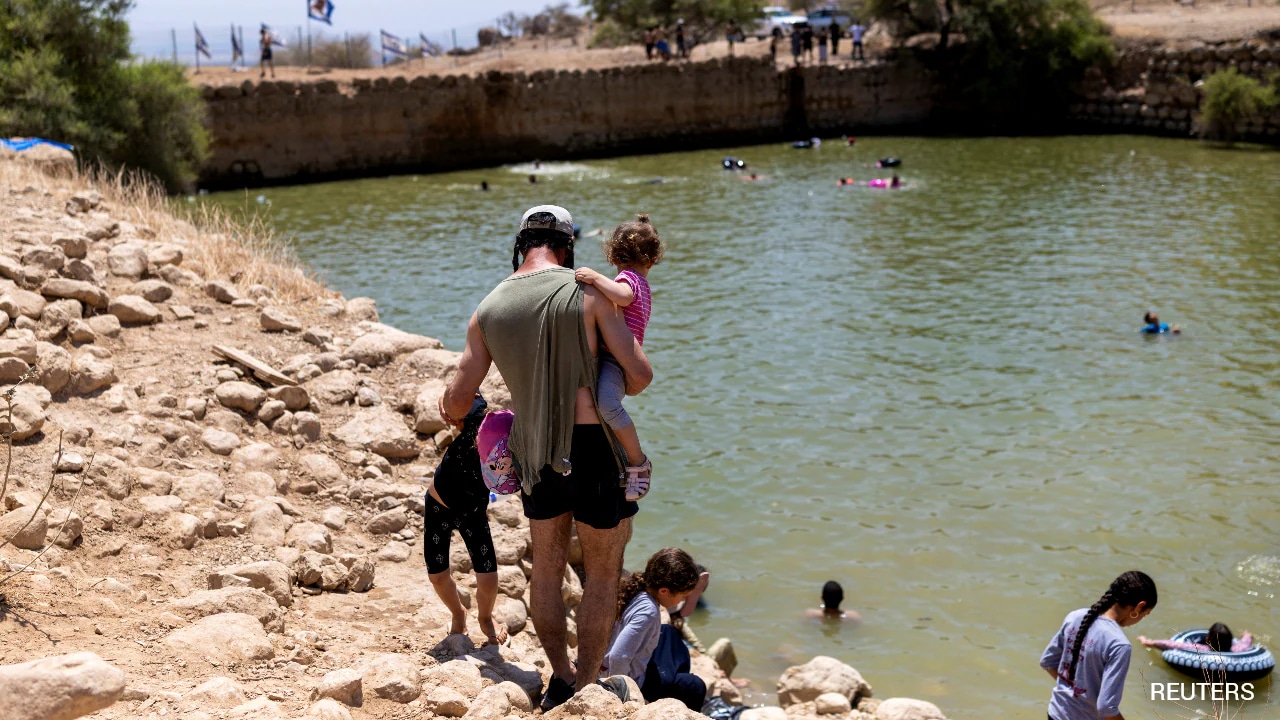
A newly constructed tourist pool gleams under the relentless glare, fed by hoses that siphon the very lifeblood out from under the feet of the people who have farmed these terraces for generations. This is not a story about abstract infrastructure or distant diplomatic treaties. It is a story about thirst. It is a story about the quiet, calculated mechanics of dispossession, played out one bucket, one pipe, and one luxury resort at a time. As extensively documented in detailed coverage by USA Today, the results are significant.
The Architecture of Scarcity
To understand what is happening in the West Bank, you have to unlearn everything you know about how water works. Water does not belong to the rain here. It belongs to power.
For decades, the subterranean aquifers cradled within these limestone hills have been mapped, measured, and heavily restricted. Under systems established through military orders and prolonged occupation, the distribution of water is starkly asymmetrical. While Israeli settlements and their expanding recreational outposts boast lush green lawns, automated irrigation, and resort-style swimming pools, neighboring Palestinian communities often find their taps running dry for weeks at a time.
Consider the mechanics of the diversion. It often happens without fanfare. A diversion pipe is laid under the cover of uneven terrain. A valve is adjusted. A natural spring, historically shared by local shepherds and small-scale farmers, is rerouted toward a settlement's commercial enterprise.
(Note: While the specific routes of these agricultural and tourist diversions are documented by human rights monitors such as B'Tselem and local field researchers, the daily experience of watching water flow past dry land remains deeply visceral for those affected.)
The mathematics of this disparity are staggering, yet they fail to capture the human toll. When a family in a nearby village has to purchase brackish water delivered by truck—paying up to ten times the rate of piped municipal water just to fill plastic rooftop tanks—every single drop becomes a calculated expense. Laundry is rationed. Crops wither before they can fruit. Livestock grow weak and listless in the pens.
And a few miles away, tourists float on inflatable loungers, cooling off in crystal-clear water.
Voices in the Dust
I sat down last year with an elderly farmer named Ibrahim in a village north of Jericho. His hands were the texture of weathered walnut wood, scarred by decades of gripping stubborn soil. He pointed toward the skeletal remains of what had once been a thriving lemon orchard.
"Water has a memory," he told me, his voice raspy against the afternoon wind. "It knows where it belongs. When the pipes are turned away from our roots, the trees don't die all at once. They suffer slowly. First the leaves curl. Then the branches turn brittle. By the time the trunk goes grey, you feel as though you have dried up with it."
Ibrahim’s experience is not an anomaly. It is a deliberate pattern.
In places like Al-Auja, once renowned for its abundant springs and fertile citrus groves, the economic backbone has been systematically fractured. The natural springs have seen their discharge rates plummet, not merely due to shifting climate patterns, but because deep boreholes drilled nearby for settlements draw down the water table before it ever reaches the valley floor.
The irony is cruel. The fertile crescent of the Jordan Valley is being artificially turned into a desert for its indigenous inhabitants, while simultaneously transformed into an oasis for those who settle upon it. Tourism is marketed as a peaceful escape into nature, yet that nature is maintained by starving the very ecosystem that sustains it.
The Invisible Stakes
Why does a swimming pool in a West Bank settlement matter on a global scale? Because it exposes the fragile illusion of separation between luxury and injustice.
When we look at resource inequality, we tend to think of it as a byproduct of geography or climate change. We blame the sky. We talk about droughts as if they are acts of God, entirely neutral and indiscriminate. But water scarcity in the West Bank is man-made. It is engineered through zoning laws, military oversight, and economic coercion.
When an illegal outpost builds a tourist attraction complete with water slides and refreshing pools, it is making a statement about permanence. It is planting a flag in the bedrock. It says: We are here, and the resources of this land belong to our comfort.
Meanwhile, Palestinian children walk miles to school past security fences, carrying plastic jugs because their schools lack reliable running water. The contrast is not just unfair; it is unsustainable. It creates a pressure cooker of resentment, despair, and quiet resistance that no amount of concrete walls or security checkpoints can permanently contain.
The Cost of Looking Away
It is easy to scroll past headlines about water rights. They sound bureaucratic, dry, and complicated. They lack the immediate shock value of breaking news.
That is the trap.
The most insidious forms of control do not always arrive with the roar of engines or the flash of gunfire. Sometimes, they arrive silently, through the slow tightening of a valve, the quiet redirection of a stream, and the evaporation of a people's livelihood under a brilliant, indifferent sun.
The next time you see a travel brochure promising an idyllic desert getaway in the heart of ancient historical lands, pause for a moment. Look past the blue water in the photograph. Listen for the dry rustle of neglected olive leaves. Ask yourself what it costs to keep a pool full while the earth below it turns to dust.
The water always remembers where it was supposed to go. And sooner or later, the earth demands a reckoning.